Elsewhere

Elsewhere: Yarny links for your clicking pleasure

Happy Friday! We’re halfway into the #fringemarlislekal (details here) and there’s still plenty of time to jump in.  Fancy Tiger — who, you may recall, are offering some of the prizes! — have a lovely interview with Anna up on their blog, and there’s still time to get a seat in some of her classes at Fancy if you’re in the Denver vicinity.

Other than that, here’s Elsewhere:

– Fascinated by this Yoke-u-lator that Kelsey Leftwich used for her amazing Summer of Basics sweater

This Ellsworth coat is perfect

So simple; so good. (Pattern here)

– I love that there’s a book of 40 of Norah Gaughan’s decades of Vogue Knitting patterns in the world (I’m into that texture-rich one pictured above)

– Ummmm …. somehow that’s all I’ve got! (lol) Man, I knew I had way too many plates spinning these past few weeks, but I have never not saved a boatload of links and references to comb through when it’s Elsewhere time. Wow, that speaks volumes.

So I’m putting it to you guys: What are the best things you’ve seen/read/heard lately? Please share!

And I hope you have an awesome weekend. I’ve got some really fun stuff lined up for you next week, so I’ll see you back here on Monday!

.

PREVIOUSLY: Elsewhere

SaveSave

The talented and the brave: Summer of Basics Grand Prize winners

The chic, the talented, the brave: Summer of Basics Grand Prize winners

LAST SUMMER, I was smart enough to invite other people to do the final-round judging for Summer of Basics, and I’ll be sure to do that again next year because choosing winners from the 140-ish submissions on the #sob18finisher feed was beyond difficult. (Y’all, in two Summers, we’ve racked up over 5000 posts on #summerofbasics!) In the end, I could only narrow it down to 6 Grand Prize winners (instead of 5) of a $100 Fringe Supply Co. gift certificate*, pictured above and listed below in order of appearance, top to bottom. Make sure you click through and check out each one’s reflections, pattern details and additional photos —

@lana_and_lino Such gorgeous pieces, and the way that she has styled them all into a micro-capsule speaks to just how effective they’re sure to be in her closet. If you only read one caption out of any of this, please make it this one! I’m applauding every word. “I bought my sewing machine in January and I could only sew straight lines …”

@the_german_edge was a front-runner and crowd favorite from the word go, with her ambitious and stylish plans, and following along with her has been pure delight. And yes, she made her clogs.

@francespaki contributing from down under, challenging herself to make some more tailored garments and hitting all three pieces out of the park. “I really feel they are true basics that reflect my style and will be worn winter after winter for years.” If you don’t wear them, Frances, I will!

@nomadiccharacter made six things for herself and three for her daughter, all of which demonstrate that basic doesn’t mean boring. And come on with that toddler lopi!

@teamajwarren Her whole recap is just pure joy, which is how I would love for us all to feel about the clothes we’ve made ourselves.

@aunthoneysestate I feel like she manages to convey so much about herself and her personal style with these three lovely garments, which she describes thusly: “Each fills a specific gap in my summer wardrobe. 1) A pretty embroidered top that goes with everything. 2) A dress that I can “put on and go.” 3) The camisole that I need at least two times a week but never made!” This is also one of many instances like this throughout the feed, which melts my heart every time: “The embroidered center panel is a vintage piece that I’ve been saving for a long time.”

Also, the 5 entrants drawn at random for a $25 Fringe Supply Co. gift certificate* are @tania.ho @hellomister @larosemarymakes @fieldwonderful @emilywools — all of whom also did a magnificent job!

Congratulations to all of you! Job amazingly well done. Please email me at <contact@fringesupplyco.com> to collect your prizes!

If you missed the round one and round two winners, do go take a look at those, too, and click through to see how their plans shook out!

. . .

Through it all, I was blown away by @ninaninawhy’s attention to detail; @blakandblanca’s jet-fueled output, tremendous style and willingness to just go for it (and omg that personalized Field Bag to match her tote); and just how many people made SHOES this year! I loved @hobbsfunk’s striking mirror selfies; melted at @clairemadeit’s mini-capsule for her baby on the way; and cheered @reddamzel’s attitude about her white-for-now sweatshirt. Then there’s @notaprimarycolor who is in a league of her own. And I want to give a special shoutout to @thestoryclubpdx, one of our first-round winners, just to say that I so enjoyed following along with her efforts all summer in such depth, and appreciated how generously she shared both her struggles and her victories.

If I could borrow garments, there’d be a lot of them: @sv_azimuth’s Twigs sweater, @malinerogne’s slip dress, @jessandhen’s back-pleat box top, @mwmmpls’s little yellow top, @megthegrand’s cheerful yellow pullover (I know: I keep saying I’m craving some yellow!), @rachelbeckman’s cardigan, @maloriehall’s … well, everything, but especially the knee-length kimono jacket, and so many other killer clothes!

As I was methodically combing through the finishers, I also made a folder for posts I wanted to refer to or quote from — so many incredible remarks and insights!. When I was done and went to see how many there were, though, I’d saved 35 posts! Which is a bit much to try to cull and link. So what I really want to encourage you to do is go read through the #sob18finisher feed — it’s truly so remarkable and inspirational, and I think every single one is a winner! Along with everyone who finished even one garment. As I’m always saying, it really is the clothes you make, the friends you meet, the skills you build that are the real prize in all of this.

Thank you all so much for making this another exceptional event! I can’t wait for 2019.

*Shipping fees will apply. Non-US winners will be responsible for any duties or taxes on their shipments. Packages cannot be marked as gifts. No substitutions, and prizes cannot be redeemed for cash value.

.

PREVIOUSLY: Round 1 winners (the planners) and Round 2 winners (the WIPs)

Elsewhere

Links to love: Knitting, sewing, slow fashion

Don’t adjust your dial, it’s not Friday yet, just Wednesday! (Remember when I used to do Elsewhere on Wednesdays? Hump-day distractions ftw.) Since Sept 1 is on Saturday, I’m actually kicking off the Marlisle Knitalong here on Friday, so I’m doing a little mid-week Elsewhere today!

LAST REMINDER: Summer of Basics ends Friday, so if you want to be considered for the Grand Prize(s), get your final post into the #sobf18finisher feed ASAP! Details on entering to win are here

– Admirable Kickstarter aimed at increasing awareness and income for Peruvian alpaca farmers (photo above left)

– “… monetizing a hobby changes our relationship with it, shifting it from play to a job. And our society undervalues play, even though it’s an important component of health. …” (photo above right)

– I don’t know why histories of colors and pigments are so fascinating, but they are! (thx, DG)

– I think I could live happily all summmer if all I owned was what Martha McQuade packed for Portugal

– (Speaking of: Do hand-drawn packing lists make anyone else think of “Sara Midda’s South of France”? Just me?)

– Current style muse: @ebonyh

.

PREVIOUSLY: Elsewhere

What I Know About: Breed-specific yarn (with Brooke Sinnes)

What I Know About: Breed-specific yarn (with Brooke Sinnes)

I’ve always counted Brooke Sinnes of Sincere Sheep Yarns as my original newfound friend in the yarn world, and she is still one of the most knowledgable and thoughtful people I know, in addition to simply being one of my favorite humans. When I first started knitting, the two of us somehow became aware of each other on Twitter, met for tacos in Berkeley, discovered that we both had Napa and Kansas City in our backgrounds, and became instant friends. Shortly thereafter, I designed  the Double Basketweave Cowl in one of her gorgeous naturally dyed yarns, and we recently decided to upgrade the recommended yarn for that cowl to her incredible US-grown and -milled Cormo — a breed-specific, single-farm yarn, still naturally dyed. So we’re relaunching the now-Cormo cowl kit in the webshop today, and I thought it would be a great time to talk to Brooke about what it means to make and knit with breed-specific yarns and get her highly informed take on where we are with known origins at this stage in the knitting world.

For more of Brooke and her yarns, check out the Sincere Sheep website, and follow her on Instagram @sinceresheep. Here’s Brooke—

. . .

When I first ran across you — when I first started knitting — I read the About page on your site about the name Sincere Sheep and that you were selling yarns made from identifiable breeds and farms, which made perfect sense to me as you live in Napa and I had lived in Napa, and that kind of awareness of “terroir” comes with the, er, territory. So I’m not sure I even realized how not-the-norm that was at the time. Did it seem groundbreaking to you when you set out with that as your mission?

At the time, although it was groundbreaking, I remember it seemed very natural to me. I moved back to Berkeley after graduating university in 2001, and I was living smack in the middle of an area known for progressive thinking. The slow food movement was really taking root. Seasonal eating, farmers’ markets and local food sourcing were a regular thing. A couple of years later, I moved to the Napa Valley and learned that wineries were creating single-vineyard wines, which was taking the concept of terroir to an even more specific level. I looked around at all of these developments related to food and the annual growing cycle and said to myself, “All of these concepts apply to natural fibers and dyes.” Every year sheep need to be shorn, and their fleece is a record of what happened to them during the year — just like grapes and other agricultural crops develop characteristics based on weather, soil, water, care, etc. The same is true of the plants we use for dyes. To take it a step further, each sheep breed has wool with different qualities that interact with the environment and make it appealing for different types of yarn. And actually, each sheep has its own individual characteristics.

Sincere Sheep came into being when I connected this concept with something I had learned while taking fiber arts classes in Berkeley: American wool prices were incredibly low. So low, in fact, that many small farmers weren’t even bothering to send their wool to the local wool broker. Instead they were throwing the wool away, composting it, or stashing it in the barn. I met with a shearer who specialized in small flocks and ‘lawnmower sheep,’ and they put me in contact with local farms where I could buy the wool. With that connection, taking the idea for terroir and translating it to fiber was doable. I had the local wool made into yarn and roving at a mill only 50 miles from my house. I dyed it with natural dyes, then labeled it with the name of the farm and its location, and also the sheep’s name if it had one. It felt really good to be supporting these farmers while making a highly transparent, local product that was fun to work with.

Like the larger “slow fashion” movement, it can feel like a new or trendy concept — knowing where your clothes or the fiber of your yarn comes from — when really it’s just an effort to get back to how things used to be. I know this is a book-sized question, but can you talk a little bit about the difference between “farm yarns” and where large-scale commercial yarns come from?

When I think about terroir in yarn, I think about texture. Farm yarns are typically made by farmers with wool from only their flock — which means all the wool comes from a specific place and reflects how the sheep lived that year. Mass-market yarns are different. They are made in large quantities, and made with wool that has been selected for specific qualities: fineness, length, or color. This means that a mass-market yarn will be exactly the same from yard to yard and from year to year. Their goal is absolute consistency. The fiber does not usually come from a specific farm, ranch, or even region!

One of my favorite things about farm yarn is how it has more texture — the wool can vary slightly from yard to yard, and it changes each year. This allows the qualities of the sheep breed(s) it is made from to shine through. For example, you get to experience the incredible elasticity of Cormo wool first hand in yarn form. Additionally this means you can revisit a farm yarn and experience how that year’s rainfall or temperature affected the character of the yarn. It is also more engaging for me to make — When I make a local, custom yarn I get to go to the farm and help with the shearing. I get to pick the fleeces that I want and send them to a mill to be processed into yarn or roving to my specifications. I think about the best yarn I can make with the wool I have just chosen. Other times, I work with a wool broker to find enough fleeces with the quality I am looking for from sheep that all live on the same ranch. From there, the wool is sent to the mill to be processed into custom yarn with specifications that we designate. It’s always interesting to open the boxes of yarn when they arrive and see how it has come out, how it is reflective of its terroir. My involvement allows me to create a yarn that shows the wool to its best advantage and a product with a unique, handmade story.

What I Know About: Breed-specific yarn (with Brooke Sinnes)

So you had this concept and named your business Sincere Sheep, but it’s a steep challenge. Was it as you imagined, or how would you describe the trajectory from where you started out to where you are now, and what you’ve had to navigate in between?

When I started Sincere Sheep 15 years ago I don’t think I was thinking long term. I saw that there was an opportunity for me to make a difference to local farmers who were hurting because of the low wool prices. That continues to be one of my goals today, even though American fine wool prices have almost doubled from 2017 to 2018. Regardless of wool price, small-scale farming is hard work and needs our support if we want it to continue.

What I didn’t realize when I first started making yarn was how little of the American textile industry was still around after the mass exodus of both jobs and machinery in the ’80s due to the push toward globalization. It was a real challenge to find a mill that could handle fine wool in small to medium quantities and then spin a yarn to consistent specifications year after year. It has been heartening to see some of these small-scale production capabilities return to the American textile industry over the past 15 years

As the business grew, I started to incorporate more international yarns that were Merino-based because of market demand. I semi-jokingly refer to those years as the era of the ‘cult of the soft.’ Throughout that time, I continued to make small farm yarns and roving mostly from California ranches and kept my eye open for when I would be able to offer more domestic bases. That happened about 4 years ago. Since 2014, I’ve been custom making my American-sourced and -spun Cormo yarn in coordination with Jeane deCoster of Elemental Affects. By working collaboratively, we can buy a large lot of wool and take advantage of large-quantity price breaks given by the mills where we have the wool cleaned and spun.

I’ve had yarns custom made for me since the beginning, and as my business has grown so has the scale of these projects. Scaling up has really changed a lot of the dynamics within Sincere Sheep. Most indie dyers buy [finished, undyed] yarn from wholesalers on an as-needed basis. This means that they only buy what they need, when they need it. The wholesaler is therefore the one who is shouldering the bulk of the production risk and inventory warehousing in order to fulfill orders. Currently, if you want to make a custom-spun yarn that includes wool from only one clip and only one location, you have to buy all the wool at one time that you are going to need to make all of the yarn that you will need for the following year. So it becomes more complicated: Not only are you forecasting how much wool is enough without being too much, but you also have to be prepared to outlay all of your cash at once. Then when the yarn is finished being milled it all comes at one time, and you have to warehouse hundreds of pounds of yarn. It is a lot of planning ahead. With everything that goes into it, it’s always an exciting day when we finally get a batch of yarn or roving back from the mill!

I know in the 6.5 years I’ve been knitting, the surge in visibility of farm yarns — and I’m referring here specifically to farmers who are having their fleece milled into yarn, and marketing it with some success, even beyond their own farmers’ market — and in yarn companies shifting more and more toward origin transparency and breed specificity has been really amazing to watch. Where do you think we’re really headed?

My mom is in sales and taught me the term ‘bleeding edge’ — meaning you are too far ahead of a trend and there isn’t yet a market for your goods. Fifteen years ago, when I was starting to make farm yarns from non-Merino wools, I was the bleeding edge. People were interested and supportive, but they couldn’t quite wrap their heads around using my yarns. Around the same time, Merino was really starting to make a huge splash as a breed-specific yarn and people were discovering that wool could be soft and wearable. Over the years since then, there has certainly grown a greater understanding of breeds and origins and that’s a very positive shift! People are now interested in single origin, non-Merino wool yarns, but I still have new customers who are surprised by just how many breeds there are. I am hopeful that this trend in origin transparency and breed specificity will continue and that people understand that they have the powerful ability to directly support farmers, mills and dyers with their purchase.

Double Basketweave Cowl (free pattern)

So let’s talk about this Cormo of yours. Cormo, to the extent it’s known at all really, is best known as an Australian breed, right? But you’re among a small number of people bringing US Cormo to the forefront. What is it about Cormo that lights you up especially, and how did you come to be making Cormo yarn?

You’re correct, Cormo is an Australian breed. The Cormo sheep was developed in the 1960s in Tasmania by crossing Corriedales (a medium-wool type sheep) with Saxon Merinos (a fine-wool type sheep). Cormo sheep were selected for breeding based on the weight of their fleeces (high); the diameter of their fiber (18-23 microns, which is relatively fine but still strong); high fertility so more lambs per litter; and body weight. Cormos were then imported in the 1970s to the US to improve the wool produced on rangeland ranches.

What I love about Cormo wool is its soft, downy hand and incredible elasticity. It’s common for me to have people unfamiliar with Cormo ask me if my yarn is cotton because of how soft it feels. We have the yarn spun and plied on the tighter side to help the yarn wear better and it looks equally great in accessories and garments. I love it when a customer wears their finished sweater to a show and tells me how much they loved working with the yarn — and then proceeds to buy more for their next project! It is incredibly satisfying to see someone love a specific yarn that much.

I first discovered Cormo wool via Sue Reuser who was farming Cormo sheep up in Orland, CA. She had the most amazing flock of white and colored Cormos. She was breeding them towards producing fleeces for handspinners. Sue had a strong and loyal base of spinners that would buy a fleece or two or three every year and would often reserve a fleece a year in advance and then come up for the shearing. I was at one of those shearings when Sue offered to sell me some white Cormo fleece that wasn’t already reserved. I bought the wool and made my first Cormo yarn from it. This continued on the next couple of years until Sue retired, and I convinced Jeane DeCoster to start making a replacement Cormo yarn with me. Now Jeane and I make four different weights of Cormo yarns every year and then each of us dyes the yarns in our own distinctive way. I love the hand of our yarns, and it takes natural dyes beautifully. I have yet to tire of knitting with it on a daily basis!

What makes you so excited about switching over to the Cormo Sport for the Double Basketweave Cowl kit?

I often talk about how much I enjoy being a part of and supporting the handmade community, and connecting with all of the people that I meet through Sincere Sheep. I’m passionate about providing makers with the best quality yarn that is both enjoyable to work with while knitting and results in a finished project that is richly textured and enjoyable to wear. I love the way the Cormo Sport feels to knit and it’s so cozy in the finished cowl. As a bonus, it’s a meaningful opportunity for your customers to support an American wool farmer, mill and dyer.

. . .

Thank you so much, Brooke! And for those interested, check out the free Double Basketweave Cowl pattern here on the blog, and find the Cormo cowl kit (includes the printed pattern and two skeins of Brooke’s beautiful yarn) over at Fringe Supply Co.!

Happy weekend, everyone—

.

PREVIOUSLY in What I Know About: Gansey origins (with Deb Gillanders)

Hot Tip: Take a selfie

Hot Tip: Take a selfie

Dianna Walla recently shared a great tip on her Instagram feed: Especially if she’s thinking of knitting with a color outside her closet comfort zone, she poses with the skein. Snapping a pic of the yarn held up to her face lets her see how she’ll look in that color and consider whether it’s really a shade she’s comfortable with and wants to wear.

For best results, stand near a window for natural sidelight — taking the pic under artificial lighting will throw off the tones of both your skin and the yarn.

.

PREVIOUSLY in Hot Tips: Check the back

SaveSave

Portugal part 2: Douro, Porto and Teresa the spinner

Portugal part 2: Douro, Porto and Teresa the spinner

We left Lisbon that Tuesday morning — the eight of us and our luggage (and shopping bags) divided between two rental cars — and headed north. One of us, Allison, is a wine importer with connections, and others of us are avid wine drinkers. Allison had one vineyard in particular she wanted to take us to; we all wanted to visit the city of Porto; and there was someone very special Rosa wanted us to meet. So Jaime and Amber, in their trademark way, had found this ridiculously amazing Airbnb in quite the remote spot, which was roughly an hour or two’s drive to each of our intended destinations over the next few days.

Portugal travel guide: Bulas winery

The winery was Bulas (the s is a sh; Bulas rhymes with goulash), in the Douro river region (aka “the Douro”), and while Allison had tried to describe the uniqueness of the Douro to us — and though we took a thousand pictures — there are no words or images that can begin to adequately convey the landscape. (A UNESCO-designated World Heritage landscape.) Six of us did the periodically nail-biting drive across skyscraper-tall bridges, through sprawling ranges of steeply sloped mountains, up and around and down into the spot where Bulas sits, surrounded on all sides with grapevines planted in perilously narrow terraces carved all the way up every slope of land, as far as the eye can see — and then some. Think of the rice terraces of Southeast Asia and now mentally plant each narrow ledge of soil with a single row of grapevines, and you still can’t begin to imagine it. It’s breathtaking.

We had a fantastic time at the winery. (Four of us dressed all in handmade — that’s Keli, me, Jaime and Amber above, looking hilariously glamorous for how sweaty we were. Pattern details here.) We were given the farm tour by Isabel, of the Bulas family, Joana the winemaker, and the nicest farm manager whose name I regret I’ve forgotten, who wished in Portuguese that our French were good enough that we could all converse that way instead of English, so he could understand. The wines (white, rosé and port) were fantastic, and we acquired a fair share of bottles before making the twisty drive back down to restaurant DOC for a posh late lunch on the river (indoors, though — it had begun storming furiously outside), arriving back to the house at twilight for makeshift light dinner of tinned fish and olives and wine and whatnot, and a late swim in a light rain. Seriously: idyllic.

Teresa spinning Bucos Portuguese yarn

But what you really want to hear about is Teresa, who Rosa took us to meet the following day. Teresa hand-spins Rosa’s Bucos yarn (bucosh), and had agreed to give us a demonstration of her technique, with Rosa there to translate. It was hot — although one of the less suffocating days of the week — and so Rosa brought Teresa and her stool out into the shaded fern patch across the lane from her house. Step by step, she demonstrated — teasing out the fleece, carding it between her two giant brushes, then spinning on her large bobbin, talking rapidly the whole way — and invited us to give it a try. Amber and Jaime being the spinners among us, they stepped up. Amber held her own at the carding, and Jaime gave the spinning a go, even though Teresa’s rig is not much like the drop-spindle Jaime teaches. Teresa has a disstaff that goes under her arm and into her waist tie, and she parks a wad of fleece on its tip. From there, she draws it out and onto the top of her bobbin/spindle/whatsit, winding it artfully around and up, and catching it just under a notch in the tip. She’s fast and skilled, and was very proud to show us and to stand for photos. She was striking such poses I fell completely in love with her and her spirit, even though I couldn’t understand a word she said. And she spoke to me persistently and at length, seeming to have faith that if she just kept it up long enough I’d eventually start to understand her. And maybe I would have — I hope so — if we’d had more than an afternoon.

Teresa also knits from her handspun, and I was the only one with big enough feet to justify buying a pair of her socks. She knits traditional Portuguese men’s socks, which are generally lace and interesting to knit, as compared to the traditional women’s socks, which are plain. She’s also a weaver, and told us (through Rosa) about weaving blankets as a girl, with her mother, and then they would pile them folded onto their heads and walk them into the village to sell them. A cousin had borrowed her loom (how long ago I don’t know), but she was eager to introduce us to her friend Ana, who weaves with Teresa’s handspun as well. So off we went to Ana’s house, where Teresa wound bobbins for Ana to weave with, and Ana proudly showed us her 100-year-old handmade loom, built and passed down by her father. Ana also asked us to speak French with her, and we managed. And eventually the two of them broke into song! They were amazing, and we hated to say goodbye, and they couldn’t believe we weren’t staying to eat and drink, but we hadn’t realized that was an option and so hadn’t planned accordingly.

To really appreciate them — especially seeing Teresa spinning and chatting away — go find them somewhere toward the middle of my Instagram Portugal Story, where you can see them in motion and hear them sing. In that photo at the top of this post, Teresa is (very briefly) modeling a heavy wool cape that’s traditional for the region, which Rosa had brought out to show us.

Portugal travel guide: Porto

We had a dinner reservation in Porto and only about an hour to roam around ahead of that, by the time we made the hour-ish drive from wherever Teresa’s house was, but we all fell instantly head-over-heels for this city and swore we’d go back when we can. We had just enough time to take more tile photos and selfies, peer into the bookstore that inspired Harry Potter from the sidewalk (such a tourist draw it requires an entrance fee), and visit our third A Vida Portuguesa — the biggest of them — before winding our way through the streets to our teensy restaurant, where we sat in the window and ate so much of everything on the menu that we had enough bacalhau left over to make a big “bacal’omelet” the next morning before heading higher into the mountains for the most epic phase of our adventure, which I’ll tell you about tomorrow.

PIT STOP NAZARÉ

Portugal travel guide: Nazaré

On our way from Lisbon to the Porto region, we stopped for lunch in the sun-drenched little beach town of Nazaré, which is apparently quite a tourist scene at peak season but we hit it about 10 minutes before that, so it felt local and charming. We had lunch (lots of bacalhau and other seafood, of course), put our feet in the ocean, and stopped into a little fabric shop Rosa recommended, called Casa dos Escoceses, where they sell Portuguese wools and traditional plaid fishermen’s shirts and rustic handmade clogs and loads of colorful scarves. I bought a big, bright blue, paisley cotton scarf because I was so smitten with all the little old ladies of Nazaré, who have a very distinct sartorial way about them: layered knee-length skirts, patterned elbow-sleeved blouses tucked in, and scarves simply draped over their heads, not tied under their chins as you’d expect. I adored those ladies, and treasure my Nazaré scarf. (We also stopped there for a night — at the Hotel Magic! — on our way back to Lisbon at the end of the trip, which is when the twilight images here were taken.)

DRIVING IN PORTUGAL

Several people on Instagram asked about this. They drive on the right side of the road, and while the road signs are obviously different, they’re easy enough to get the hang of — and with GPS, it’s really no big deal in that regard. The only challenging thing is how narrow the roads are in so many places; learn to beep your horn a lot on your way around narrow blind curves. We had designated drivers and navigators in each car (I was a navigator, and my hat’s off to the drivers), and as long as someone was monitoring the GPS and the signs and talking the driver through it, it was all fine. However, to drive in Lisbon is not a thing I would ever want to do. (And I say that as someone who drove in San Francisco for years without ever thinking a thing about it.)

(Jen Hewett x Fringe Field Bag, notebook and tool pouch from Fringe Supply Co.)

. . .

D O U R O  +  P O R T O   T R A V E L   D E T A I L S

Lodging

• Calçada do Souto Farm
Stunning Airbnb that’s like a tile-roofed stone fortress that opens up to a backyard pool with amazing views out over a valley of vineyards. Quite remote (I believe it was about an hour or hour-and-a-half drive from Porto), but if the location works for you, the house can’t be beat.

Wine and Dining

Bulas Wines
Traditional Vinho Verde region wines, including white, red, rosé and a variety of ports. Jaw-droppingly beautiful place and lovely people.

DOC
By far the poshest place we ate in Portugal: chic minimalist interior, impeccable service (of the invisible sort), world-class food — from the amuses bouches to the entreés — and the most picturesque setting, right on the river Douro.

Taberna dos Mercadores
Teeny tiny and authentic, on a steep Porto street just up from the river. Casual vibe and fantastic service — we really enjoyed these guys. Be aware that the portions are huge: 5 of us ordered bacalhau and that alone was enough fish to feed the whole table plus the people waiting on the sidewalk. Big portions are apparently typical in the north of Portugal.

Shopping

• A Vida Portuguesa
If we could only have gone to one location of this made-in-Portugal emporium, I’d pick the Porto one — it’s large and stunning and has some of everything that the other two stores had, plus more in the way of books, pantry foods (tinned fish, olive oil, salt, tea, etc), Burel blankets, baskets and lots more.

.

PREVIOUSLY in Portugal guide: Part 1, Lisbon and Portuguese knitting

Photo of me and my Teresa socks © Anna Dianich; remaining photos © Karen Templer

SaveSave

SaveSave

SaveSave

SaveSave

SaveSave

SaveSave

SaveSave

SaveSave

SaveSave

SaveSave

SaveSave

Portugal part 1: Lisbon and Portuguese knitting

Portugal travel guide: Lisbon and Portuguese knitting

So seriously, where do I even begin? Our epic Portugal adventure breaks down into four parts, sort of, and while there’s a lot of yarny/sheepy stuff I want to tell you about, I know a lot of you are also quite eager for Portugal travel tips and specifics, so I’m going to do my best to cover it all by breaking this narrative into those four parts, with linked footnotes on each for specific restaurants, lodging, shops and such. I suppose the best place to start is at the beginning, so let’s talk about Lisbon!

Lisbon Tile Museum

I flew from Nashville to Atlanta on June 16th, where I met up with my pal Anna Dianich (of Tolt), and together we flew overnight to Lisbon, landing at 6:40am local time — that’s 12:40 in the morning my time, and 10:40 at night in Seattle, where Anna had started out. As you know, I am not a seasoned international traveler — my trip to Paris with Bob last year was our first time in Europe, and we never left the city. By contrast, this was a trip planned by my most intrepid globetrotting friends, but the group part wasn’t initially officially starting until we were meeting up to leave Lisbon on the 19th, so Anna and I were on our own the first two nights. I had read about Baixa House on sfgirlbybay last summer and knew that’s where I wanted us to stay, but they have a 3-night minimum, which turned out to be a blessing (and my new favorite travel rule). We went ahead and booked the room for the night of our flight, which meant when we landed we had a room to check into, rather than being at loose ends until 3pm with luggage and exhaustion and all. So we took a cab straight to the hotel, got our key and the full tour of our apartment, dropped our bags and washed our faces, and got to experience the best thing about Baixa House immediately: the breakfast. BH is an old apartment building — 13 units that are now rented as hotel rooms — and it’s the best of both worlds: a full apartment and kitchen and whatnot like an Airbnb, but staffed. Every day they leave little jars and trays in the fridge: fresh yogurt and cheese, butter, maybe some ham, definitely marmalade. And each morning, they leave a bag of freshly baked bread hanging on your door. So because we had rented the room for that night before (er, it was still night to us), our breakfast was waiting for us.

Lisbon travel guide: Baixa House hotel

Sitting in our beautiful sunny living room, savoring these treats, tired as could be (trying not to think how pretty and peaceful my bedroom was), it was tempting to never leave. But we were determined to stay awake until Portugal bedtime, and it turned out one of our fearless leaders, Fancy Jaime, was staying at Baixa with her boyfriend. (They had come for a week or so together ahead of the girls’ trip.) So Anna and I spent our first morning wandering aimlessly through the narrow, twisty, hilly streets of the Alfama district trying to find them at the super cool Copenhagen Coffee, after which the four of us did some major ogling at the tile museum, a little shopping at A Vida Portuguesa (the littlest one and our first of three, but we didn’t know any of that yet), and then went to an outdoor market back near BH. We parted ways for dinner — Anna and I desperately wanted something light and salad-y and found it at Eight — and finally climbed into our beds after however many hours of being awake!
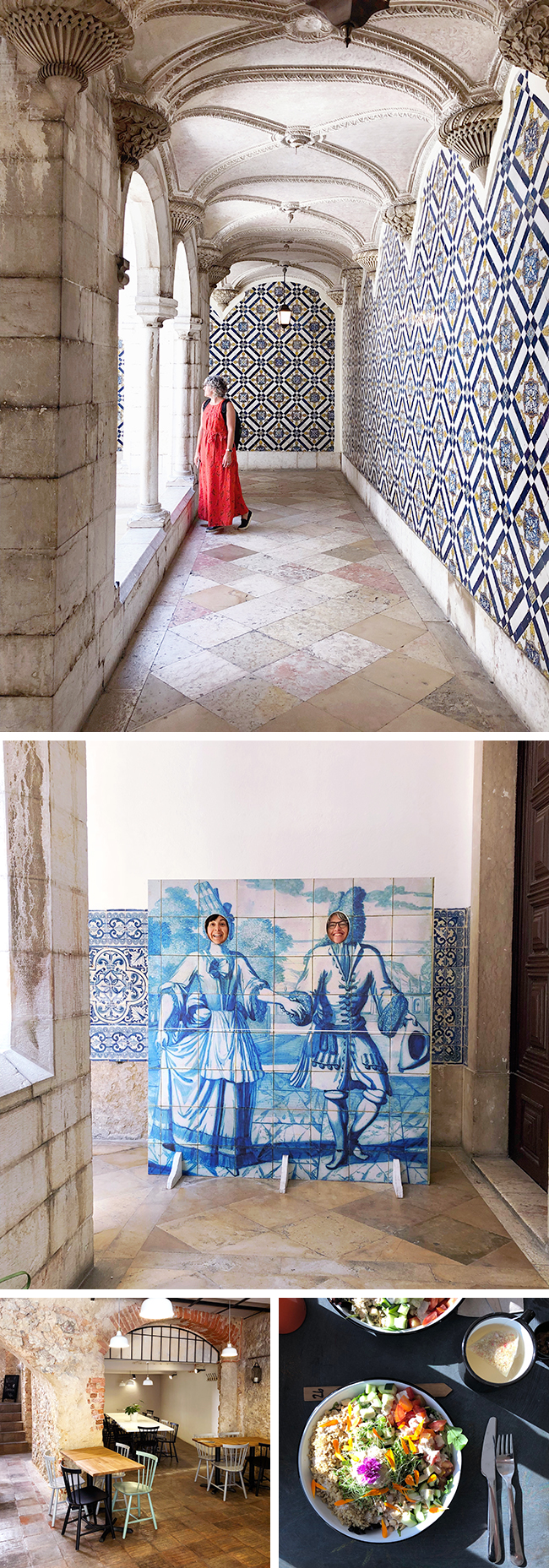
Lisbon tile museum, Copenhagen Coffee, Eight - the Health Lounge

By the next morning, 7 of the 8 of us had arrived in Lisbon, and Rosa Pomar, who we had traveled to Portugal to meet, had generously offered to let us into the shop (Retrosaria is normally closed on Mondays) and give us all a Portuguese knitting lesson. When we arrived that morning, three of her colleagues were also there — one of whom, Anabela, was knitting my Anna Vest! — and they treated us to the best example of the famous local pastry, pastéis de nata aka pastel de nata (pronounced pashTEL de nada). Rosa’s shop is small but stunning, and it was incredible — as in, worth flying all the way to Portugal — to get to see all of her Rosa Pomar yarns, in all of their colors, together in one place. Rosa is doing amazing work, working with an assortment of Portuguese shepherds and mills to make a wide variety of local yarns, almost single-handedly reviving the wool industry in her country. I’ve been smitten with her Beiroa, in particular, and not only was I swooning over the big basket holding the full rainbow of it, but she had a little granny square sampler that was so beautiful I bought 10 skeins to try to replicate it on my own. She also sells a variety of shoes and boots, handmade by an elderly Portuguese man, and nearly all of us bought sandals. (They were actually out of my size, so I’m waiting for mine to be made, at which point they’ll send me both my shoes and my yarn. It’s that WHOLE ROW of skeins pictured next to her granny square quad up top!)

Lisbon travel guide: Retrosaria Rosa Pomar yarn and shoes

You may recall the time I knitted one of Rosa’s hat patterns in the Portuguese way (in short: working from the wrong side of the fabric, tensioning the yarn around your neck, and throwing it around the needle with your thumb — it’s brilliant), but relearning in Portugal, from Rosa, in a classroom I’ve seen on her Instagram so many times, was a wormhole experience, and one to cherish. And Rosa herself is even lovelier than I could have imagined. After having been Instagram friends for several years now, to get to know her and hear her voice was the best thing about the whole trip. But there’s lots more to be said about that.

When we left Rosa’s, we had lunch at a tiny, local, authentic place called Taberna da Rua das Flores — the start of what would become a daily bacalhau tradition — followed by Livraria Bertrand, the world’s oldest bookstore; our second A Vida Portuguesa experience, the larger shop on Rua Anchieta (below); and then a wander around LX Factory, a giant old warehouse compound now filled with little shops and eateries and bakeries and coffee shops and gelatarias and bookstore Ler Devagar. After which we all split up for dinner (some went to Belém) and a good night’s sleep before the real adventure was to begin the next day.

Lisbon travel guide: A Vida Portuguesa, sidewalks

. . .

While we’re talking about Lisbon, I’ll skip ahead for a second, because we spent a final afternoon and night in Lisbon at the end of our trip. After returning our rental cars (I’ll get to that), we paid Rosa one last visit at the shop, went to the nearby Burel wool store (lots more about Burel to come) where I bought the most amazing winter coat-vest imaginable, picked up dinner provisions at Prado Mercearia, and 7 of us spent the evening in our amazing apartment eating all the things (including some of my tinned fish I wouldn’t have room for) and striving to cram all of our purchases into our luggage before we took turns leaving the next morning. Keli Faw (of Drygoods) had found this place on Airbnb that was sprawling and had Lisbon-style tile in nearly every room, with a fully tiled kitchen, and balconies all the way around. It was splendid.

Lisbon guide: Prado Mercearia, Luminous Cibele

Regarding travel in Portugal, there are two main things I want to tell you. 1) Except in the tinier, more remote villages, nearly everyone speaks excellent English, so language is really not an issue. Even when we stopped for lunch one day in a little village in the mountains where the only person on duty at the restaurant (we’re pretty sure he was the cook as well as the server) spoke no English, we worked it out. 2) It’s quite affordable to travel there, apart from the airfare. We were not roughing it — as you’ll see. We ate very well (ranging from groceries at “home” to little hole in the wall places, to one very fancy meal), stayed in nice places (a mix of hotels and Airbnbs, although we shared rooms everywhere, which helped), and had two rental cars, and my share of all of that was about $85/day. Same with shopping: I bought a beautiful locally made cotton blanket at A Vida Portuguesa for 30 euros (you can see it in the shopping bag photo up top); handmade shoes from Rosa for 84 euros (far left in the shoe photo above, as well as on Anna’s feet in the cobblestone flower sidewalk shot). You can get perfectly good Portuguese wine for about 5 euros a bottle. We were pretty stunned at how affordable it all was. And as you’ll see, the country is truly beautiful and the people are lovely. I highly recommend it!

One other note about Lisbon in particular, though: Wear sensible shoes. It is very, very hilly (comparable to the hilliest parts of San Francisco, but all over) and the sidewalks are all ancient cobblestone, well smoothed by years upon years of foot traffic. They are beautiful, but not to be taken lightly.

. . .

T R A V E L   D E T A I L S

Guidebook

• “The Monocle Travel Guide to Lisbon”
Baixa House had a copy in the apartment for us to use, and it was so good I’ve ordered a commemorative copy for myself and will be sure to use more Monocle guides in the future.

Lodging

Baixa House
Gorgeous, sunny 18th-century apartment building that is now run as a hotel, with housekeeping. There’s no restaurant but they leave breakfast foods (yogurt, cheeses, marmalade) in your fridge and fresh bread on your door each morning. We were in Eduardo VII and Jaime was in Belem. This is my favorite place I have ever stayed and I would go back in a heartbeat.

Luminous Cibele
Our Airbnb for our last night in Lisbon. We would have been very comfortable there for much longer, as it was beautiful and sprawling, with amazing views of the city from its many balconies.

Dining

Copenhagen Coffee
Pictured above (bottom left under the tile museum photos), the Alfama location is a super chic little oasis of a space with both food and drinks and a pretty courtyard (unlike the other one we also went to, which was a fairly ordinary coffee shop). Get the cardamom bun.

Eight — The Health Lounge
Good clean food — salads and grain bowls and such — in a beautiful hipster-style space. Also good for shopping. (My dinner pictured above, bottom right under the tile museum photos)

Taberna da Rua das Flores
Rosa had told us this is her favorite, but it’s teeny tiny and hard to get a table — especially for 8. So we went for a late lunch and loved it. Super local and authentic Portuguese dining.

Manteigaria
Rosa and her staff say this place — just down the block from her shop — makes the best pastel de nata in Lisbon. I can tell you we had a few, and none were anywhere near as good as these.

Prado Mercearia
We never got to eat at the restaurant Prado (in town on the wrong nights) but did get to load up on local cheeses, hams, olives, crackers, etc, at their adjacent beautiful little market, the Mercearia.

Sites / Shopping

Museu Nacional do Azulejo (National Tile Museum)
The National Tile Museum is a very manageable size but does a great job showing and telling the history of Portugal and its famous tile.

A Vida Portuguesa
Specializing in Portuguese-made goods, AVP has some of the most beautiful shops I’ve ever been in. There’s enough that’s different about the smaller Rua Ivens and larger Rua Anchieta locations that we went to both (and a third in Porto), and I recommend you do too! Blankets (including a wide assortment from Burel, see below), ceramics, home goods, soaps, pencils and notebooks …

Retrosaria Rosa Pomar
In addition to her full line of Portuguese artisan yarns, she also stocks a few other choice yarn brands and a small selection of fabric, as well as shoes and boots handmade by an elderly Portuguese gent, which are not to be missed.

• Livraria Bertrand
The world’s oldest operating bookstore is also quite beautiful, and when you buy something, they ask if you’d like a rubber stamp saying you bought it at the world’s oldest operating bookstore: in English or Portuguese.

Icon
Also specializing in locally made goods, but more along the lines of jewelry, bags, a few clothes, and decorative objets.

Burel Mountain Originals
The shop of the Burel wool factory which I’ll be telling you about in another installment. A wide variety of goods made from their “burel” cloth, which is sort of like an even denser boiled wool, as well as their jaw-droppingly beautiful woven blankets, scarves and shawls.

.

Photo of Anna and me outside the tile museum © Jaime Jennings; photo of Rosa Pomar and me © Anna Dianich; all other photos © Karen Templer

SaveSave

SaveSave

SaveSave

SaveSave

SaveSave

SaveSave

SaveSave