Make way for Making Things

NOTE: 03.19.19 — Due to a range of concerns raised about fairness toward designers — both in the business model and their response to calls for more inclusivity and transparency that had fallen on deaf ears — I asked yesterday that the three patterns I had listed on Making Things be removed from the service. I’ve also removed the link to my profile/patterns that was originally at the end of this post. (Commissions I received will be donated to SPLC.) The Sloper and Log Cabin Mitts patterns are both available for free here on the blog, and the Anna Vest is available on Ravelry. If you’re a Making Things member with the Anna Vest already in your library, it will remain available for 12 weeks. Please email me if you have any trouble accessing it.

Make way for Making Things

I had this funny idea five years ago, it seems, to do a series of interviews called the 1-Q Interview, and then I apparently only did it once — one question to Julie Hoover about the value of seams. (An excellent and life-changing interview, I must add!) I was reminded of it the other day when I began to interview Megan Elizabeth, formerly of Wool Days yarn and now with a shiny new web app to talk about, called Making Things. I’d sent her an opening question and was planning to follow up with the rest, but in her infectious enthusiasm for what she’s doing she sent back a whole interview’s worth of an answer! So today I present you my second (unintentional) 1-Q Interview.

To find out more about Making Things, check the website and their Instagram feed @themakingthingsapp.

. . .

When you first got in touch with me … how long ago was that? … you were working on an online tool for reading patterns and tracking your progress. An upgrade to existing pattern readers, basically. But in the meantime, the idea has really morphed and grown. Can you share a short history of the app?

I’d been running Wool days (a boutique Australian yarn company) for 3 years, and the same conversation kept coming up with our community: I want my making world to fit snugly into my fast and crazy world, so I don’t have to leave it behind. So I can still be me.

And while I loved what I got to do every day (visiting local sheep farms, creating yarn, talking with our community) I sometimes struggled to see how Wool days was going to keep up with the rest of my world. There are too many of us who are passionate about knitting and crochet for us not to have the support, infrastructure and opportunities we take for granted in the rest of our lives. (Netflix anyone?) So being a typical “too much to do, not enough time” person, I started thinking about what it would look like.

I shared my ideas with others, because I know how I make, and what I need. But I can’t speak for everyone. Turns out others had been thinking this way too! I had some of the most wonderful, in-depth conversations with people I knew, and more importantly, people I didn’t.

It became a thing. So at the start of this year we built a thing.

It was simple and awkward. And people were obsessed. The first week, makers spent an average of 10 hours in using the platform.

Working with designers, we took a small selection of patterns and reformatted them so they were interactive. Which basically means knitting and crochet patterns were now truly digital. They adapted to your screen size, there was a sticky highlighter to keep track on the page, row counters, dual axle chart reader, you could make notes directly in the pattern, and there was a scrapbook page to document your project.

It was all just as seamless as using a pen and post-its. At least it was supposed to be.

Every day we’d get feedback on improvements, changes and things that just didn’t work. And every night we’d make it better. Some things were massive changes, and some things were quick tweeks. We were all learning how we make things, and what was frustrating about it. Wanting to knit on the train and not need to mark a dog-eared chart with multiple coloured markers. Wanting to keep making with friends, even when they go home. Or they live on the other side of the world. Wanting to support others who find deep satisfaction in their creativity. We were co-creating our dream tool for making.

We were also working really closely with designers (they create the patterns at the centre of our making world!), and it didn’t take long for conversations around recognition, pay, support and safety to come up. Designers build communities, brands, stories. They dream up, design, test, do maths, redesign, tech edit, photograph, format, market, sell, teach and tech support each pattern they create. So we started rethinking how we access patterns, in a way that celebrates all the work of designers, and creates a predictable and sustainable income — one of the most powerful drivers of creativity.

Yarn stores, dyers, podcasters, teachers, tech editors have joined in the conversation too, and they have some epic ideas. We are a creative people, not only with our hands but our minds. We’ve all thought “what if …” Now we’re building it. Together.

So that’s where we’re at! We officially launched yesterday, which means you can become a member of Making Things to access all the patterns (1000+ tech edited, tested and beautifully photographed patterns), and all the tools. Our library of patterns is now your library of patterns. Our community is now your community. Our platform is now your platform as we build this together.

. . .

Thanks, Megan — I can’t wait to see how it goes and grows!

And for anyone wondering, yes, you can find a few of my patterns there (which automatically makes that link an affiliate link, fyi). [No longer available; see note above.] Let me know if you try it out!

.

PREVIOUSLY in 1-Q Interview: Julie Hoover in defense of seams

Queue Check — October 2018

Queue Check — October 2018

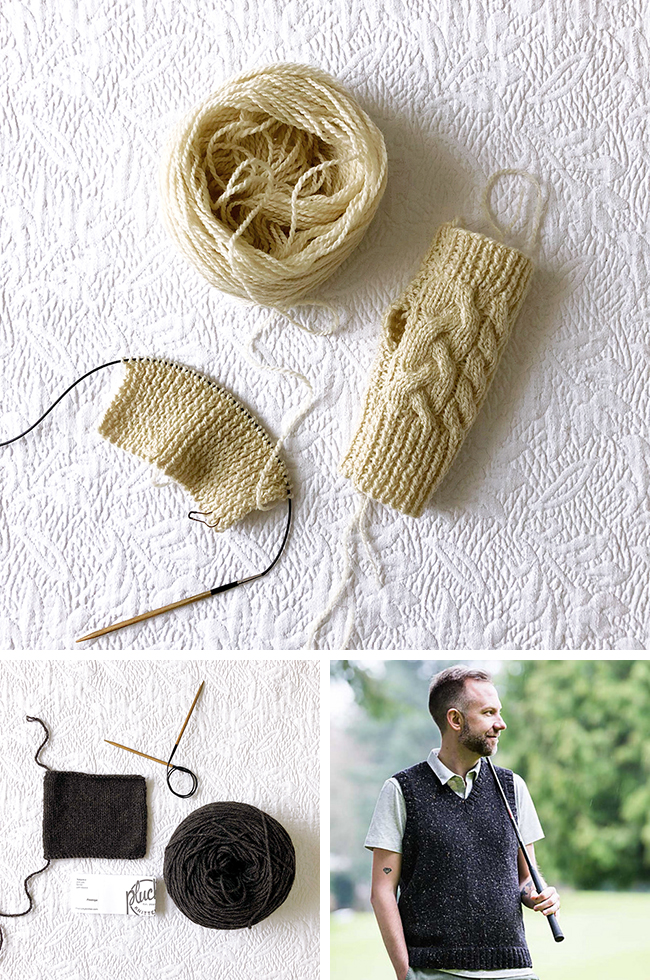
Raise your hand if you thought I would go another month without casting on a sweater. Anyone? Not me. I contented myself with that dickey for a little bit, and have been test-knitting my own mitts pattern — the Cascara Mitts they’re called — which Tolt is publishing on Saturday as part of their 5th-anniversary collection. (I’ll be at the store/party on Saturday and am actually teaching this pattern on Sunday but the class is sold out!) And I think Bob recognized an opportunity and rushed into the void, requesting a sweater vest for himself, and even picking out the yarn — the skein of Plucky Knitter’s Yakpaca that I bought at Stitches West earlier this year. He’s convinced that since it’s a vest, it won’t be overly warm for him; I’m dubious but I love the man so I’ll knit the vest and hope! I’ll be using Churchmouse’s simple little His Vest pattern, but probably raising the neck a tiny bit.

I do think I’m narrowing in on a final decision for my next sweater, but in the meantime I want to focus on Bob’s vest and on finishing up the unfinished:

My Hozkwoz hat is within an inch of done
My blue Bellows just needs a couple of seams and some buttons
My lilac pullover-to-cardigan-conversion is just one fun steek experiment away
– And I have a pair of Log Cabin Mitts awaiting their thumbs

It had been my plan to do these things for Slow Fashion October, but I have had myself stretched wayyyy too thin for that. Fortunately, they’ve all been waiting patiently for both me and the weather, which has more or less arrived, so I’m excited to tackle it all.

.

PREVIOUSLY in Queue Check: September 2018

Q for You: How many clothes do you make/buy each year?

Q for You: How many clothes do you make/buy each year?

Last weekend, I tackled the closet cleanout challenge for Slow Fashion October (you can see how far I got in my saved Story), and also posted on Instagram about having gone about 6 months without buying a single solitary garment or shoe — 100% unintentionally and unknowingly — and how since then (in the past 11 months total) all I’ve bought is four t-shirts and four pair of shoes, plus a piece of outerwear. (I guess I can use the word “vest” for it, but it seems so inadequate!) In thinking about that, I asked myself whether I was so content and oblivious because I was adding clothes to my closet through making instead of buying. We’ve talked about the fact that if you’re making your own clothes, it’s essentially impossible to acquire them at a typical shopping rate — it’s inherently slower. But looking back through the same period, I’ve knitted two sweater vests (sweatshirt vest and plum Anna) and a pullover, and sewn two sweatshirts (short-sleeved and long-sleeved, both not quite right!) and two pair of pants (recycled denim and natural canvas). If you count the outerwear vest and the yet-to-be-seamed blue Bellows, I’ve added a grand total of 12 articles of clothing to my closet in 2018. Add in the pajamas I made during Summer of Basics and it’s a whopping 15! I wish I had some way of knowing what my lifetime average was up until last year, but I can tell you it’s a long way from 1-ish garments per month. And yet, somehow, even this list of items seems almost excessive to the me I’ve gradually morphed into over the past few years. I find the whole thing mind-boggling.

And for the first time since beginning to knit, I’m taking as long to pick my next sweater project as it would have taken me to knit one!

Who am I?!

Last night I was reading this bizarre piece on newyorker.com that was sent to me by a #slowfashionoctober friend, about how Rent the Runway has pivoted from special-occasion wear to become a source of everyday clothes for tens (hundreds?) of thousands of women. The article opens with a sort of suggestion that it has something to do with the slow fashion movement, but I have a hard time seeing how a company that’s buying up thousands upon thousands of garments of questionable origin and shipping them endlessly around to one person after another after another after another (with dry cleaning in between each) is any kind of antidote to the ills of fast fashion. NEVERTHELESS, it opens with some mind-boggling stats: “Each year, as Hyman is fond of pointing out, the average American buys sixty-eight items of clothing, eighty per cent of which are seldom worn; twenty per cent of what the $2.4-trillion global fashion industry generates is thrown away.”

Sixty-eight items of clothing per year? As an average?! At my most gluttonous, I’m certain I never bought 68 items of clothing in one year. And obviously making anywhere near that number is hilarious to even consider. All of which brings me to my Q for You: How many articles of clothing do you add to your closet in a year? And what percentage of them do you make versus acquiring them through other means? I know not everyone is in the habit of assessing their closet in the sort of gory detail I do for this blog, so I don’t assume you know exactly, but what’s your best guess? Or a range. As always, there’s no right or wrong answer! I’m just. So. Curious.

.

I look forward to your responses, and wish you a happy weekend. I’ll be back to sorting through my piles if anyone wants to join me! I’ve got a really great closing interview lined up for Monday, and plenty more yarny posts to come next week!

.

PREVIOUSLY in Q for You: When do you give up on a WIP?

The dickey I didn’t know I needed (2018 FO-22)

The dickey I didn't know I needed (2018 FO-22)

There was a night a couple of weeks ago where I was frantically looking for something to knit. My plum Anna Vest was blocking; I’d left my marlisle hat at work; I no longer have the thumb instructions memorized for the Log Cabin Mitts, and picking up my unfinished pair wasn’t going to take up that unexpected chunk of knitting time anyway. And so on. I could have cast on a sweater, but it would have been both underconsidered (I can’t make up my mind) and wool (since that’s what I have in my stash in sweater quantities), and I obviously didn’t want to do that. So I pulled up New Favorites and scrolled through looking for something I’d been wanting for a decent amount of time and that I also had yarn for in stash, and I landed on Grete, the crazy dickey I can’t get out of my head. PERFECT. Then I remembered it’s written for bulky yarn, which I don’t have meaningful amounts of in stash. ARGH. And then it slowly dawned on me: the exquisite single-batch, toffee-hued, Oregon-raised bulky I’ve been dying to knit with. I only had one skein on my shelf at home, but I had plenty in the webshop and had set aside a pile for myself at the studio. (Hilariously, I had made this connection last spring when the pattern published but had forgotten it in the meantime.) So I cast on.

The only thing I didn’t like about knitting this was how quickly it was over. I have friends who say the thought of coffee gets them out of bed in the morning. I had one morning where I woke up thinking “the sooner I get up and get through my workday and my workout, the sooner I can knit those cables.” Although, I did extend it by making some changes and revisions and re-knits along the way.

When I first blogged about this pattern, I mentioned that I wanted the neck to be snugger, and we talked about various other mods in the comments, including putting a back on it, which I did. But I was surprised to discover when I started knitting that the neck ribbing folds down over cables, as opposed to ribbing folding onto itself, and I couldn’t imagine wearing that, so I ripped it back. In total, here are the changes I made:

The dickey I didn't know I needed (2018 FO-22)

– Cast on 8 sts fewer (on US8 needle) for snugger neck
– Ribbed for 8″ (instead of 10″ of half ribbing/half cables)
– Worked an increase round at the end of my ribbing to get to the original stitch count
– Instead of binding off for the back neck, put those sts on waste yarn
– Worked the front panel exactly as written, on US10 needle for main fabric
– Returned the back sts to needles and worked a back just like the front, but only two repeats of the chart
– (I’m wishing I had added another repeat or two on the front so it hits me more like the one on the model, but that’s ok — I never did check my gauge so don’t know how it compares!)

In the interim, I tried two other ideas for the back (involving stockinette and short-rows and altered stitch counts to adjust for the gauge …), thinking it might not lie flat or sit right if I didn’t account for neck shaping somehow. But that was time wasted, because this totally worked. The back flap gives it a little visual ballast, plus I couldn’t stand the thought of cold air on the strip of skin between a shirt collar and the bottom of the dickey. And while I thought it was just a visual thing, it does actually help it stay seated better as well.

I also couldn’t be happier with my yarn choice for this, the OUR Yarn, and love it most because it’s a way I can feel like I’m wearing a luscious wool turtleneck sweater in a climate that doesn’t really allow for that. And did I mention it looks amazing with my matching Log Cabin Mitts?

The dickey I didn't know I needed (2018 FO-22)

So I’m eager to knit another one — wider somehow to account for my broadness, and with another variation for the back — and am thinking it should be black. I’m just debating between this same yarn for that (a deep, rich black which would be gorgeous) and trying it in the intended yarn, Luft, which is a wool-cotton blend and lighter, more heathery black.

Pattern: Grete by Woolfolk Yarn, with mods listed above
Yarn: OUR Yarn from Fringe Supply Co. in toffee (8.8oz, 2.25 skeins with my mods)
Pictured with: Fringe Field Bag in waxed camo

.

PREVIOUSLY in Finished Objects: Plum Anna Vest (pattern now available)

New Favorites: Brandi’s neck sculptures

New Favorites: Brandi's neck sculptures

Remember back at the end of last month when I said “Or perhaps I’ll cast on a Grete, if there’s a suitable yarn for it in my stash”? So that happened, and I’ll show it to you as soon as I take some pics, but it’s amazing. And between that and the situation with my too-warm sweater collection and my short attention span right now, I’m kind of obsessed with the idea of a winter wardrobe plan that consists of some very simple long-sleeve tops combined with statement-making neck accessories that also fend off the coming cold, and would be immensely satisfying to knit. I’m once again reminded of the loop stitch Markham Collar (which Tara-Lynn has since sent me and I just dug out) but am also newly fixating on Brandi Harper’s sculptural, convertible head-and-neck-ccesories, the Hoodie (above bottom) and the Shawl Collar (above top). Both would be great with yarns held double or triple, making them great stash busters, as well.

.

PREVIOUSLY in New Favorites: Building blocks

Weekend Reads

Weekend Reads: slow fashion, knitting, sewing

There’s the new UN report on climate change, the BBC documentary on fashion pollution, and also some lighthearted and inspiring stuff to talk about and explore!!

– Before I forget: If you’re at Rhinebeck this weekend and looking for a Field Bag, you’ll find it in the Harrisville Designs booth in Building A. (Eat a falafel for me! Hug a sheep for me! Say hi to everyone for me!)

– Tomorrow is International Repair Day, just in time for mending week coming up!

– Everything about this post of Mimi’s is amazing on all the levels

– Have you heard there’s a Fall 10×10 starting Monday? (I have a funny little idea I might make happen …) And that Lee Vosburgh has made a downloadable “define your style” guide? I haven’t had a look at it yet, so tell me what you think if you beat me to it!

99% Invisible is my very favorite podcast I rarely get to listen to, but I’ll be spending part of my weekend listening to their recent series, Articles of Interest, with episodes on plaid, pockets, blue jeans, kids clothes and more (thx, everyone)

–  I 100% agree with what Heather said about the overlap of sewing “frosting” and slow fashion (and I have a little #sewfrosting plan of my own)

– If I were anywhere near the Rhode Island School of Design, I’d be checking this out: “Repair and Design Futures is a multidisciplinary exhibition and programming series that investigates mending as material intervention, metaphor, and as a call to action.” (thx, Vanessa) (photo, above bottom)

– I will be in Palm Springs before their exhibition Scraps closes, though! (via @kikiluscious)

– I loved Ash Alberg’s thorough responses to this week’s Slow Fashion October prompts (among so many others!)

– For the month of Slotober, Emily at Reunion Yarn is offering her Unraveling Club online workshop (how to unravel sweaters and reclaim the yarn) for just $10, no code needed

– I would wear this apron every day, everywhere

– And maybe this quilted wonder on top of it (#tamaracksociety goals)

– And this is just jaw-dropping

Please note that I’ve corralled all of the great stuff I’ve been sharing in the Stories for the @slowfashionoctober account as saved highlights at the top of the profile page, so in addition to catching up with the posts in the main feed, do take a little time to flip through those — there’s just so much amazing, thoughtful, heartfelt, inspiring stuff.

Thanks again for spending some of your time here this week, dear readers. See you on #slowfashionoctober over the weekend and back here on Monday!

.

PREVIOUSLY: Winners + Weekend Reads + More

How to make a visual closet inventory

How to make a visual closet inventory

OK, so I’ve had a lot of questions about how I do my photographic closet inventory and Closet Rummy™ outfit planning — especially since talking about it on the Love to Sew Podcast — and with so many people participating in the closet cleanout challenge for Slow Fashion October, I wanted to post a full rundown on how I do it.

This has been the single most effective thing I’ve ever done in terms of helping me really really KNOW what’s in my closet and how it works together; saves me time getting dressed; and prevents poor making/purchasing decisions. For instance, if I’m considering knitting something like a navy blue pullover, let’s say, it’s easy to think “oh hell, that’ll go with everything.” But when I can pull up all of my pants (har!) and say, Now really, which of these will you wear it with?, and the answer turns out to be two plus jeans, that’s informative. (Like is that enough to justify it, or will it lead to the ol’ “I need to make x, y and z to go with my navy sweater.”) Or if I’m obsessing over a pair of shoes, I can glance at the most recent outfit rundowns and ask myself How many of those outfits would I actually wear them with, and are they better than whatever is already pictured there?

It’s funny how many people have said to me “I know your closet better than my own,” and that says it all about how clear and illustrative it is to have this sort of photo inventory, and to consult it regularly.

My process might not work precisely for you, but I hope you’ll be able to adapt it in a way that will! Here are my steps:

1. TAKE PHOTOS

This takes like two minutes, total, when it’s a matter of adding a new acquisition to your existing inventory (and hopefully you add rarely anyway, right?), but it can feel daunting when you’re starting from scratch. So I don’t recommend trying to photograph your entire closet. Pull a selection of the clothes that are relevant right now, that you’ll be wearing in the next month or two, and just photograph those. Then you can add gradually over time.

– Place the garment against a white wall or surface and in daylight. (You don’t want a surface color or the yellow tint of artificial light throwing you off.) Our guest room gets excellent natural light so I use the wall adjacent to the window for this (and the rice paper blind acts as a natural filter). I take a painting off the wall and hang the garment on that nail, then aim my iPhone at it. It would be even better to have a large sheet of white foam core or illustration board (from the art/craft store framing department); lay it on the bed or floor near a window or open door; and lay the garment on there with no hanger. I do this with shoes and mean to start doing it that way with clothes to eliminate the hanger.

– Why is that better? Ideally, you’d have nothing in the photo that isn’t the garment, and especially nothing that’s adding an extra color. If you make a black-and-white outfit combo and the shirt is hanging on a pink hanger or background, it will register on your brain as a black-and-white-and-pink outfit, which it’s not. My wooden hanger is at least a neutral, but it would be better to have a white hanger or no hanger at all.

– Do your best to hold the camera so it’s parallel with the garment. You want the photo to be as straight and accurate as possible, with no distractions or distortions. And I try to keep the scale the same from one photo to the next, so the relative proportions are evident — although that’s not always strictly possible. The hanger (along with the paneling of my guest-room wall) is helpful in that regard: I try to keep the hanger about the same size and position in the frame when shooting tops, for instance. You could also make markings on your foam core for where you want the hanger and the edges of your photo to be, or whatever works!

2. EDIT AND SAVE PHOTOS

-iPhone photos, at least, tend to be quite yellow and/or grey, and you’re not likely to have perfect light every time, either. I use the A Color Story app on my phone to correct the photos (as previously discussed here, along with tips from Jen Beeman and Brandi Harper) but you can use the built-in edit function or any app you like. If you are not familiar with photo editing, a few simple steps will go a long, long way. Use the Sharpen function. Play with the Brightness and Contrast settings, and try the Curves tool in ACS. (It can be as simple as grabbing the center dot on the curve and dragging it toward the upper left corner a little or a lot.) Use the Warmth slider to correct the blue/yellow balance, and the Tint slider to balance the green/red tones. Seriously, with just a little trial and error you’ll get the hang of it! Then it will only take you a few seconds per photo once you do, and you’ll be able to use those skills to improve all of your photos.

-Again, try to be as consistent as possible with editing the photos so they’re all nice and clear and bright.

– If nothing else, make an album in your camera roll and keep all of your garment photos together in there.

– Even better is to save them together in a folder on your hard drive or in the cloud, which is what I do, with descriptive filenames like “black linen pants” and “ivory fisherman sweater.” I have few enough clothes that I don’t subcategorize them, apart from the fact that I keep shoes in their own folder, but if you want to make folders for pants and dresses and sweaters, go for it! (That might also help you see any imbalances, like if you have 20 pairs of pants and only two shirts.) Again, organize them in whatever way works best for you. I like having mine on a cloud-based service so I can access them from anywhere, anytime I might need to.

3. COMPILE PHOTOS INTO OUTFITS

– Once you have them saved somewhere, even just opening up that folder in grid view wherever the images live can be enough for you to see your whole closet at a glance, and that alone will likely give you outfit ideas or guide your future decision making.

– Since I use Photoshop every day of my life, I use it to compile my outfit grids for the Wardrobe Planning posts, which I then print out and keep handy. There are quite a few apps now that apparently allow you to do the same sort of thing, but I have not personally tried any of them, since I have a process that works for me. Stylebook is the one that gets mentioned to me the most often. Capsule Wardrobe was created by knitter Kelsey Leftwich. And I recently ran across one called Personal Lookbook on Instagram. I’m sure there are many more, and would love to hear from anyone who has used any of them!

– But you can also line up pics into outfits anywhere you can import a photo. It could be a spreadsheet or a word doc or just about anything, really. The only important thing is that you be able to place any given photo more than once, since you’ll want to incorporate any given garment into multiple outfits, right?

Like just about anything, this could feel daunting and time-consuming while you’re in startup mode, trying to figure out your best tools and techniques and process. But once you find a system that works for you, it will actually save you a ton of time and take only a few minutes here and there to update — and then a fun hour here and there planning a month of outfits or what to pack for your next trip.

I hope everyone will share their own strategies and advice in the comments below! And if there’s anything I’ve left out, just ask!

.

By the way, pictured is my recently finished Anna Vest, the pattern for which published yesterday. It’s my 21st FO of the year, the third knitted garment I’ve finished in 2018, and there are a few other details on Ravelry. So this photo has been added to my wardrobe files!

.