Scene and bought at Rhinebeck

Scene and bought at Rhinebeck

Got back from Rhinebeck late Monday night — more properly known as New York State Sheep and Wool Festival — exhausted from the fun of seeing so many beloved people and meeting so many new ones. I know I say this a lot, but it’s always a pleasure to get to put faces to some of the many names I see on comments, orders and Instagram accounts, and to hear from you what it is you enjoy about this blog, so thank you to everyone who stopped to introduce themselves! And also to everyone who shopped the Fringe Supply Co. shelves in the Harrisville booth — it was such a mob scene I never even got to take a picture of it!

Scene and bought at Rhinebeck

My housemates* and I arrived a day early this year, which gave us a chance to hike up Overlook Mountain (amazing) and wander the streets of Hudson (adorable). The festival, for me, was pretty much just like last time: totally overwhelming on Saturday, relaxing and lovely on Sunday. It was quite warm — I was sleeveless both days — but no complaints, after I nearly froze last time. I bought a spectacular sheepskin from Sawkill Farm after having been close to getting one from her newsletter awhile back, and a sweater quantity of Harrisville’s denim-y blue wool heather they made special for the show. And in Germantown Sunday eve, I bought a gigantic vintage colorwork cardigan that was hanging on a rack on the sidewalk at Luddite Antiques, which I plan to bundle up in for porch knitting now that the weather in Nashville seems to have finally turned a corner. (Knock wood.) All in all, a most excellent trip.

Scene and bought at Rhinebeck

The same heartfelt thank-you goes to everyone who stopped by our booth at Fiber in the ’Boro on Saturday, which I’m so sad I had to miss! I love that sweet festival so much. As lovely as Rhinebeck is, I can’t say this often enough: There are wonderfully charming sheep and wool festivals all over this country and around the globe. Clara Parkes keeps a sizable list but I’m sure not even that is comprehensive! So please seek them out, have a blast, pet some sheep, and support your local/regional farmers and fiber folk.

p.s. Bravo to this gentlemen who was spotted carefully guarding his partner’s Field Bag at the festival while he napped and she shopped—

Scene and bought at Rhinebeck

*Pictured left to right in the group photo: @fancyamber, me, @knitknotes, @jen_beeman, @kategagnonosborn, @fancyjaime, @courtneykelley

.

PREVIOUSLY in Craftlands: What I Know About Rhinebeck

SaveSave

SaveSave

SaveSave

SaveSave

SaveSave

Fringe and Friends new-year knitalong: Preview and plans!

Fringe and Friends new-year knitalong: Preview and plans!

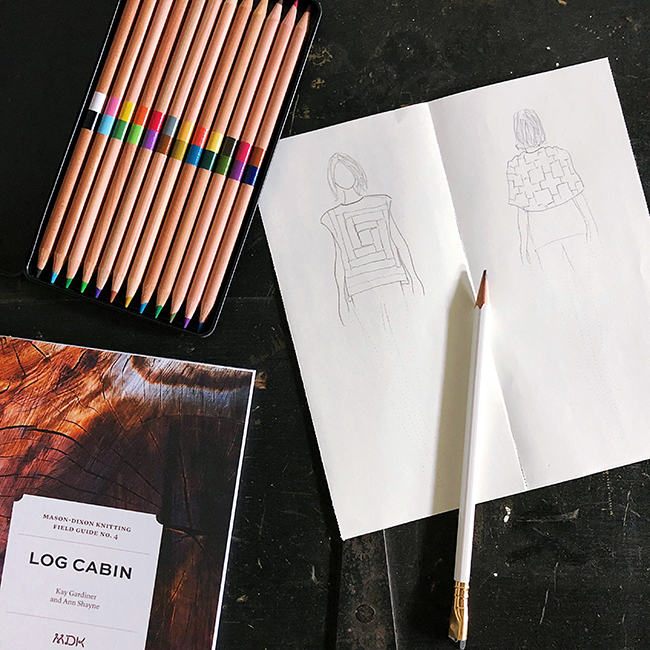
Ok, announcement time! If you had a theory about the next Fringe and Friends Knitalong based on my former teasing, you may still be right … eventually. But for this next one, I’ve decided it’s high time to do something I’ve been talking about forever, plus this time I want to base it on a technique rather than a specific pattern (or even a garment type). How many times have I said I want to knit a big stash-busting blanket? Except there’s the minor drawback that I don’t actually want to knit a whole blanket. However, I am endlessly intrigued by Log Cabin construction. So this time around, I’m inviting you to join me for a little log-cabin free-for-all! Keep reading: This is even more exciting than it might sound!

WHAT IS LOG CABIN?

In a nutshell, log cabin is a method of knitting — based on traditional log cabin quilts — where you knit modularly, picking up stitches along one edge of a square and continuing to knit, then proceeding to build off the other edges, so the work expands organically rather than being seamed together, and without any intarsia. (Although there are cases where you might knit large blocks of log cabin and then seam those together.) It’s patchwork for knitters.

THE PLAN

My friends Ann Shayne and Kay Gardiner over at Mason-Dixon Knitting — two of the smartest and most entertaining knitters I know — have very strong feelings about log cabin, so I’m teaming up with them for this one, and the starting point will be their fourth Field Guide book, Log Cabin, which contains an overview of how log cabin construction works, with assorted variations and three patterns, from which boundless things could be made. You are welcome to follow any of those,  or any other log cabin patterns, such as, say, the Albers Cowl or the Mitered Crosses Blanket or the Log Cabin Shawl. But what I love about using log cabin as the basis of this is that YOU CAN MAKE ANYTHING you might dream up. In addition to the myriad ways there are to knit log-cabin style, just think of all the things there are in the world that you can construct from squares or rectangles — washcloths, pillow fronts, blankets, wraps, sure. But also cowls, box tops, shrugs, ponchos, ruanas. You could inset a panel in something, or knit a yoke and sleeves and join it to two big log-cabin blocks for the body. Truly, there is no end of ideas, and I can’t wait to see what you all might think up!

On top of that, whatever you make could be monochrome, ombré, tonal or rainbow-colored, in garter or textures. (More about that later.) And in addition to being rife with possibilities, this is a totally beginner-friendly idea, and makes room for those who want to make garments as well as those who do not. You could even be a quilter or crocheter or weaver and still play along! It is 100% up to you! And of course, you’re not required to work from stash, but that is one of the great benefits of this sort of knitting/crafting.

Between now and kickoff, we will be peppering you with ideas and food for thought, but the best starting point is the pocket-sized Log Cabin Field Guide, with its tutorials, and two posts on the Mason-Dixon blog: Start Small and Things Get Interesting.

THE SCHEDULE

We’re all headed into the thick of holiday bustle and holiday knitting, and we want to do this during selfish-knitting season, which means you have from now until the end of the year to conceptualize, swatch, paw through your stash for yarn and color palette ideas, and formulate a plan. And we’ll cast on January 1st.

That’s also when I’ll announce the rest of the panel, but you’ve probably already guessed Ann and Kay are on it!

HOW TO PARTICIPATE

To knit along (or crochet- or quilt-along) simply use the hashtag on Instagram or wherever you post: #fringeandfriendslogalong. You’re welcome and encouraged to share your planning between now and then, but try to refrain from casting on until the official start date if you want to be eligible for prizes and all of that.

PRIZES?

Sure, probably! We’ll have details at kickoff time. ;)

. . .

I think this is the most excited I’ve ever been about a FAFKAL, and I’ve been mighty excited about them all. Like I can’t stop thinking up ideas, and have had to forbid myself from opening up my stash bins and starting to gather yarns until I’ve crossed off certain other more urgent matters from my to-do list. But you will see me scheming here soon. How about you — are the wheels already turning in your mind?

.

SaveSave

SaveSave

The cost (and payoff) of handmade

The cost (and payoff) of handmade

Once again, in light of Slow Fashion October, I’ve been tracking costs on my handmade clothes this year because I wanted to see how it held up over last year’s tally. And again, it’s a weird thing to talk about publicly (at least if you’re a born-and-raised Midwesterner like me), but I think it’s really illuminating in terms of the impact of acquiring less and making what you can, even when some of the handmades are an investment—

SEWN
$18.00 : White linen shell
6.00 : Grey wool pullover
20.00 : Striped muscle tee
54.25 : Blue button-up shirt
12.00 : Olive pants
73.00 : Blue jeans
17.50 : Denim pants
21.25 : Camo pants
——
$222.00 — average cost of $27.75 per garment

KNITTED
$175.00 : Black yoke sweater
213.50 : Camel Channel cardigan
110.00 : Linen Sloper
112.00 : Fisherman sweater
38.50 : Purple lopi pullover
——
$649.00 — average cost of $129.80 per sweater

So even with the top-shelf denim (for my jeans) and a couple of comparatively pricey sweaters in there, I’ve spent a combined average of $87.10 per month on my handmade clothes. If those were the only clothes I had added to my closet this year, and I had spent less than $100 per month, I’d be utterly floored and perfectly satisfied.

However, that’s not all I’ve spent or acquired. Since $87/month represents a savings for me, I’ve been able to invest in some coveted pieces from companies I feel good about supporting, such as my natural Willie jeans, my Elizabeth Suzann silk top, and my State smocks.

Far and away the most astonishing thing to me is I’ve added only about 2-2.5 garments per month to my closet. In my past life, 2 garments would have been a slow day at the mall, not a month’s total, yet in no way do I feel deprived or like I’m making do. Just the opposite: My wardrobe has never been better looking or higher functioning. So my heartfelt thanks to everyone who has inspired and encouraged me in this endeavor.

.

PREVIOUSLY in Slow Fashion October: Slow Fashion Citizen Jen Hewett

SaveSave

SaveSave

SaveSave

SaveSave

Elsewhere and then some

Elsewhere and then some

First things first:

1) I’m in Rhinebeck this weekend, where our lovely stockist Harrisville Designs will have a nice juicy Fringe Supply Co. display in their booth. (That’s building 39, booth 3!) I will also be hanging out in their booth on Saturday morning, from gates-open until falafel time, so come say hello if you’re there! After that, I’ll be roaming the fairgrounds, and I have a The Future is Female pin for anyone who is carrying any Fringe bag around the festival (while they last), so if you see me, show me!

2) Meanwhile, back at the ranch, DG will be holding down the fort at Fiber in the ‘Boro, our favorite show of the year. This is a fantastic little Middle Tennessee fiber festival, and if you’re in the area, don’t miss it! That’s all day Saturday.

3) I’m seriously dying to tell you what we’re cooking up for the next Fringe and Friends Knitalong, but it’ll have to wait until I’m back at my desk, so look for that on Tuesday!

4) The Slow Fashion October topic for the final 10 days — is WHERE. As in, share your sources, people! Clothing and shoe brands, services, fabric retailers, yarns, whatever it may be … where do you get the stuff you feel good about? Share it on #slowfashionoctober.

And with that, a fully Slotober edition of Elsewhere:

– The warm and wonderful Sandi Hazlewood interviewed me for her Crafty Planner podcast this week and asked me a bunch of good questions nobody has asked me before! (Let me know if I said anything stupid.)

– Samantha Lindgren has posted the full details of the big fabric swap she’s organizing — I’m so excited about this!

– Coincidentally, Sam referenced the very next link I wanted to share this week, which is Felicia’s post Enough is as good as a feast — have you read it?

– Seamwork on personalizing vintage clothing to give it new life

– “In April, 2017, Markham became the first municipality in North America to support textile diversion by banning textile waste from curbside collection service” (thx, Erin)

– “Of course I want to make every new pattern I see, and to buy all the beautiful yarn and fabric I can get my hands on, but then I’m just back to fast fashioning my slow fashion — and how many of those projects will I actually finish?”

– “We could argue all day about relative merits of recycled polyester versus organic cotton, or how much you’re benefiting the environment by paying more for organic cotton, but it’s hard to argue with a mother getting paid a fair wage in safe working conditions.” (thx, Leila)

Wherever you are, I hope you have a fantastic weekend! Thank you for reading—

.

PREVIOUSLY: Elsewhere

SaveSave

SaveSave

New Favorites: (Holiday) hat mania!

New Favorites: (Holiday) hat mania!

I’ve been favoriting hat patterns like crazy at Ravelry lately, and have printed out no less than threeHuck, Lancet and No. 1 below — as my just-in-case alternate travel project for later this week. (How will I pick one?!) Since I know a lot of you are gearing up (or already in the midst of) holiday knitting, I thought this would be a good chance to update the ever-popular Holiday hat knitting cheat sheet, this time organized by what kind of knitting you’re in the mood for. Note that most of them are unisex, and a couple include kids’ sizes—

1.) Simple knits and purls: Anker’s Hat by PetiteKnit (See also: the sweater version)

2.) A little colorwork: Luzerne Hat by Whitney Hayward

3.) A lot of colorwork: Miguel Hat by Rosa Pomar

4.) A little cabling: Parallelogram Hat by Angela Hahn

5.) A bit more cabling: Kagome Beanie by Veera Välimäki

6.) Teeny-tiny cables: Sumburgh Hat by Jen Arnall-Culliford

7.) Whole big bunch o’ cables: Brackett by Whitney Hayward

8.) Stockinette plus: Top-down Ear Flap Hat by Purl Soho (free pattern)

9.) Little bonnets: Animal Bonnet by Jenny Gordy

10.) Big bonnet: Diana Hat by Martha Wissing

New Favorites: (Holiday) hat mania!

PREVIOUSLY in New Favorites: Ol’ softies

SaveSave

SaveSave

2017 FO-13 : The purple lopi pullover

Finished: Purple lopi pullover

After a year and a half, I finally knitted the second sleeve of the top-down tutorial sweater and seamed them both up, and the sweater is — more or less — finished! And I do adore it. As it’s fully documented in the tutorial, all I really need to tell you about it is the finished counts and measurements, below. But what I mean by “more or less” is A) I need to take a second pass at the neckband and seam up the basting stitches in the raglans, but B) I think it might become a cardigan! (Which would obviate redoing the neckband.) I knitted this in Lettlopi for the sake of the tutorial because it knits up so quickly at this gauge, and I absolutely love the color, but I don’t have a lot of cause to wear an Icelandic-wool pullover in Tennessee! (I only get away with the black one because it’s short-sleeved and cropped.) Plus ever since taking the elastic out of the waistband of that older J.Crew boiled-wool pullover, I don’t really need another purple pullover, either. So I think it would get more wear if it were vented — i.e., if I turn it into a deep V-neck cardigan, which would then be some semblance of that purple cardigan I saw a few years ago and have still never gotten out of my head.

It would be good fun to do, since at this point the only way to go about it would be to machine-stitch along the contours of where I want to cut it, and then add the button band. I can’t imagine trying something like that (for the first time!) with any other garment than this, as there’s less than forty bucks’ worth of yarn in this sweater. On the other hand, I do already have a purple cardigan, albeit quite different. So I’m pondering.

Pattern: Improv
Yarn: Lettlopi by Istex in Color 1413 (purchased at Tolt)
Cost: free pattern + 7 balls of lopi at $5.50 each = $38.50 (I know!)

Finished: Purple lopi pullover

GAUGE

3.75 sts and 5.5 rows = 1 inch (measured over 4″ = 15/22) knitted on US10; ribbing on US9

TARGET MEASUREMENTS

39″ chest = 148 sts
12.5″ upper arm circumference = 50 sts (10 at underarm)
9″ yoke/armhole depth (50 rounds)
13.5″ body length (2.5″ hem ribbing)
22.5″ total length
16″ sleeve length (3.5″ cuff ribbing)
7.5″ cuff circumference = 40 sts

DETAILS

— CO 51 sts, divided with markers as follows ( 1 | 2 | 9 | 2 | 23 | 2 | 9 | 2 | 1 )

— Increased for a basting stitch in the center of each 2-st raglan

– Planned on 10 sts cast on at each underarm, and divided the raglan stitches evenly between sections when separating sleeves from body

— Worked raglan increases as kfb on either side of the raglan stitches

— Increased at the front neck and all raglans on 1st RS row then every other row until 14 sts each front, 37 back sts. Cast on 9 sts and joined in the round (front sts at 14 each + the 9 cast on = 37 front). Neck depth approx 3.5″

— Increased the front and back until 64 sts each (counting 2 from the raglans at separation, plus 10 per underarm cast-on = 74; front + back + underarms = 148)

— Increased the sleeve-side raglans until 39 sts (counting 2 from the raglans at separation, plus 10 underarm cast-on = 49); work-even till separation at 9″ depth (adjusted to 50 sts when starting sleeves)

— Sleeves were knitted flat, decreased 5x (40 sts), every 8th row after the first couple of inches, then switched to US9 needles and worked 1×1 ribbing for 3.5″

— Worked body even for 10.5″ (with a basting stitch at each side seam, to be mattress stitched later), then switched to US9 needles and worked 1×1 ribbing for 2.5″

— Worked the neckband as 1×1 ribbing for 2.5″ and did folded neckband

— Seamed chest circumference is approx 39″, for about 4.5″ positive ease

.

PREVIOUSLY in FOs: Refashioned army jacket

SaveSave

SaveSave

Slow Fashion Citizen: Jen Hewett

EDITOR’S NOTE: After three years of collaborating with Jen for Fringe Supply Co. (and taking her online class), I’m thrilled to have her on the blog today!
—Karen

Slow Fashion Citizen: Jen Hewett

BY KATRINA RODABAUGH // It’s an honor to share the work of talented printmaker, fiber artist and surface designer Jen Hewett in this week’s interview. I adore Jen’s use of color and shape in her bold and wildly inspired prints but I was also smitten with her Print, Pattern, Sew project where she printed her own fabric to make into garments. This allowed her to fuse her abilities as a surface designer and a sewer — rendering her garments unique and also imprinting her aesthetic not just in the silhouettes or combination of color and fibers, but in the bold and beautiful graphics of the garments, too.

I’ve known Jen for several years through the San Francisco Bay Area arts community, and while I loved her work from the very beginning, I always appreciated her candor, commitment and critical eye, too. Also, several years ago she brought champagne to my birthday brunch with a silver spoon because it’s known to keep the bubbly from going flat, and I fell for her then and there. Who knew silver spoons keep champagne from going flat? Jen did.

It’s that grace, humor and thoughtful nature that she brings to her work and her community. Watching Jen continue to push herself in her prints and in her technical skill is something that makes my heart race — she’s always inventing new projects, experimenting with new color palettes, and pushing outside of her comfort zone to make work that is simultaneously refined and absolutely alive. Welcome, Jen!

. . .

Your printmaking work is sublime. I adore your graphic prints, choice of fabrics, and the particular way you combine shapes and color to create bold and beautiful prints. Can you talk about what inspired you to start printmaking?

I’ve always been creative, and had started a stationery company in my twenties. I ran that until 2004 when, carrying a lot of credit card debt from the business, I sold the stationery company and started working a corporate job. My job was very uncreative (although I worked with a lot of designers and writers), but it allowed me to pay off my debt, and it gave me the time to figure out what to do next.

I needed a creative outlet, so I took a screenprinting class on a whim in – I think – January 2007. I was quickly hooked, and spent a lot of my free time in the screenprinting studio. I was laid off from my corporate job in December 2008, at the peak of the Great Recession. No one was hiring. I went to the studio as often as I could, and began selling my prints. My art career grew from there.

Slow Fashion Citizen: Jen Hewett

I remember when you launched your Print, Pattern, Sew project and it was thrilling to see your printmaking work applied to your wardrobe. This was a beautiful moment in slow fashion when your craft was transferred to your wardrobe and resulted in unique and meaningful garments. What led you to start Print, Pattern, Sew?

In 2014 I had a weekly project called 52 Weeks of Printmaking. Every week I’d create a different print, and would share it on my blog and social media. Halfway through the year I decided I wanted to do something more complex in 2015.

I took Jess Swift’s class, Pattern Camp, which is an online class about creating digital repeat patterns. It wasn’t much of a leap to figure out how to do this manually. At that point, I had been sewing my own clothes for a couple of years, and thought it would be fun to merge my love of sewing (and clothing) with my love of printmaking.

Every month in 2015, I hand printed yardage, then sewed that fabric into a different garment using either a self-drafted pattern or one from an independent pattern designer. At the end of the year, I had twelve truly custom garments, as well as a book proposal based on the project.

So many folks are intimidated to begin making their own clothing. Fear of imperfection, clothes that won’t fit, poor craftsmanship or somehow getting it wrong. Of course, we all have to start somewhere but were there any specific classes, patterns or tutorials you adored when you first started making your own garments?

As a working artist, I’m used to starting things that are just beyond my abilities and then figuring out solutions along the way. I approach sewing in this manner, too. Of course, I started with simple garments – April Rhodes’ Staple Dress was the first garment I sewed, quickly followed by Sonya Philip’s Dress No.1 and Dress No.2. None of those garments were perfect. Nothing I sew now is perfect.

Really, the best advice I can give anyone is “practice.” You can spend a lot of money on a good machine and nice fabric, but none of those things will make up for lack of skill. The only way to build your skills is to work on increasingly more complex garments, learning from (and fixing) your mistakes along the way.

Printing your own clothing is really a beautiful act in reclaiming fashion and making the garment truly your own. Designers talk about emotional attachment or why we keep certain garments forever even if they might be more sentimental than practical — the wedding dress is the typical example. Your printed clothing has the added emotional attachment of being designed and printed by you. Do you feel a certain attachment to these garments that you haven’t experienced in a store bought garment? Would you think twice before sending one to the Goodwill?

I don’t really treat any of my clothes as precious. I believe that clothes are meant to be worn, and not to be stored away in a closet for a special occasion (except for true special-occasion clothing). Wearing a garment regularly means honoring the time and money that went into its creation. And I tend to wear my clothes until they fall apart, so that by the time I’m ready to discard an item, I feel that I’ve gotten full use from it.

I probably won’t ever discard garments made with my hand-printed fabric, though. I do have an archive of my printed fabric, and will likely just add the garments to that archive.

Slow Fashion Citizen: Jen Hewett

It seems we’re craving connection and that’s one driving force in Slow Fashion. We’re exhausted by mass production and want something special or something valuable that can’t be so easily replicated in fast fashion. We often equate value with money but it’s also that triad of money, time and craftsmanship. Do you think making your garments for Print, Pattern, Sew altered your concept of the value of your garments?

I have always valued quality over quantity when it comes to clothing. I grew up wearing a uniform to school. I had five white blouses, two skirts, a sweater and a blazer. I got two pairs of school shoes each year, and they were meant to last the year. These were unexciting but durable clothes, and I had to take good care of them. But because I didn’t have to have a different outfit every day, my parents allowed me to splurge a bit on non-school clothes, buying a few pieces of well-made clothing that would hold up under repeated wearing. I didn’t have a lot of “free dress” clothes, but what I did have was of a good quality.

Sewing has changed how I shop for clothes, though, breaking my occasional impulse shopping habit. I rarely go to the mall or shop in boutiques anymore, unless I have a very specific purchase in mind. But the real excitement for me in making clothing is less a desire to opt out of fast fashion (partly because I never really bought into it in the first place, except for a couple of years in college) and more in the ability to create something that fits me and my style.

Any tips you might have for someone just starting to sew their own garments? Maybe tools you particularly love or something else that you learned through your project that inspired you to continue?

Always make a muslin when you’re trying a new pattern. It may seem like extra work to do so, but it saves so much work down the line. From my muslins, I’ve figured out that I’ve cut the wrong size, or that I need to make bust or dart adjustments. It’s much better to discover this before you’ve cut into your good fabric and have started sewing.

Also, buy good fabric. Your garment is only as good as the time and materials you put into it. Why spend all that time making something with shoddy fabric?

And finally, invest in a serger and an invisible zipper foot. I spent so much time making French seams before I had a serger. That was time I could have spent on something else! And I used to avoid anything that required an invisible zipper because I found them so intimidating. Once I had an invisible zipper foot, a whole new world of sewing opened up to me.

Lastly, your first book is underway. Congratulations! When can we expect it to be published? And could you tell us maybe just one thing about the book that you’re particularly excited about?

My book, Print, Pattern, Sew, will be published by Roost Books in May 2018. I’ve just reviewed the final, pre-press layouts. I think it’s such a beautiful book. I worked with the best team, and I’m excited for us to finally have it in our hands. I’ve been teaching some of the practices that are included in the book both in person and through my online classes, and I’m also thrilled that I’ll be able to reach so many more people through this book!

Slow Fashion Citizen: Jen Hewett

Katrina Rodabaugh is an author, artist and slow-fashion advocate. Visit her website www.katrinarodabaugh.com or follow her on Instagram at @katrinarodabaugh

.

PREVIOUSLY in Slow Fashion Citizen: Kristine Vejar

Photos © Jen Hewett, used with permission