Blue Bellows at long last

Blue Bellows at long last

Meanwhile, I’ve finished my warmest sweater to-date, lol, my second edition of Michele Wang’s Bellows cardigan. I was SO RIGHT back in February when I shelved this: My November self could not have been happier to get to finish a sweater exactly as the corresponding weather for it arrived. I mean, how often does that happen? When I put it away, I had seamed the shoulders, knitted the button band, and left myself some notes for record-keeping purposes. So all I had to do on Sunday evening, with the first overnight freeze upon us, was seam the sides and sleeves and sew down the pockets. And well, in theory, sew on the buttons, but I haven’t identified the right ones yet. This will definitely qualify as a coat here in Nashville for most of the season, and I still expect to wear it mostly on my couch on cold, drafty nights since the color is so weirdly difficult to pair with anything.* But I wore it to work on Monday with my natural wide-legs and black tee — the only outfit I’ve come up with so far — and it was cozy both indoors and out.

(Please pardon the grainy-splotchy photos, they were taken in the gloomiest light imaginable and brightened to within an inch of their lives. The yarn does not really look like that top photo — it’s the best I can do!)

My original charcoal Bellows (now my mom’s) was knitted at slightly finer than pattern gauge and scaled for a little more fitted fit. This one is slightly chunkier than pattern gauge, and while I made it the same length as before, it is both bigger and thicker. There’s just more of it, so I’m extra glad I kept it to this length, 16″ from cast-on to underarm bind-off. (Slightly shorter than the pattern; the model must be 7′ tall.) For this one, I mostly followed the third size but I think they’re basically size 2 sleeves with a size 3 sleeve cap to fit the armhole. I made the same mods as before: no cables in the ribbing, only three repeats of the cable chart. But I made two other significant changes for this one:

Blue Bellows at long last

1) I added pockets. There’s not really an ideal way to do it with this stitch pattern, so it’s slightly awkward but worth the trade-off. I have pockets! All I did when knitting the fronts was to knit the first chart repeat once, then 4 rows of ribbing between the two slip-stitch borders for the pocket edging. The pocket lining is 16 rows of reverse stockinette then the first 4 rows of the second chart repeat, so the ribbing on the pocket overlays the bottom 4 rows of the second cable, which makes it look a bit truncated. But pockets tend to hang open a little bit, giving you a glimpse of the cable inside the pocket, which I think optically balances it out a little bit. I’m not sure anyone would ever be aware of it if I didn’t point it out — they look more natural than I thought they would.

2) I wanted the button band to be a bit narrower on this one, but conversely wanted the shawl collar to be a little more voluminous than the original. With the difference in gauge I was really winging it on that adjustment. I removed 4 four full rows of ribbing, making the band a total of 8 rows rather than 12, and worked some extra short rows for the shawl shaping — 13 on the first short-row sequence, 11 on the second, according to my notes. (I no longer know how that compares to what’s in the pattern.) With the narrower band, I worked 3-st buttonholes, for slightly smaller buttons, so now I need to find the right buttons.

Ultimately, this thing is a beautiful beast, being extremely warm and also taking up an entire cubby in my little closet, so we’ll see whether it winds up getting worn enough to earn its keep. But for now, with the temperature having not escaped the 30s yesterday, I really am happy to have it! I love this classically woolly yarn and think it made for a powerhouse sweater, but there’s no question my original yarn choice (Balance held double) made for a more regionally appropriate version.

Bellows pattern by Michele Wang in limited-edition yarn from Harrisville Designsall Bellows posts
Town Bag from Fringe Supply Co. (I don’t have to hide it anymore!)

*For everyone who keeps telling me it’s not a hard color to wear, please try to understand that you really can’t know — unless you’ve seen this yarn in real life — and take my word for it? I can’t even get a photo to reflect the actual purpley-dusty-tourquoiseness of it, much less demonstrate how it really does not go with denim like you’d assume it would.

.

PREVIOUSLY in 2018 FOs: Hozkwoz Hat

Sólbein palette ideas and a GIVEAWAY

Sólbein palette ideas and a GIVEAWAY

I had the good fortune of being at Tolt this weekend, where I got to spend some time at the Istex Léttlopi wall along with Andrea Rangel, picking out possible color pairings for Sólbein and the Steekalong. (That sounds like a band name!) As I mentioned in the announcement, Mary Jane designed this cardigan to be knitted in tonal shades of a single color (light, medium and dark), and lopi comes in lots of great colors, but pairing them up is not so easy a thing to do if you’re ordering online. So I hope you’ll find these suggestions helpful. (Thanks so much for my friends at Tolt for letting me do this in the middle of their anniversary madhouse!) These are, of course, on top of the two colorways already pictured in the pattern, both of which are gorgeous.

Some of the combos above are perfectly tonal (such as the pumpkin pie and chocolate combos, 2 and 3); others rely on a pale grey for the lightest shade where no pale version of the color in question exists, and you could also use the (off) white the same way, as we did for the purple combo, 7. Combos 9 and 11 represent the idea of a light/dark neutral motif on a colored field, which would be a different look but possibly quite pleasing.

PLEASE NOTE that I have not actually swatched these so I can’t vouch for how they would hold up — I definitely recommend buying a ball of each and swatching to see — but I think these are all fairly safe bets.

I’m using the Istex color designations here, which are numbers. Sometimes you also see them with name names, but the official color numbers seem like the safest way to label them here since that’s what’s on the ball band:

1. 1700 + 9419 + 0005

2. 1419 + 1704 + 9427

3. 0085 + 0053* + 0052

4. 0086 + 0085 + 0058

5. 0054 + 1700 + 1701

6. 0054 + 1417 + 1416

7. 0051 + 1702 + 1414

8. 0054 + 1406 + 1407

9. 0086 + 0085 + 9418

10. 0054 + 1419 + 9431

11. 0054 + 0057 + 1703

Andrea reminded me I’ve been talking about wanting and black and navy sweater forever, so I think I’m probably doing that top combo myself! (Especially since I have a sweater’s worth of the heathered black leftover from my little quick black raglan.)

*I didn’t get that one into my list, but I’m 95% sure that’s the right color number.

. . .

GIVEAWAY

I also just got an email from Berroco, the yarn company that distributes Istex Lopi yarns in the US and Canada, and they offered up a prize of a sweater quantity of Léttlopi to one of you, dear readers. (Open to knitters with a shipping address in the US or Canada.) To enter, leave a comment below saying which three colors you’re thinking of using for your Sólbein, and I’ll pick a winner at random from all comments received by 5pm CST tomorrow, Nov 8. I’ll update this post with the winner’s name at that time, so check back Thursday evening to see if you won!

UPDATE: Chosen at random, the winner is Jo who posted “Although your color combos are amazing, my choice would be 0052 for the body with 0056 and 1701 as the accents. Thanks for the opportunity!” Congratulations, Jo! Please email me <contact@fringesupplyco.com> for instructions on how to collect your prize. Thanks to everyone who entered, and I’m so excited to see all y’all’s sweaters come January!

. . .

MORE TO COME

There have been questions since Monday about yarn substitutions and alternative steeking methods (as opposed to the sewing machine approach) and we will cover all of that along the way, I promise! But the short answer to the latter is no, you do not have to use the sewing machine approach.

Lots more as we go—

.

PREVIOUSLY in Fringe and Friends Knitalongs: Get ready to steekalong!

Fringe and Friends Knitalong 2019: Get ready to steekalong!

Fringe and Friends Knitalong 2019: Get ready to steekalong!

Last year when I was teasing you all about the next Fringe and Friends Knitalong (“fafkal” as they’ve come to be known), I no doubt planted the seed in some of your minds that it would be about steeking. Which was true at the time! But it got pushed back a year, for various reasons (making way for the Logalong), so I’m just that much more excited to let you in on the secret today, which is that yes, next up will be the Fringe and Friends Steekalong! My partner in crime this time will be my pal Mary Jane Mucklestone, a colorwork legend in our own time, and the featured pattern will be her exquisite Sólbein Cardigan, which I’ve been dying to knit since first laying eyes on it on the dock at Squam last year. It’s among the most beautiful uses of colorwork I’ve ever seen, with that fluttery featheriness that comes from the tonal stranding, plus I’m so excited to knit my first steeked garment along with all of you and Mary Jane.

Sólbein originally appeared in the Lines issue of Making and is now available for individual download, if you don’t have the magazine.

WHAT IS STEEKING?

For anyone new to the term, steeking is cutting your knitting. Most people prefer to do colorwork only in the round, but that would rule out anything that’s not a tube. So for instance, to get a cardigan you knit a seamless pullover with a couple of extra stitches up the front where the opening should be. And when the pullover is done, you cut straight up through those stitches to create the opening, then add your button band or other edging. I KNOW! I’ve only ever done it on a swatch, but it’s going to be thrilling.

NOTES ON THE SWEATER AND YARN

Sólbein is one of Mary Jane’s brilliant instances of knitting Léttlopi at a looser than traditional gauge — lopi being a yarn with an unparalleled character and halo that magically fluffs to fill — which means it knits up quickly and creates a fabric that is light as air and also not quite as warm as a typical Icelandic lopapeysa. You can read more about lopi yarn here, but it comes in an incredible array of colors (find it online at Tolt, Fancy Tiger and others, if your local doesn’t stock it) and is quite affordable.

What makes the Sólbein colorwork so effective is the use of tonal colors, so to preserve that you want to choose light, medium and dark shades all in the same family. If you decide to go with three totally different colors, you’ll get a completely different effect, which could be differently stunning. Have some fun with the swatching for this!

[UPDATE: I put together 11 possible color combos for you to consider!]

If you are thinking of substituting yarn, take that into account about the gauge — most aran-weight yarns will not knit up so nicely (especially with colorwork) on larger needles, so you would want to substitute a bulky yarn, and make sure you’re using one suitable for steeking. It needs to be yarn with grip, definitely not anything slippery smooth or superwash.

Technically, you may knit any steeked garment you like for the kal, and we’ll also talk about how to add a steek to a pullover to make it a cardigan. But I hope you’ll knit the gorgeous Sólbein with us! Just look at the excitement on Mary Jane’s face!

Fringe and Friends Knitalong 2019: Get ready to steekalong!

OK, she always look like that. ;)

THE SCHEDULE

Like the last one, I’ve decided to save this to enjoy during selfish-knitting season, after the holidays, which means you have from now until the end of the year to dream, swatch, and think about any modifications you might make. And we’ll cast on January 1st.

That’s also when I’ll announce the rest of the panel, but obviously MJM is on it!

HOW TO PARTICIPATE

To knit along simply use the hashtag on Instagram or wherever you post: #fringeandfriendssteekalong. By all means, please share your swatching and planning between now and then, but try to refrain from casting on until the official start date. And meanwhile, make sure you’re following @mjmucklestone on Instagram!

Are you excited?

.

PREVIOUSLY in Knitalongs: Fringe Marlisle Knitalong

Top photos by Carrie Bostick Hoge, used with permission

Queue Check — October 2018

Queue Check — October 2018

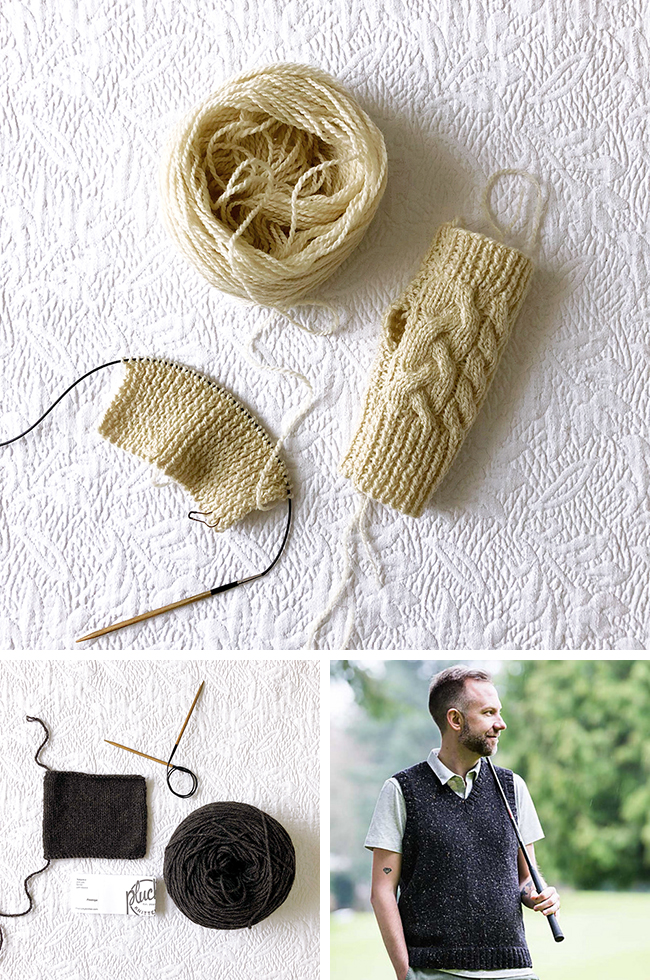
Raise your hand if you thought I would go another month without casting on a sweater. Anyone? Not me. I contented myself with that dickey for a little bit, and have been test-knitting my own mitts pattern — the Cascara Mitts they’re called — which Tolt is publishing on Saturday as part of their 5th-anniversary collection. (I’ll be at the store/party on Saturday and am actually teaching this pattern on Sunday but the class is sold out!) And I think Bob recognized an opportunity and rushed into the void, requesting a sweater vest for himself, and even picking out the yarn — the skein of Plucky Knitter’s Yakpaca that I bought at Stitches West earlier this year. He’s convinced that since it’s a vest, it won’t be overly warm for him; I’m dubious but I love the man so I’ll knit the vest and hope! I’ll be using Churchmouse’s simple little His Vest pattern, but probably raising the neck a tiny bit.

I do think I’m narrowing in on a final decision for my next sweater, but in the meantime I want to focus on Bob’s vest and on finishing up the unfinished:

My Hozkwoz hat is within an inch of done
My blue Bellows just needs a couple of seams and some buttons
My lilac pullover-to-cardigan-conversion is just one fun steek experiment away
– And I have a pair of Log Cabin Mitts awaiting their thumbs

It had been my plan to do these things for Slow Fashion October, but I have had myself stretched wayyyy too thin for that. Fortunately, they’ve all been waiting patiently for both me and the weather, which has more or less arrived, so I’m excited to tackle it all.

.

PREVIOUSLY in Queue Check: September 2018

The dickey I didn’t know I needed (2018 FO-22)

The dickey I didn't know I needed (2018 FO-22)

There was a night a couple of weeks ago where I was frantically looking for something to knit. My plum Anna Vest was blocking; I’d left my marlisle hat at work; I no longer have the thumb instructions memorized for the Log Cabin Mitts, and picking up my unfinished pair wasn’t going to take up that unexpected chunk of knitting time anyway. And so on. I could have cast on a sweater, but it would have been both underconsidered (I can’t make up my mind) and wool (since that’s what I have in my stash in sweater quantities), and I obviously didn’t want to do that. So I pulled up New Favorites and scrolled through looking for something I’d been wanting for a decent amount of time and that I also had yarn for in stash, and I landed on Grete, the crazy dickey I can’t get out of my head. PERFECT. Then I remembered it’s written for bulky yarn, which I don’t have meaningful amounts of in stash. ARGH. And then it slowly dawned on me: the exquisite single-batch, toffee-hued, Oregon-raised bulky I’ve been dying to knit with. I only had one skein on my shelf at home, but I had plenty in the webshop and had set aside a pile for myself at the studio. (Hilariously, I had made this connection last spring when the pattern published but had forgotten it in the meantime.) So I cast on.

The only thing I didn’t like about knitting this was how quickly it was over. I have friends who say the thought of coffee gets them out of bed in the morning. I had one morning where I woke up thinking “the sooner I get up and get through my workday and my workout, the sooner I can knit those cables.” Although, I did extend it by making some changes and revisions and re-knits along the way.

When I first blogged about this pattern, I mentioned that I wanted the neck to be snugger, and we talked about various other mods in the comments, including putting a back on it, which I did. But I was surprised to discover when I started knitting that the neck ribbing folds down over cables, as opposed to ribbing folding onto itself, and I couldn’t imagine wearing that, so I ripped it back. In total, here are the changes I made:

The dickey I didn't know I needed (2018 FO-22)

– Cast on 8 sts fewer (on US8 needle) for snugger neck
– Ribbed for 8″ (instead of 10″ of half ribbing/half cables)
– Worked an increase round at the end of my ribbing to get to the original stitch count
– Instead of binding off for the back neck, put those sts on waste yarn
– Worked the front panel exactly as written, on US10 needle for main fabric
– Returned the back sts to needles and worked a back just like the front, but only two repeats of the chart
– (I’m wishing I had added another repeat or two on the front so it hits me more like the one on the model, but that’s ok — I never did check my gauge so don’t know how it compares!)

In the interim, I tried two other ideas for the back (involving stockinette and short-rows and altered stitch counts to adjust for the gauge …), thinking it might not lie flat or sit right if I didn’t account for neck shaping somehow. But that was time wasted, because this totally worked. The back flap gives it a little visual ballast, plus I couldn’t stand the thought of cold air on the strip of skin between a shirt collar and the bottom of the dickey. And while I thought it was just a visual thing, it does actually help it stay seated better as well.

I also couldn’t be happier with my yarn choice for this, the OUR Yarn, and love it most because it’s a way I can feel like I’m wearing a luscious wool turtleneck sweater in a climate that doesn’t really allow for that. And did I mention it looks amazing with my matching Log Cabin Mitts?

The dickey I didn't know I needed (2018 FO-22)

So I’m eager to knit another one — wider somehow to account for my broadness, and with another variation for the back — and am thinking it should be black. I’m just debating between this same yarn for that (a deep, rich black which would be gorgeous) and trying it in the intended yarn, Luft, which is a wool-cotton blend and lighter, more heathery black.

Pattern: Grete by Woolfolk Yarn, with mods listed above
Yarn: OUR Yarn from Fringe Supply Co. in toffee (8.8oz, 2.25 skeins with my mods)
Pictured with: Fringe Field Bag in waxed camo

.

PREVIOUSLY in Finished Objects: Plum Anna Vest (pattern now available)

Anna Vest pattern, now available!

Anna Vest pattern, now available!

I’m so happy to report that my Anna Vest pattern — originally designed for Tolt’s book Farm to Needle: Stories of Wool back in 2015 — is finally available for standalone download through Ravelry. Originally inspired by a vintage men’s pattern from WWII, this cute little waistcoat pairs classic style with modern shaping in a versatile layering piece. As those who’ve already knitted it can attest, it is an excellent project for learning garment finishing techniques such as inset pockets and a sewn-on, 1×1 button band. But for this revised edition, I’ve added the options to omit the pocket(s) and/or work a simpler, quicker, picked-up garter-stitch button band instead. The original sewn-on band (on the grey sample) is quite polished, and has very tidy buttonholes as well, but it is a project and a challenge unto itself. It’s totally worth every minute, but life is also short oftentimes, and the picked-up version (on the plum sample) is perfectly lovely and way less daunting. So I approve of you doing it either way! And since many people have knitted this vest more than once (myself included), there’s always the option to do both and compare.

A few things to note:

– There was a cut-and-paste error in the layout of the book, with an errata note on the Ravelry pattern page. That error does not exist in the standalone PDF pattern, so the erratum only applies if you’re knitting from the 2015 Farm to Needle book version of the pattern. (Hopefully this 2018 PDF version is error-free!)

– We did an Anna Vest Knitalong a few years ago, so there’s all kinds of additional tips and info if you take a scroll back through that, including in-depth tutorials for how to knit the inset pockets and how to attach the sewn-on button band (if you choose that option).

– There are 6 sizes to choose from in the pattern, and I want to emphasize that this vest looks great on all body types. In fact, I mentioned when it first published that I had seen its predecessor (in 38″ circumference) on a whole slew of women at Stitches South and it looked amazing on every single one of them. When the pattern published, Tolt posted pics on their blog of the whole staff wearing the size 38 sample, and you can see what I mean!

– And thank you so much to my friends at Kelbourne Woolens for providing the yarn, Germantown, for the new plum-colored sample (which is officially called Rhododendron).

I hope you love the pattern, and I can’t wait to see what you make of it! For existing projects, see the #annavest and #annavestkal feeds on Instagram and the finished projects on Ravelry.

Anna Vest pattern, now available!

p.s. I was really excited to shoot the plum vest and waxed plum Field Bag together, and meant to release them on the same day. In the few days since the bag released, we’ve been totally wiped out of them. There are still some at or en route to a few of our stockists — most notably, there will be some in Harrisville Designs‘ booth at Rhinebeck this weekend — and we will have one more small batch at Fringe Supply Co. in early November, after which we have a fabric shortage problem until spring!

.

Waxed plum Field Bag + Anna Vest update

Waxed plum Field Bag + butterscotch Porter Bin + Anna Vest

This was me last month, wearing the original Anna Vest and knitting the new Anna Vest while “modeling” for today’s debut of the waxed plum Field Bag! Can you even take your eyes off how gorgeous this all is — and especially that plum Field and butterscotch Porter situation? This is officially my new favorite color combo.

I can finally tell you this story: I’d been having a hard time deciding on a color for the new vest, and then I discovered that my friends at Kelbourne Woolens’ newest yarn, Germantown, came in a color that’s a perfect match for the Field Bag that was in production at the time. That felt like fate to me, and I couldn’t wait to see them together. (I do love a matching Field Bag and WIP situation!) The waxed plum Field Bag is available today at Fringe Supply Co. and at our stockists around the globe. The pattern, however, needs a few more days. I did finish the vest and we shot it on Monday, but the pattern itself is not quite finished, so look for that next week!

I’m sorry I haven’t been able to pull together a Weekend Reads list for Slow Fashion October this week — too many plates spinning, for real — but I’ll hope to share stuff on @slowfashionoctober over the weekend, so keep an eye on that. And I’ll aim for a mega list for next weekend. I also shared a peek into my actual, physical closet on IG this week and am hoping to start the clean-out challenge this weekend (if I get the vest pattern done, lol) — I’d love to see yours, too! Or hear how it’s going if you’ve already started.

Happy weekend! Thank you for spending part of your week here—

.

Photos by Hannah Messinger for Fringe Supply Co.