Make Your Own Basics: The pullover

Make Your Own Basics: The pullover

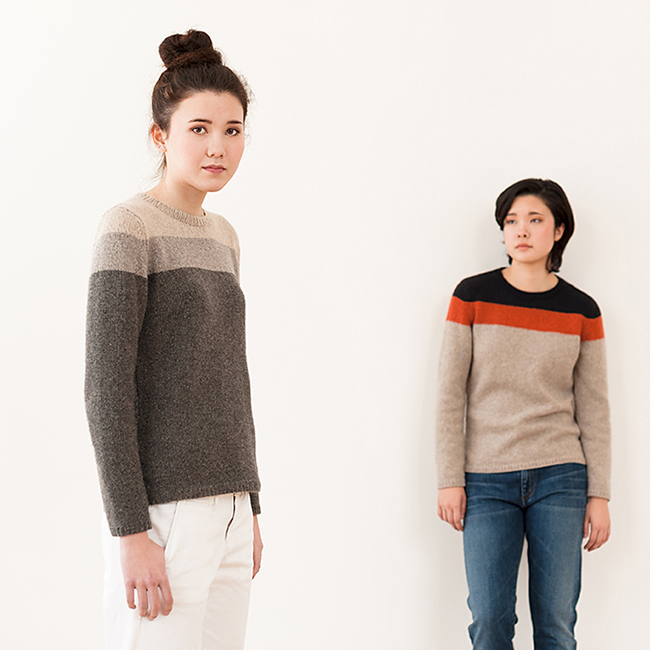
Ok, continuing on with my attempt to build a small directory of patterns for anyone wanting to make their own wardrobe basics, let’s talk about the ultimate staple, the piece no closet should be without: the crewneck pullover sweater. Honestly, the Ravelry database is full of patterns for basic crewnecks — in every gauge and construction method — but the challenge is finding the best of them. These are just a few of my personal favorites, with minor distinctions among them:

TOP: Echo Lake by Courtney Kelley is the ultra-classic sweater pattern, knit in pieces (bottom-up) and seamed together, with picked-up stitches for the neckband, which means it will also stand up to years of wear. So if you really want to go old-school on the approach as well as the sweater, this is the one. Echo Lake is written for DK yarn/gauge. There is also a Custom Fit pattern that allows you to do this same thing, a seamed basic pullover, but at whatever gauge you choose — called Tramontane.

MIDDLE LEFT: Tide Chart by Amy Miller is the simplest of the batch in terms of construction, being a top-down seamless raglan. It’s also DK weight, and like everything I’ve chosen here, it has classic proportions and good neck shaping. (So many don’t!) If it’s a top-down raglan you’re after, you could also skip the pattern and learn to improvise your own at any gauge, using my top-down tutorial.

MIDDLE RIGHT: Polwarth by Ysolda Teague is a more advanced and detailed top-down raglan. In sport weight, it has slightly shaped and minimalist raglan seams, brioche in place of the ribbing, that classic sweatshirt neck detail, and even optional bust darts. This one is just as simple and timeless as the others in its appearance, but also looks like it would be really fun to knit.

BOTTOM: Classic Hemmed Crewneck by Purl Soho has a really polished look about it, thanks to the turned (instead of ribbed) hem, cuffs and neckband. It’s worsted gauge and is knitted in the round (seamlessly) from the bottom up, so it’s a hybrid approach. Another of my favorites — also worsted, bottom-up, seamless — is Purl Soho’s Sweatshirt Sweater (free pattern), which doesn’t have the sweatshirt neck detail like Polwarth but does have a gym-class-style kangaroo pocket, which is optional.

You’ll also find lots more suggestions (not all quite so basic) and a discussion of the pros and cons of different construction methods in Pullovers for first-timers: Or, an introduction to sweater construction.

EDITED TO ADD [Feb ’17]:

Make Your Own Basics: The pullover

I’m not sure how I forgot about Julie Hoover’s Veneto when first assembling this post, but it’s a top-notch and highly adaptable option. It is sport-weight gauge, so a finer weight, and has timeless proportions, subtle waist shaping, and perfectly shaped set-in sleeves and neckline. Also knitted flat and seamed — so a true classic in pretty much every sense. You can not only easily omit the color-blocking and make it a single color, but also tinker with the length, the waist shaping, the amount of ribbing (or alternate treatment) at each edge, etc., to transform it in any number of ways.

.

PREVIOUSLY in Make Your Own Basics: The button-down shirt

Queue Check — April 2016

Queue Check — April 2016

In addition to the blue Loopy Mango pullover I knitted since my last Queue Check (which was nowhere on the radar), my black Anna Vest is also now finished, and I can’t wait to show it to you. But I also can’t wait to cast on what’s next! I’ve made some decisions about that whole vacation knitting conundrum and have basically decided to cast on ALL THE THINGS. I’ve been such a good little monogamist lately, mostly, but it does get me into trouble from time to time. So here’s what I’ve decided:

1) I’m officially going with the Clever Camel for my long-debated (to put it mildly) Channel Cardigan — my yarn arrived on Friday! Once I had knitted and blocked this swatch, I knew it was meant to be. I literally have been carrying the swatch around with me, I love it so much. What I’ve been trying to find for this one is a yarn that’s both snuggly and rugged, which is a very tricky (nearly impossible) combo. So in that sense, this wound up being an easy commitment to make. On the other hand, that rare mix of softness and durability comes with a hefty price tag. This will literally be the most expensive garment I’ve ever owned, so I did have to take a few deep breaths before placing the order. But it’s an investment I believe in. This swatch is so insanely beautiful and soft and light and amazing in every way — and the yarn (and its gorgeous halo) looks incredible with Channel’s stitch pattern. But the 100% baby camel fiber is even warmer and more durable than wool, and it doesn’t pill. So for a sweater I expect to spend months knitting and decades wearing, it’s completely worth it. And this yarn is such a joy to have running through my fingers, I know I’ll be blissed out for every minute of the knitting.

[[ SPECIAL NOTE: Jones & Vandermeer has very kindly offered a discount for any of you who might want to give Clever Camel a try. Use discount code FRINGE at checkout and it will deduct 10% off your order of Clever Camel. Good through May 13, 2016. ]]

I’m going to go ahead and cast on for this, but I intend to basically spend the whole summer knitting it. Since there’s no rush and this one won’t be the best thing for social situations, travel situations (other than at the beginning) or the occasional brain-fried-on-the-couch-at-night situations, there will also be stockinette in progress—

2) I’ve decided the black Linen Quill will become the lightweight, 4-season (a/c combat) cardigan I talk about needing at the start of every summer. I’m going to knit it top-down, ultra basic, with inset pockets and a vertical button band — all the traits I believe comprise the perfect timeless cardigan. I’m planning to cast on this one tonight at Knit Picking Night at Craft South. If you’re in Nashville, I hope you’ll come! 5-7, as usual.

3) I am definitely going to do the black Flex in the near term, but I’m leaving it up to fate whether it goes to Florida with me. I’ll be able to get the yarn for this one locally at Nutmeg, so I’m just waiting for news of its arrival.

By the way, I’ve seen it suggested a few different times and places that I’m hosting a Channel knitalong? I have no such plans! At least not in any formal sense. But if anyone else wants to cast on and knit it at the same time as me, the more the merrier!

.

PREVIOUSLY in Queue Check: March 2016

New Favorites: from Rugged Knits

New Favorites: from Rugged Knits

I had the pleasure of interviewing my friend Andrea Rangel awhile back for the Spring 2016 issue of Knitscene, and got to hear a little bit about the patterns she’d been developing for her upcoming first book, Rugged Knits. Last week, the pattern preview hit Ravelry and you can see the book is chock-full of cute and useful cardigans, pullovers, vests, hats and shawls. I’d like to knit all of the hats, frankly, but two of the sweaters in particular gave me the heart eyes:

TOP: Woolen Explorer is an Icelandic lopi-inspired oversized cardigan that borders on a coat. Knitted in Lettlopi (and you know how I feel about Lettlopi), it’s sure to be a weightless, warm and woolly dream of a thing to wear — and also fun to knit.

BOTTOM: Hazy Cloud is a simple saddle-shoulder V-neck, but I love the allover two-color colorwork with solid seams and edgings. I’d love this in black and ivory.

Rugged Knits will publish in July. Congratulations, Andrea!

.

PREVIOUSLY in New Favorites: Flying Squirrel to the rescue

Elsewhere

Yarny links for your clicking pleasure

Happy Friday, friends. I’ve got a fun and informative roundup for you today—

The evolution of Spincycle — great post about a great yarn business

See also the Hinterland backstory

The problem with baby camels (is there aren’t that many of them!)

Oh lord these sweaters

– And uh also, this sweater (talk about a new look at the pattern)

– I’m looking for a few minutes to watch these little movies about makers

Love this post about jealousy, something I wish I didn’t find such a struggle

J. Cathcart Wason, Shetland’s knitting M.P.

I might need this book

So awesome what Ace & Jig does

Best hat in the history of hats

– And can we talk about these curly locks?

Have a great weekend, everyone! Pop by Fringe Supply Co. if you’re feeling shopish. ;)

.

PREVIOUSLY: Elsewhere

Photos via Tolt and Paper-Tiger

How to seam on a button band

How to seam on a button band

I’ve preached a lot about the merits of the vertical button band over the years, even though I’ve only actually done it myself a couple of times. But when I was writing the Anna Vest pattern (and knitting its predecessor), I knew with absolute certainty it needed to have a vertical band. The opposite of this would be a picked-up button band, where you pick up stitches along the front edge(s) of your cardigan and then work those stitches in garter stitch or 2×2 ribbing or whatever the pattern might call for. That’s simpler and faster to do, but it also creates a less firm band and contributes to the problem of the band gaping when it’s buttoned. Vertical bands, by contrast, are knitted on small needles in 1×1 ribbing, which is very dense and thus creates a nice firm band. There are a couple of downsides. The first is you have to knit it, and if you think 50-ish inches of 1×1 ribbing doesn’t sound that bad — I mean, it’s only 11 stitches wide, in this case — let me point out to you that’s a full 50g skein of yarn. It’s a lot of knitting, I’m being honest here. Second is you have to seam it on, and again, that’s a long stretch of seam. But as I believe anyone who’s completed their Anna will tell you, it is 100% worth it.

STEP ONE is to get the sweater ready for its band. You need to have knitted the fronts and back, blocked all of the pieces to the pattern dimensions, and seamed them together, so you’ve got a finished neckline. (If you’re doing a crewneck cardigan with two separate, straight fronts, you could feasibly do those without having seamed the shoulders together. Arms or armhole edging can be done either before or after the band — they’re not relevant to this process.) You want to make sure to block the pieces first because you want the length of the pieces to have been finalized so you’re matching your band to the finished dimensions. Also, while blocking, pay extra attention to the neckline edge stitches — the flatter you can get them to lay, the easier this will be.

STEP TWO is to knit the band(s). In the case of a V-neck sweater like this, you’ve got one continuous band that runs up one side, around the back of the neck, and down the other side. A vertical band like this is a lot like a bias strip in sewing — it’s stretchy and can be manipulated to match the length of the fabric you’re attaching it to. So my recommendation is not to knit to a finished length, but rather to knit to within range of the end and keep those stitches live for the moment. You can finish it up once the rest of the band is seamed on so you can knit it to the precise length your knitting and seaming calls for.

How to seam on a button band

STEP THREE is to line them up, ready to seam. Because we’re leaving the exact length of the band TBD, it’s necessary to start with the lower right front edge of the band, so you can knit the button holes for that side of the garment, then carry on with plain 1×1 for as long as it takes to fit the edge. I’ve also written Anna so that the first stitch on each RS row is slipped with yarn in front, then knitted on the wrong side. This creates a really nice, attractive, smooth edge for the side of the band that remains visible (see top left photo above). The opposite edge of the band is in stockinette (as is the body edge it’s joined to), for the sake of easy seaming. So the band has a definite right and wrong side, and you want to make sure you’ve got it lined up that way.

How to seam on a button band

Note, too, how the buttonholes line up with the right front piece, above. I’ve left a removable marker in each front piece where the shaping began, and you can see the top buttonhole sits just below that spot.

How to seam on a button band

STEP FOUR is to start seaming! When you go to pick up that first bar in the bottom of the band, make sure you’re between the edge stitch and the adjacent knit stitch. You should be able to count five full knit stitches (five V’s) to the right of your tapestry needle, plus the slipped edge stitch. Try not to use black yarn your first time! And do this sober and in good light.

Now here’s the trick. This is plain old mattress stitch. (There are good tutorials at Kelbourne Woolens, Purl Soho and Knitting Help, if you need it.) However, typically with mattress stitch you’re joining two pieces of identical fabric, as you  are in Anna’s case at the side seams. Normally, you have an identical number of rows of knitting, and they’re of the same gauge, blocked to the same dimension — so it’s a direct 1-to-1 equation. With a button band, that’s not true. You’ve specifically knitted the band on smaller needles, which means tighter row gauge — more rows per inch than what you have on the body pieces you’re seaming to — so it’s no longer 1-to-1. What that means is you have to lay them flat next to each other, use your judgment, and work back and forth picking up whichever bar is directly across from the one you just picked up, which most likely will mean skipping one every few rows along the straight parts of the front, and easing them together as makes sense along the slopes. (The outer lane of a racetrack is longer than the inner one. So you’ll need to allow more band fabric along the front curves.)

Getting started is the hardest part, and you should expect it to take several tries before you find your rhythm with it. The beauty of mattress stitch — especially at the start of the seam — is that to pull it out, all you have to do is yank on one end. As long as you haven’t split the yarn anywhere along the way, it slides right out!

How to seam on a button band

If your ratio is off, and you are in effect joining too much band fabric to the corresponding body fabric, it’ll shove out of alignment like you see in the top photo above. Try again, picking up fewer rows and keeping them adjacent rather than sequential, and you’ll wind up with the bottom version.

It definitely requires some patience and persistence, so just be mentally prepared for that and not in a hurry. Once you get past those first few rows or inches, you’ll pick up speed and see your joinery improving. When you get to the back of the neck, where you’re joining the band horizontally to vertical stitches, you want to run your needle under both legs of each stitch (the whole V). And when you reach the lower left front, where you left off knitting your band, you’ll have a much better idea of how close you are to the right length. Knit a little bit, seam it on; knit a little more; until you’ve got exactly the length you need.

You may get so much better as you go that you decide to start again and really nail it. Because, after all, you’ve put this much effort into knitting this garment and this band. You’ll never regret taking the time to get it right!

p.s. There’s no schedule for the Anna Vest Knitalong, so join in anytime! Just use hashtag #annavestkal wherever you might post!

p.p.s. This yarn is Terra from The Fibre Company/Kelbourne Woolens

.

PREVIOUSLY in the Anna Vest Knitalong: A sampling of Annas

Vacation plan, part 2: Taking to make

Vacation plan, part 2: Taking to make

So we talked about the making to take part of the vacation equation. Now for the hardest part of packing for any vacation: choosing a knitting project (or three!), i.e., what to take to make. Our Florida road trips represent a lot of knitting time. There’s the 13 hours in the car each way — only half of which am I the driver — so even with naps and other distractions, there’s easily 8-10 hours of road knitting. There’s usually most of a day on the boat, during which I knit pretty much the whole time (my absolute favorite place to knit), but this time there might be a multi-day boat trip. Can you imagine all the uninterrupted deep-sea knitting? And then there are evenings and whatnot. So it’s easily the most knitting-rich scenario in my life, and I like to use it wisely. I’m of multiple minds for this one:

1. This would be a fantastic chance to make serious headway on my Channel Cardigan (take two) at long last, and it would be fun knitting for filling otherwise long dull road hours. I’ve swatched and am beyond sold on using the Clever Camel — omigod you guys. I truly can’t wait to spend hours upon hours with this yarn, but haven’t actually settled on a shade or ordered it yet. Intellectually, I believe in the investment I’ll be making for this sweater in this yarn, but it will be by far the most I have spent on a garment in my entire life. I have to work up the nerve to actually place the order!

2. The Linen Quill would be the perfect yarn to be working with in this scenario, and I am absolutely dying to cast on with the black. Only problem is I can’t decide whether it wants to be a cardigan or a wrap. Actually … that’s not true, I realize as I’m typing. All I have ever wanted in life is a sweater’s worth of the Habu yarn I designed my Wabi Mitts around, and basically here it is, refined and in skein form. So yes, it wants to be a sweater. And the yarn is already in my possession — at least, enough of it to make it through the trip — but what sweater do I want it to be?

3. Then there’s the grey marl half of the Linen Quill stash, which I have in my head would be truly gorgeous as a Slope tank. Truly. Gorgeous. But can I bear knitting fingering on 3s, even for the duration of a tank top? Cringe, yearn, grimace, yearn … cross this one off. Maybe a modified Beach Tank?

4. Ever since knitting my Togue Stripes tank, I’ve been longing and praying for Quince’s Kestrel to come in black, and huzzah, as of last week it does! So now I’m more keen than ever to knit Heidi Kirrmeier’s Flex tee. In addition to wanting the garment very much, it sounds like the construction would be a ton of fun AND I love the idea of a project that might well be completed in the space of the trip. (Plus I could finally participate in Shannon’s Tops, Tees and Tanks Knitalong!) However, is this yarn in my possession? Not at the moment. So again, if that’s the one, I need to act fast.

What to do?? What to do!!

Vacation plan, part 1: Making to take

Vacation plan, part 1: Making to take

There are only 8 days between me and my spring vacation and I can only think about two things: things I want to make to take; and things I want to take to make. You know what I mean! Today let’s focus on the first part: making to take. We’re road tripping to my sister’s house in Florida (our favorite home away from home!) and rumor has it that, weather permitting, we may be sneaking in a little weekend jaunt to the Bahamas on their boat. I bought this length of retro/hipster/ethnic tropical print fabric from Ikea a few weeks ago, and now all I want to do is make some sort of Mrs. Roper-worthy ankle-length caftan out of it for this and future Florida trips. The sort of thing you throw on upon arrival and don’t take off until you head home. You know, wear it barefoot on the boat, with Saltwaters on the dock, and trade up to nicer sandals for dinner in some beach hut restaurant. I’m slightly torn over whether to keep it ultra basic — wide and boatnecked — like this Craftsy tutorial, or to model it more on my beloved Harper Tunics from Elizabeth Suzann (which I scored at her sample sale), with some shoulder slope and an actual neckhole. Or maybe a nice deep V-neck? If you have a favorite caftan pattern, let me know!

Photos: Hat from J.Crew; Saltwater Sandals from Zappos