Q for You: How do you use Pinterest?

Q for You: How do you use Pinterest?

When Pinterest was young, I was deeply in love. Back around 2011-’12, when I also happened to be a brand-new knitter, it was an essential part of my daily routine. I’d log on late at night with a glass of wine, and/or first thing in the morning with my yogurt, scroll back to where I’d last left off, and wander my way upwards — looking for random inspiration and also (maybe moreso) for interesting people. In those days, your feed was made up very straightforwardly of the chronological pins of the people you had elected to follow, and it also displayed who they had repinned an image from, as well as any comments on the pin. So not only could you control what you were seeing by choosing who to follow, and could keep your place because it was chronological, but you could find and meet new people! I loved seeing who my chosen pinners were getting their best pins from, clicking through to find out more about those people, and interacting. Along with being lit up by all the beauty in my curated page, I discovered all sorts of interesting people with excellent taste, and met some of my favorite knitters and even one of my very best friends that way.

Then, as seems to be inevitable, things went south. From my perspective, anyway. A redesign a few years ago buried the community layer — no longer did the bottom of each pin in the scroll say who it was repinned from, comments were collapsed (and thus suppressed, activity-wise). If you want a pin to lead you to other good pinners, it now requires time and effort. The feed stopped being chronological and gradually became jammed full of sponsored or suggested pins, so it was no longer specific to the pinners you’d chosen to follow. Which meant it looked more like the old front page (the everyone page) and less like one’s own little curated world. And now they’re even collapsing the captions — it’s like they have a vendetta against words! Having worked in tech, I have no doubt they’re making data-driven decisions — they must have evidence that other people didn’t care about all that stuff that made me love it in the first place. I guess. But is that true? Or is Pinterest no longer the phenom it once was because so many other people valued it the same way I did, data notwithstanding?

The thing is, I still love Pinterest — or at least, I want to. I long for those days when I could call it up in my browser and know I was going to tumble down a gaping rabbit hole of gorgeousness, but I’ve been trying to find new ways to make use of what it is, since it’s no longer useful to me in the way it was. I think now I use it more the way it was originally conceived — simply as a place to store things I want to save and find again, or occasionally to search for something specific. I’m enjoying making my guest board for BT. I have some secret/shared boards for project planning. I’ve been repinning the whole site archive onto series-themed boards, and love being able to see whole series at a glance like that. (And hope you do, too!) And I still see a lot of blog traffic coming from Pinterest, so I know people are still using it.

But I am curious, and so that’s my Q for You today: How do you use Pinterest? What do you use it for and hope to get out of it. Do you look at it every night/morning or only when you have a specific need? What works for you, Pinterest-wise. Or do you use it at all?

I look forward to your responses, and also wish you a happy weekend!

(NOTE: The image above is a screengrab from my Yarny Goodness board. I have two Pinterest accounts — karentempler and fringeassoc)

.

PREVIOUSLY in Q for You:

Our Tools, Ourselves: Beth Thais

In Our Tools, Ourselves, we get to know fiber artisans of all walks, ages, styles and skill levels, by way of their tools. For more on the series, read the introduction.

Our Tools, Ourselves: Beth Thais

In recent months, Beth Thais — I mean, @beththais — has become one of my very favorite Instagrammers. You may recall she was also one of the WIP of the Week winners last summer. I don’t really know anything about her other than that she’s an incredible sewer and knitter, takes beautiful photos and lives in the Bay Area. Since encountering her online, I’ve wished I had made friends with her while I still lived there, and having asked her to answer my Our Tools, Ourselves questions — reading her answers and seeing these photos — has made me wish I had moved in with her. Forgive me if that sounds creepy, but I think you’re likely to feel the same way. ;)

In addition to her Instagram feed, you can find her on Ravelry as beththais. Thanks so much for doing this, Beth!

. . .

Do you knit, crochet, weave, spin, dye, sew … ?

I knit (14 years running), sew (five years) or quilt (two years) almost every day. I enjoy spinning and crochet on occasion. I dyed my first-ever skeins of yarn last month and I liked it.

Tell us about your tool preferences and peccadilloes.

I get attached to the potential tools bring, and their sentimentality. Like fabric on the bolt, it’s easy to pick up a tool and picture all things you could make with it — that sense of possibility is so heady and hard for me to resist.

I do most of my sewing on a modern Bernina and a Brother serger that I researched and bought deliberately. And my rotary cutter and mats and my first good pair of sewing scissors were the same. Most other things I use, including the 1950s Gimble sewing machine I learned on, are things I’ve stumbled across online or at garage sales, or I am lucky to get them as gifts from family or friends.

And I know it’s bizarre, but I just don’t care that much what kind of needles I knit with. Metal, wood, circulars, DPNs — I care about the yarn and the pattern, everything else is background.

Our Tools, Ourselves: Beth Thais

How do you store or organize your tools? Or do you?

I have a big cabinet for yarn and another for fabric. The fabric cabinet was pulled out of the dining room of a 1920s home in Burlingame, California, before demolition and came to me by way of Craigslist years later. My husband restored it and installed it in the spare bedroom I use as a workshop. He did such a beautiful job — it looks like it’s been a part of our house for a hundred years.

My yarn cabinet is a 1930s kitchen cabinet with stove burner etched glass that I bought from a woman downsizing her home in Oakland. She had used it for many years to hold painting and ceramic art supplies, so it’s on a second tour of duty storing tools for making. My rolled sewing patterns are in a ceramic umbrella stand I found at a garage sale. Boxed patterns are in two baskets in an order I can pretty much recite but has no real organization behind it.

I have a yellow standing sewing box that I treasure. It’s a bizarre little piece of midcentury furniture built entirely with making in mind: pin cushions on the inside of the lid, dozens of little pockets lining the inside for your tools and notions, a deep curved bottom for your sweater or hand sewing project in progress, and little wheels so you can drag it all around the house with you. It is incredibly useful, but also so specifically built to my purpose that I can’t help having an affinity. We share interests, it and I.

When my projects leave the house, I have little tool kits to go with them. Tasa Gleason came to a monthly Seam Allowance meeting at A Verb for Keeping Warm in Oakland with a Sew Together bag she had made. We all loved it and kept after her until she agreed to teach a class so we could each sew our own. I have a full-sized one for hand sewing and the mini size for knitting. They have built-in pin cushions and needle stops and a million pockets and I know by heart what goes in each one.

Our Tools, Ourselves: Beth Thais

How do you store or organize your works-in-progress?

With exceptions for gifts made on a deadline, I give myself freedom to work on what inspires me. I use a big bulletin board to plan projects obsessively when it suits, but also wait for that idea that bewitches me out of nowhere. Some of my most euphoric makes are completely unplanned and heady with that sense of giving into a wonderful whim.

My Snoqualmie cardigan sent me on a bus to buy yarn on my lunch break, and I cast on during my commute home despite not having the right size needles to do a tubular cast-on properly. So one sleeve starts with a long-tail cast-on and it looks a little different than all the other hems, and while I completely get that most people think that’s totally nuts, I don’t know … it’s never bothered me. I look at that cast-on that doesn’t match and remember how much I loved that sweater when I first saw it, and how thrilling it was to turn around and suddenly be making something so beautiful and complex with my own hands.

This approach begets many active projects. I have a drawer for sleeping or misbehaving WIPs, and an accordion wall rack that has the ones I’m rotating between more frequently. I’m a huge fan of the Stowe Bag for active projects — if I end up with more WIPs than bags, I can always make more. There is literally a Stowe on the project rack that has pieces of other Stowes-in-progress inside.

I’ll pick the project that speaks to me and head to my little rolling sewing box if I’m working around the house, or grab the right travel bag if I’m headed out the door. It’s a system that works surprisingly well, and I’m grateful for the freedom to have most days start with thought and a decision about what I’ll spend time with.

Our Tools, Ourselves: Beth Thais

Are there any particularly prized possessions amongst your tools?

I inherited a beautiful blue spinning wheel that has been in my husband’s family for generations. I spin on a modern wheel, but think about restoration.

I have a small gold thimble from my husband’s grandmother. There’s a scissor case that looks like a pizza slice that I made on a whim that I’m bizarrely attached to and take everywhere. My husband is a geologist and my pattern weights are all rocks he’s brought home over the years.

I have a standing mirror that was the mirror my mother-in-law shared with her sisters in their room growing up. The table that holds my sewing machine and serger is an old oak desk built for two people to use facing each other. The drawers open in either direction, which I adore, and it’s full of weird little corners and drawers that I fill with patterns and notes and books and tools.

Do you lend your tools?

About two years ago, a woman at an improvisational quilting class who was much better at improvisational quilting than I was gave me a 12 x 12 ruler because she had a spare and I didn’t have one yet. It felt like a validation of the skill I was trying to learn, and support of the work I had left to do. I will lend anything and give most things if you need them; I believe in our community and the support we can give each other.

Our Tools, Ourselves: Beth Thais

What is your favorite place to knit/sew/spin/dye/whatever?

I work away from home and I have young children who don’t nap anymore, so nights are my creative time. And I’ll get up much earlier on weekends that I ever do during the week, and have the sun come up while I’m cutting out pattern pieces if I’m feeling ambitious, or sit on the couch with sleepy pets and knit and think about the day. It’s a meditation, a beginning and end of the day I always recognize.
Our Tools, Ourselves: Beth Thais

What effect do the seasons have on you?

I’m consistent in my inconsistency; seasons tend not to change my approach.

Do you have a dark secret, guilty pleasure or odd quirk, where your fiber pursuits are concerned?

I knit everywhere, I sew everywhere, but I only feel like spinning if it’s 75 degrees and breezy and I can sit outside, listen to music and have a glass of wine. It happens maybe four times a year and it is transcendent.

I take a project with me everywhere; it’s like a comfort object. The one day I leave the house convinced that bringing a WIP is silly will be the day I get a seat on the train and that train will break down and spend 45 minutes stuck in a tunnel. If you happen to meet me in the supermarket, know there’s at minimum a sock-in-progress somewhere on my person.

What are you working on right now?

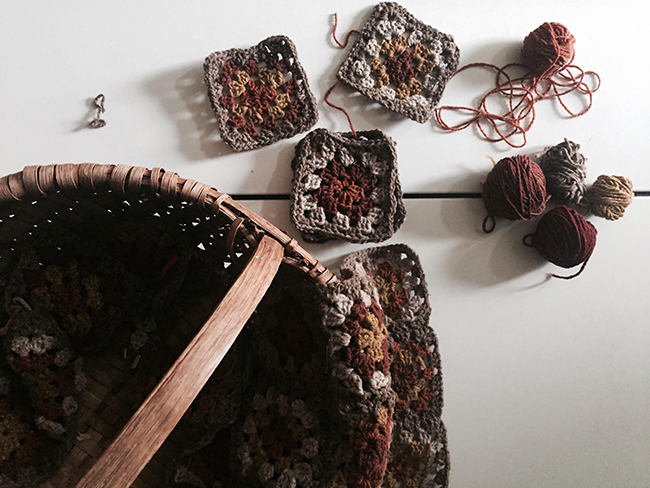
I have a crocheted afghan that lives in a basket on top of a cabinet. Knitting feels the best to me, but I’ll crochet a square every few weeks just for the feel of something different in my hands. There’s a Furrow Cowl by Jared Flood that’s been my project of choice for a few weeks and is nearing the finish line, knit off a treasured cone of Sally Fox’s naturally colored cotton.

My most ambitious undertaking is an English paper pieced quilt called Patchwork of the Crosses, designed by Lucy Boston. It’s my first hand-sewn quilt, my first English paper pieced project. Weaving, crochet and spinning are enjoyable, but I’ve never found them captivating the way I do knitting and sewing — and I think I assumed I had found the two types of making I’d love most. But I folded the two first little fabric scraps around paper templates and stitched the edges together and I knew immediately that I’d do this forever. It’s such a surprise and a gift, to find another thing to fall in love with.

Our Tools, Ourselves: Beth Thais

PREVIOUSLY in Our Tools, Ourselves: Karen Templer

Photos © Beth Thais

Hot Tip: Go long

Hot Tip: Go long

I ran across this tip on Pinterest a few years ago — a link to a 2009 blog post about “traveling loop” — and only just recently tried it. It’s a cure for what may be a less-common problem: trying to knit with a circular needle that’s longer than the circumference of your knitting. All you do to get the excess cord length out of your way is pull the right needle tip out, along with the slack in your cord, bend it into a loop, and start knitting. The loop will remain between those two stitches, and will travel around the round with them, just like a stitch marker would. (In fact, it could function as your Beginning of Round marker if that’s where you create the loop.) It will continue to travel on up your left needle tip at the end of the round, so once you’ve knitted the last stitch, you start over — pushing your stitches to the end of the left tip, pulling the right one out, making your loop. There are step-by-step pics in the blog post linked above, but it’s also the kind of thing that’s hard to grasp until you’ve done it.

So when and why would you do this? It will work on a cowl or a sweater body or any circular situation where your cord is too long but your tips aren’t. For small-circumference knitting, you’d still need to resort to Magic Loop or DPNs. (Long needle tips won’t allow you to knit a hat or mitts this way.) But I’ve discovered a bonus aspect of this, if you’re knitting a sweater body in the round, is that using one really long needle is a decent alternative to the two-needle method for try-on. With this method, when you’re ready to try on, just pull the two tips free and the whole sweater can rest on the longer cord. It makes for more fiddly knitting, but it’s a good trick to have in your arsenal.

(And why are the two tips in the pic different colors? See Mismatch your tips.)

UNRELATED: I’ve been having a lot of trouble getting this blog (and others) to load in Safari over the past week. Are you any of you experiencing that?

.

PREVIOUSLY in Hot Tips: Bury your ends

Top-Down Knitalong FO No. 4: Jen Beeman

Top-Down Knitalong FO No. 4: Jen Beeman

The day has come when all of the Top-Down Knitalong panelists have completed their sweaters! I’m kind of sad to see it wrapping up — this whole event was so awesome — but I’m also thrilled to finally see and show you this handsome pullover that Jen Beeman of Grainline Studio knitted for her husband, Jon.

. . .

Your sweater is such an interesting case. It looks like you knitted exactly the sweater you set out to knit, easy peasy, but in fact it was a circuitous journey. Most notably, you ripped out your first version (when you were just past the sleeve/body divide) and started over. Remind us all what happened there.

Originally Jon wanted a fisherman’s rib sweater, so I swatched in full fisherman’s rib, figured out my gauge, then got to work. I took the very early yoke out a few times to make small adjustments to the stitch counts but as I was only a few rounds in it wasn’t a big deal. Once I got that settled and the knitting began in earnest I had Jon try the sweater on every inch or two to make sure I was headed in the right direction. Everything seemed alright at first, but a few inches before the split I realized that the stitch pattern was obliterating my yardage and I also calculated that it was taking me approximately 45 minutes to knit one round of the sweater. I was knitting something like 350 sts in fisherman’s rib (did I mention that Jon has extremely broad shoulders yet? He does) and was starting to get a pretty bad feeling when he would try the sweater on for me. I decided to knit beyond the split about 1″ into the body before making any final decisions. When he finally tried it on, the sweater was extremely heavy, the knit pattern had way too much drape, and I was almost out of yarn. After a bit of texting with my knit crew, it was obvious I needed to start over in half fisherman’s rib.

After I switched rib patterns I actually did take the pattern back from after the split one more time. Since Jon has quite broad shoulders compared to the rest of his body he often has the problem where he has to go up at least a size to accommodate them, leaving him swimming in the rest of the garment. I was having that problem here and decided to adjust the increases a bit towards the bottom of the raglans which did the trick nicely.

I definitely think the switch in stitch was a great call.

Apart from the stitch pattern, this is a really straightforward top-down raglan, right? Did you ultimately stick pretty close to the basic top-down method — did you do any basting stitches, flat sleeves, any other diversions from the norm?

Other than the stitch pattern, I think it’s pretty straightforward! I did knit the sleeves flat, then seam because Jon is VERY hard on his clothes. I also left a basting stitch in each raglan to help keep the shape. That’s another weird story. When I tried to close the basting stitches I realized the mattress stitch was pulling apart the stitches next to it leaving a not so beautiful raglan seam in it’s wake. This is probably not the right thing to do, but I ended up joining the two stitches using a sort of duplicate stitch, which I think ended up doing the same thing. Sometimes I kind of just wing it when I’m knitting so I hope you by-the-book knitters aren’t cringing too hard right now!

Top-Down Knitalong FO No. 4: Jen Beeman

Whatever works, I say! It pains me that your first top-down wasn’t just a total breeze. Between the starting over and the slowness of the stitch, the scale of the men’s sweater, the overall time it took … I worry it left you thinking top-down is onerous! Do you? Are you eager to try it again? I feel like I want you to cast on something your size and 3.5 sts/in, and have a quick fun win!

Umm … so I don’t think I’m the biggest fan of top down? I totally understand why it’s so popular, I’ve just never really been a knit-in-the-round person. I do think a lot of that is because [as a sewing pattern designer] I’ve been trained to think of 3D forms in 2D, so knitting in pieces just makes more sense to me. That said, I might try it again but I’m going to knit some sweaters flat to cleanse my palate first ;)

There was also one other delay, alluded to above, which is that you ran out of yarn. The stitch pattern just ate way more yarn than you’d estimated, right?

Yes, that was a downer for a bit. I originally calculated by taking my gauge, yarn weight and Jon’s measurements, and comparing them to a brioche sweater that matched these numbers, then ordering an extra skein on top of that yardage. Apparently either my math was bad or brioche and fisherman’s rib don’t quite translate because I ran out of yarn about ¼ of the way into the second sleeve.

The yarn for your sweater (and one of the WIP of the Week prizes) was generously provided by Jocelyn of O-Wool — thank you, Jocelyn! I’m on record as being a huge fan of Balance, this yarn, having knitted three sweaters and a vest out of it. There is one thing people need to know about it — and lots of yarns that are a blend of different fibers, organic cotton and wool in this case — which is that the fibers take the dyes differently, which is what gives the yarn its lovely heathered quality. But that also means dye lots really matter, as does alternating skeins as you knit. And O-Wool does a great job of emphasizing that on their site. But I think the importance of dye lots (and buying more than you think you might need) is a really important lesson for knitters to learn, and there’s also a great tale here about the knitting community, so I wanted to bring this up.

By the time you realized you needed more, the dye lot was sold out. So how did your yarn shortage get resolved?

Unfortunately, I realized too late that I was going to run out of yarn — although honestly, I knew it was going to happen; I just think I was in denial about it after everything else that happened with this sweater. I emailed Jocelyn as soon as I, let’s say, came to terms with the fact that I was short on yarn and sadly my lot had sold out. Since O-Wool is direct-to-customer only there wasn’t a lot that could be done. So I did what any knitter in this situation would do, harassed people on Ravelry till a kind soul with 5 skeins took pity on me. I traded her 5 skeins of the new dye lot for her 5 of the old dye lot and I was back in business! Thank you again, Summer!!

I love knitters. I’ve been contacted a few times by someone who had a yarn emergency and knew I had yarn in my stash that might help, and I’m always happy to help if I can. So I also want to say thank-you to the kind knitter traded with you! 

So after all of that, the sweater is done! (With plenty of winter left in Chicago.) How do you feel about the finished sweater, and more important, how does Jon feel about it?

After everything was said and done, I’m happy with the sweater. The blend of wool and cotton is perfect for guys who are always overheating in wool, and the sweater fits Jon pretty well. I’m really glad I stuck it out and got it done because, as you can probably tell from the photos, Jon hasn’t taken the sweater off since it dried. One nice thing about knitting, or really making anything, for Jon is that he’s one of the most appreciative people I’ve ever met. He guards everything I’ve made him like it’s worth its weight in gold, so despite the long journey to the end of this sweater, I’m so glad I stuck with it!

Thanks so much to Jocelyn for providing me the yarn for this sweater, and thanks to you, Karen, for signing me up for this, even though at times you might have thought I wanted out. You ladies gave me the ability to give Jon this sweater that he absolutely loves!

. . .

Thanks so much for playing along, Jen! So that’s a wrap. If you missed any of it or want to revisit it, you can scroll through the complete knitalong posts or scan the directory of them all here. Don’t forget to follow Jen, Brandi and Jess on Instagram for more of what they’re up to. And thanks again to everyone who participated for making this such a phenomenal event, with so many amazing sweaters having come out of it. I’m in awe.

.

PREVIOUSLY in Top-Down Knitalong: FO No. 3: Karen Templer

Elsewhere

Yarny links for your clicking pleasure

Well, this has been quite a fortnight, hasn’t it? By which I mean, of course, the time when craftivism made it onto the covers of both Time and The New Yorker (and I haven’t managed to get hold of either). Crazy days, my friends … here’s Elsewhere for you—

Brief history of the brassiere

– How many of us have the same relationship to knitting that Einstein had to music? (Not that any of us is Einstein)

“Hygge” trending toward “lagom”

– Food for thought: What would an import tax do to fast fashion? (thx, Angela)

This note from Martha McQuade about “cost per wear”

How much yarn is too much?

Beyond brilliant

Most heartbreaking needlepoint I’ve ever seen

Most blood-pressure-reducing photograph I’ve ever seen

– And an excellent response to the spurious suggestions that the pussyhats weren’t the handmade, grassroots phenomenon we know them to be: “Mr. Cohen, these hats are crocheted.” (Whatever your feelings about pussyhats — and mine are decidedly mixed — I will fervently honor and defend my fellow knitters’ rights to make and wear them and get the credit they deserve!)

AND SHOP NEWS: There are some spectacularly fantastic new Bookhou pouches at Fringe Supply Co. today, along with reloaded shelves of Bento Bags, both volumes (now Olga and Michele) of Brooklyn Tweed’s Capsule series, and lots more! Go have a look

And have a wonderful weekend, everyone. Thanks for being here—

.

PREVIOUSLY: Elsewhere

Green is the new Thistle

Green is the new Thistle

I’ve apparently not been enthused about Pantone’s Color of the Year since 2014’s pick, “Radiant Orchid” (and my yarn choice, Brooklyn Tweed’s Thistle). And I was puzzled when I heard this year’s Color is Greenery, thinking didn’t we just have Emerald? But apparently that was 2013. 2015 was “Marsala,” and 2016 was a baby pink-and-blue combo I did not love. But if you saw this Instagram post last Spring or that green camisole top I made in August, you’ll guess I’m on board with Greenery. (Even if the flat Pantone swatch brings to mind that color all the packaged food companies use to convey that theirs are the “healthy” cookies.)

So what about yarn? There are millions of green yarns in the world, from neon to murky, and from chartreuse and mint to alpine and olive. But “Greenery,” this grassy, cheery, newly-sprouted-leaf green is not the easiest color to come by in a yarn. The two best options I can find are Quince and Co.’s colorway called Snap Pea, pictured up top on their Chickadee but available on all of their wool yarns, and Green Mountain Spinnery’s Cotton Comfort pictured in the color Leaf. Sincere Sheep also has a semi-solid colorway called Virid that’s available on several bases, and a new color called Katydid launching later this month that might be even closer. And for a tweedy alternative, there’s Arranmore (my current amour) in the color Shamrock. Other suggestions?

.

PREVIOUSLY: Yarns in waiting, late 2016

New Favorites: Purl’s most brilliant blanket

New Favorites: Purl Soho's most brilliant blanket

Here I am adding to my list of blankets I’d love to nap under but don’t have the patience to knit! But being a sucker for clever construction, I can’t let this one go unremarked: Purl Soho’s new Learn-to-Love-Steeks Blanket (free pattern). I know, you’re thinking “Did she just say ‘clever construction’ in a post about a blanket?” I did. With refined facings and edgings, it’s a simple single-stripe stockinette blanket, but it’s worked in the round — in a big tube, in other words — and then cut open. The implications and levels of brilliance of that combination are explained far better by Laura in her intro to the pattern than I can paraphrase, so you should really just go read the whole thing.

.

PREVIOUSLY in New Favorites: Unexpected cables