Logalong FO 1 : My fingerless mitts

Logalong FO 1 : My fingerless mitts

This goofy Fringe and Friends Knitalong tradition of my interviewing myself about my finished project — in keeping with my interviews of the rest of the panel — feels even goofier this time around, since I’m going first! And yet, here goes:

. . .

At kickoff for the Log Cabin Make-along, you noted that you’d chosen a small project for yourself, fingerless mitts, to keep your first-ever Log Cabin project manageable. Now that they’re done, how do you feel about that decision?

I’m very pleased with myself for making that call, and have been having a blast with this little mitts project. What got me hooked on this idea was the construction challenge — exploring the various ways I could imagine of joining a square into a fingerless glove with a gusset, with the hope of finding a solution that was creative and polished and in keeping with the methodologies of log cabin knitting, all at the same time. And which would also be describable for others. (What I might have done were it just me could be different from what I ultimately did, which could be put into pattern form.) So I got to learn and enjoy the basics of log cabin knitting, while also solving this really fun construction puzzle.

I wanted a proper thumb gusset, not just a tube with a slot for the thumb (like these and these). And I wanted the right and left mitts — the log cabin patterning of them — to be mirror images of each other, which requires that they be worked differently. So in the end, it’s two book-matched squares followed by the fun of joining them into the round and sculpting the thumb gusset, which is done in a way that I’ve never seen before (although who knows) and am really proud of.

So you’re loving the process, but how do you feel about the finished object of them?

I am beyond in love with them. In fact, as I told Ann and Kay this weekend, they’re so pleasing to me on so many levels that it feels like they might be the only truly clever thing I’ve ever done in my life. Except I can’t really take much credit — unplanned bits of brilliance simply revealed themselves when I molded the first one into a tube. The top and bottom strips form extremely tidy cuffs, and the long vertical patch down the palm allows some stretch, like ribbing, so it hugs the hand really nicely. I do take credit for the sculpting of the gusset! The geometry of it all really lights me up, and the log cabin essence of them makes them unique and intriguing among all the hundreds of mitt patterns I’ve ever seen and loved. They are SO fun to make. Plus they lend themselves to so much creativity and variation as far as mapping out color and placement! They’ve given me that old “knitting is MAGIC” jolt. Not a bad way to start off a new year.

You were a little torn over yarn, wanting to emulate a textile you love on the one hand and wanting to knit from stash on the other hand. (Not literally, ha! Although that’s a thought …) How did it shake out?

I needed to knit more than one version so I had them to experiment with as far as the joinery and thumb construction. After finishing up the original one from stash yarns — which was the crudest of the rough construction attempts — I decided I really needed to see how it would work with marls, for less contrast. I already had natural Shelter in my stash, so I bought a skein each of the black and grey Shelter marls, and used those for the next iteration. Then being more torn than ever, I put a pic on Instagram and the marl version was overwhelmingly the crowd pleaser. Given that I’m planning to publish the pattern, I also thought it would be good to have the sample be in a specific, available yarn, so I went with the Shelter trio.

There will be lots more of these knitted from my random stash, for sure. I want monochrome ones, sequence textures, flashes of color … all the variations. These are an absolutely fantastic project for odds and ends.

Logalong FO 1 : My fingerless mitts

There are sort of two philosophies or camps in the #fringeandfriendslogalong community — those who are hell-bent on keeping stitches live (binding off and picking up as little as possible) and those who savor the bind-offs. Which do you fall into?

While I totally get the impetus and would love to try something free-form and live-stitch at some point (I’m sure it’s faster), I am definitely Team Bind-off-pick-up. I really like the little shadow line you get in the work, the way it emphasizes the geometry of it all. It adds an architectural character that I really really love. But what I never imagined was how you get that sense of satisfaction that comes with binding off any project — over and over and over. I think that’s a big part of what makes log cabin knitting feel so satisfying to me. The tidiness and that “done” feeling, with each completed patch. It feeds my OCD.

Plus picking up stitches is such an important skill in knitting, so the more practice the better, right?

You originally had a bigger, more complex idea in mind and said you might tackle it after the mitts. Is that next?

First I want to knit another dozen pairs of these, lol. And I’m so into all of the boxy sweaters happening on the hashtag, and tempted to do something along those lines. So I don’t know if the cardigan/cocoon/kimono idea will come to fruition or not. Only time will tell! But no matter what, there’s a lot more log cabin in my future. I’m truly grateful to Ann and Kay for recruiting me into the cult.

And about the mitts pattern: When?

As soon as I can finish getting it written, edited and laid out! I’ll be moving on it as fast as possible, because I’m so eager to see what others will do with it. If anyone wants to test knit in the nearer term, let me know!

Pattern: Coming soon [UPDATE: Here’s the free Log Cabin Mitts pattern!]
Yarn: Shelter by Brooklyn Tweed in Fossil, Newsprint and Narwhal
Pictured with: Vanilla cardigan

. . .

To see how everyone else is faring, check out the #fringeandfriendslogalong feed.

.

PREVIOUSLY in Log Cabin Make-along: Insights and inspiration from the feed

SaveSave

SaveSave

Insights and inspiration from the Log Cabin Make-along

Insights and inspiration from the Log Cabin Make-along

I’ve finished my log cabin mitts, and am trying to figure out how I would/could maintain this blog if all I ever knit henceforth are more and more and more of them. Which is to say I am extremely pleased with how they’ve turned out (already started another pair, now that I’ve made this little discovery) and totally addicted to log cabin knitting. I hope to have photos to share next week, with the pattern soon to follow. Meanwhile, the #fringeandfriendslogalong feed continues to be a hotbed of creativity and inspiration and observation — already approaching 700 posts!

In addition to designer Julia Farwell-Clay’s incredible Richard Diebenkorn-inspired shawl-in-progress pictured above, influences cited have ranged from Paul Klee and Josef Albers to weaver Margo Selby (thanks, Cal!), a photo of Kirsten Dunst in Rodarte, indigenous textiles of Togo/Ghana, and yes, even a pay phone. Once you get log cabin in your head, inspiration is everywhere! The scale of projects underway ranges from a beer koozy to a circle skirt to sweaters and blankets galore. There are people exploring keeping stitches live and others savoring the recurring sense of satisfaction that comes with each bit of bind-off; some free-forming their blocks while others map out every detail; and still others starting projects without any idea what they might become (gosh, what a lot of pretty knits). And then there’s the log cabin meets Hello Kitty meets pussyhat hat.

Basically, you never know from one minute to the next what marvelous knitted block or insightful thought you might encounter! If you’re still on the fence, I would urge you to pick up some needles and a bit of yarn fluff from your stash, and knit a square. Then pick up sts along the side and knit another square. Then a rectangle alongside those. See what happens to your brain and where the exercise takes you! And like I said, I’ll be along soon with that mitts pattern, and then we’ll see if you can stand to not cast on.

If you have no idea what I’m talking about, see the Log Cabin Make-along intro, Meet the panel and timeline posts. And whatever you’re up to this weekend (marching? knitting? cleaning house?), I hope it’s a good one! See you back here on Monday—

.

PREVIOUSLY in Log Cabin Make-along: How to avoid, minimize and weave in ends

SaveSave

SaveSave

SaveSave

Deep Winter wardrobe: Outfits!

Deep Winter wardrobe: Outfits!

In my ongoing effort to better document how my carefully chosen and lovingly made garments are adding up to a wardrobe, I’ve been trying to take more outfit-of-the-day selfies, so I’m including a half-dozen recent ones here … even though a couple were taken before we really reached Deep Winter status. (I know — my ankles are showing!) In that last photo, I’m wearing all ready-to-wear clothes — a rarity for me these days. The boiled wool sweatshirt is from J.Crew several years ago, when I still bought the occasional unknown-origins item; the vest is the sleeveless Clyde Jacket I mentioned Tuesday having gotten at Elizabeth Suzann’s most recent sample sale; and the jeans are my two-year-old J.Crew made-in-LA ones. The denim vest in the fourth photo is also J.Crew, from years ago. In the first photo, the tunic is handmade but not by me. The rest of these clothes are all knitted or sewn by me. In three out of the six photos, I made everything I’m wearing. That is still astonishing to me every time it happens, even though it’s taken me several years of progressive wardrobe building to be able to say that.

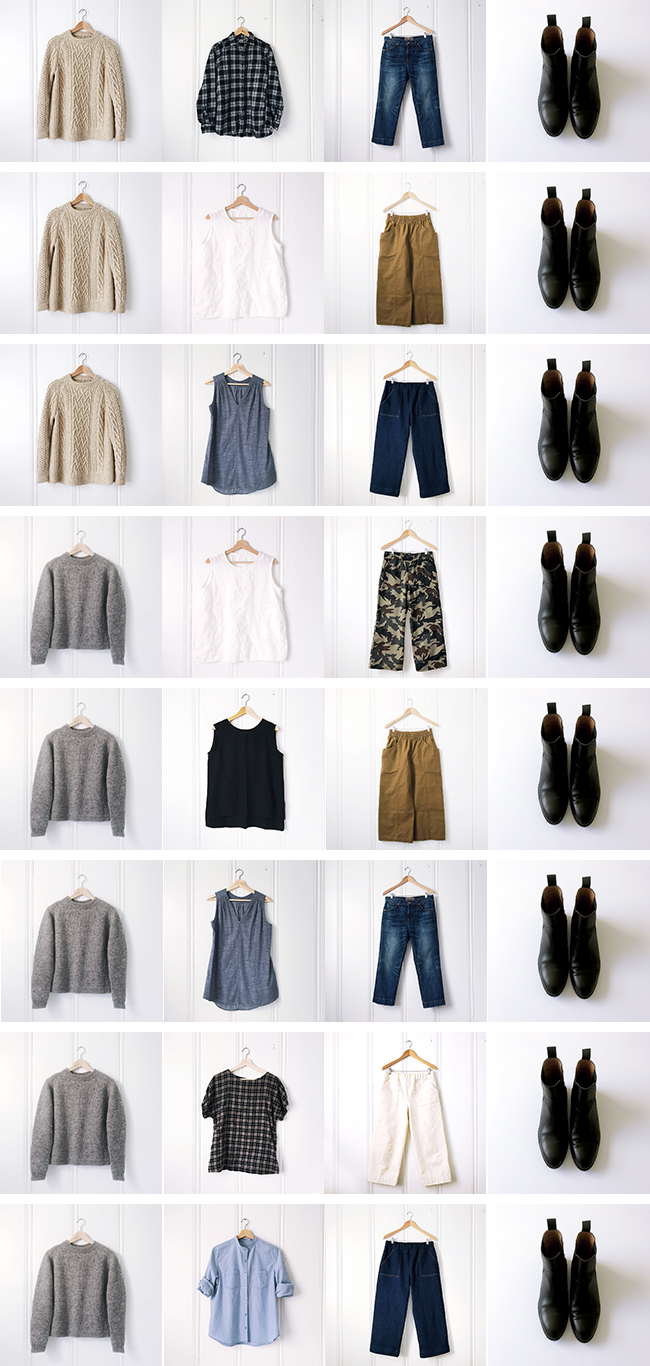
As far as how I’m putting things together this winter, I’m in uniform mode: pick a pullover or cardigan, a top to go under it, and a pair of wide-legs or jeans. Always with the same pair of black boots. (There are some of the November pre-winter outfits that still apply, if you just swap out the flats for boots.) So, for my first hand of Closet Rummy this round, I assembled some combos for these two pullovers:

Deep Winter wardrobe: Outfits!

Then, just to see what happened, I kept the exact same set of tops/pants and just dropped two different pullovers down the line on top of them. Totally works:

Deep Winter wardrobe: Outfits!

Here are the two remaining storebought pullovers in the lineup. The big grey turtleneck is a no-brainer: Just add pants.

Deep Winter wardrobe: Outfits!

With these cardigan outfits, you can allllmost take any combo and just swap out the cardigan for any of the other cardigans and it still works. So these 10 outfits are really closer to 40:

Deep Winter wardrobe: Outfits!

And now I know what I’m wearing for the next 60+ days! Thanks for always indulging me in this little parlor game.

For details on all of the garments pictured here, see my Winter closet inventory.

.

PREVIOUSLY in Wardrobe Planning: Deep Winter closet inventory

SaveSave

SaveSave

SaveSave

SaveSave

SaveSave

New Favorites: Two-way hats

New Favorites: Two-way hats

I remember as a kid in the midwest, heading out into the snow to play, wearing a beanie that was lined — i.e., a double layer — so you could wear it either side out and fold up the brim so the inside was showing. I hated that hat. It was itchy and shifty, due to the layers, but warm, due to the layers. I hadn’t thought about that hat until seeing the hat pattern above, which I fell instantly in love with, and shortly thereafter came the one below. And now I’m obsessed with them both.

ABOVE: Reversible Rib Hat by Natsumi Kuge is contrasting colors that meet in the middle for a two-tone, ribbed, fold-up band that’s the same either direction

BELOW: Femte by Sari Nordlund is contrasting textures! I couldn’t love it more than I do. Absolutely stunning.

New Favorites: Two-way hats

PREVIOUSLY in New Favorites: Under wraps

SaveSave

SaveSave

SaveSave

SaveSave

SaveSave

Deep Winter wardrobe: Closet inventory

Deep Winter wardrobe: Closet inventory

Somehow, winter set in without my having had a chance to properly “plan” for it. And whereas normally in January I’m well into a spring-forward frame of mind, we’re having a hard-core winter this year and I have to expect it to hang around awhile. So there’s no mood board, or make list, or any of my usual strategizing to be had. There’s just looking at what garments I have to work with (below) and figuring out how to put them together (coming up) for optimal warmth and comfort.

I actually have a whopping five (technically six) new seasonally-appropriate things in my closet since the last of the Wardrobe Planning posts

– I started and finished my grey Cline pullover and my ivory cardigan
– I finished my natural wool pants
– At Elizabeth Suzann’s December sample sale, I scored a pair of clay canvas Wide Clydes, as I like to call them (they are decidedly not Culottes!), and a navy canvas Clyde Jacket that for some reason was abandoned before receiving sleeves. ($38!!) I adore it.
– And oh yeah, number six was that grey wool sleeveless tee that I haven’t managed to wear yet. Itchy.

And there are two things outstanding: the blue Bellows currently on my needles, which I hope to complete by month’s end, and the purple lopi pullover-to-cardigan conversion, which I’m more motivated to actually act on!

So apart from those two standing in the wings, here’s the full cast of Winter characters—

STARS OF THE ENSEMBLE

Deep Winter wardrobe: Closet inventory

ROW 1fisherman sweater, grey pullover, boiled wool pullover (J.Crew 2014), striped raglan pulloveryoke sweater

ROW 2) vanilla Improv cardigancamel cardiganpurple cardiganblack Improv cardiganblack Sloper turtleneck

ROW 3white linen shellstriped muscle tee, chambray tunic (made for me, unblogged), grey wool tee (questionable, see above), black gauze shell (and tee equiv)

ROW 4) chambray button-up, plaid tee (me-made, unblogged), silk smock (Elizabeth Suzann, 2017), denim vest (J.Crew, ancient), navy canvas vest  (Elizabeth Suzann sample, 2017)]]

ROW 5) natural wide-legs, canvas wide-legs (Elizabeth Suzann sample, 2017), camo wide-legs, dark cropped jeans (J.Crew Point Sur, made in US, 2016), denim wide-legs

SUPPORTING CHARACTERS AND CAMEOS

Deep Winter wardrobe: Closet inventory

My Cowichan-ish vest and Anna vest, my State Smocks, my lone ratty old turtleneck sweater (H&M men’s, 2012), and a ragtag bunch of t-shirts, flannels and other jeans.

I’m in good shape! Outfits coming up …

.

PREVIOUSLY in Wardrobe Planning: November sweater weather

SaveSave

SaveSave

SaveSave

SaveSave

SaveSave

SaveSave

SaveSave

SaveSave

Logalong: How to avoid, minimize and weave in ends

How to avoid, minimize and weave in ends

We all know one of the deterrents to any multi-strand or patchwork project — such as Log Cabin! — is how many ends it can leave you to weave in. Even the most sanguine among us — the ones who will extol the virtues of end-weaving as closure and bonding and meditation — can sour on the process when faced with too many of them. Ends are a fact of life, but not only are there lots of methods for weaving in ends, there are at least as many ways to minimize them! Which is what I’ve polled our illustrious Log Cabin Make-along panelists about for today. (There’s also lots of general community advice under How do you weave in your ends? and a good overview of basic methods in this Purl Soho tutorial.)

I have it comparatively easy. First: My fingerless mitts project consists of two 7-inch blocks — plus some appendages and fanciness — each made of 9 strips, so even if you changed colors on every single strip, the absolute project maximum would be 36 ends. (As compared to a blanket?) Second: Mitts have a wrong side. Nobody will ever see the inside of them, so it isn’t as critical for them to be artfully done. That said, all I’m doing is sliding my tapestry needle one direction under a stack of bumps, then back the other direction, as seen above. Done.

Were I more concerned about it (or more accurately, if I could remember to do it!), I would knit them in as I join each new color, which is done in the same way as trapping floats in colorwork. For this, I hold my working yarn in my right hand and the yarn to be trapped in my left hand. Every-other-stitch, for maybe 10 stitches or so, insert your working needle into the stitch to be worked and under the strand to be trapped, wrap the working yarn around the needle as usual and pull up the stitch. You’ve caught the loose strand in the backside of the stitch, and it won’t show on the front of the work. (Very Pink demonstrates an alternative version here.) Once you’ve trapped it a handful of times, snip off the rest of the end. For many people, this is sufficiently neat and tidy to be done even on a blanket or such where the back of it will inevitably be seen. If you want it to be more like invisible, or not to exist in the first place, here’s the rest of the panel with further thoughts and ideas! And of course, if you haven’t checked out the #fringeandfriendslogalong feed, I highly encourage you to do so!

. . .

Logalong: How to avoid, minimize and weave in ends - Russian Join

VERONIKA JOBE of YOTH Yarns (Instagram: @yarnonthehouse)

One of my tackles with my Log Cabin project has been the many ends I’m producing. Now, don’t get me wrong! I actually find a peace and rhythm in duplicate stitching my tails in place at the end of a project, but when we’re talking 18 ends per 9-block square, that makes even me cringe. I have high hopes in publishing this beauty as a pattern and kit at the end, so cutting down on work that the common knitter dreads is key.

I started by posting on Instagram to see what my community had for suggestions — went through various comments and links, eventually landing on the good old-fashioned Russian Join. I am by no means an expert at the Russian Join, but I do have some experience under my belt with this technique. If you are up for wanting to try it out for the first time, I highly recommend watching one of the many YouTube videos out there and seeing the actual process. [Editor’s note: My first introduction to Russian Join was this Susan B. Anderson video.] Here are just my little tips and tricks that I found useful!

1. I like to knit to the end of my row where I want my transition to happen, mark it using a thin removable marker inside the plies of my yarn, and then unpick 6-8 stitches back so I have enough room to work with.

2. My preference is to overlap my yarn ends about 3″. Most tutorials recommend 2″, but I like to lean on the side of caution.

3. Not all yarns like to be invaded and create a nice opening down the center, so I just weave my end in and out of the plies in a various manner. Nothing too precise. The key is to get that end to lock in. Weave or slide in further than you think. If you end up having a little tail sticking out, don’t worry. You’ve left yourself a whole 1″ cushion and you can just snip it off!

4. You can easily tighten or loosen your gauge a bit to make sure that the transition lands right where you want it to once you start knitting.

. . .

Logalong: How to avoid, minimize and weave in ends

KAY GARDINER of Mason-Dixon Knitting (Instagram: @kaygardiner)

I have a tough-love attitude about weaving in ends: I just do it.

With log cabin, which typically is worked in garter stitch, it’s not an unpleasant task, as it’s easy to hide the ends by weaving them back and forth through the “bumps” of the garter ridges. (The two photos of the WS of my piece show a mess of ends and then how neatly they disappear when woven in.)

I try to minimize the number of ends, for the sake of the integrity of the piece. It’s a game: When I eliminate an end, I win. One firm rule: I never cut the yarn after I’ve bound off a strip if the next strip is in the same color, as is the case with certain color schemes.

Logalong: How to avoid, minimize and weave in endsIn the case of my log cabin pullover, I’m knitting all the strips in a single color. If I were working the basic spiral log cabin block, around and around, I’d never have to cut the yarn until the main body piece was finished. Unless there was a knot or break in the skein (aka an Act of God), I’d have only 2 ends!

But my strip layout is done courthouse-steps style, with 3 sides that form a U shape. The pattern requires you to work the two side strips (which are identical) before working the bottom strip of the U. If you go back and forth knitting Side A and then Side B and then the bottom strip (C), you may end up with more ends than necessary.

After working the initial Side A, I cut the yarn. I start with new yarn to knit Side B. I do not cut the yarn after Side B; I then work Side C, the bottom strip that completes the U, then (without cutting the yarn), I work Side A of the next layer of the U.

Then I have to cut the yarn, go across the piece to the other side, and start Side B. But I knit 3 strips with only 2 ends—victory is mine!

. . .

CAL PATCH of Cal Patch (Instagram: @hodgepodgefarm)

I’ll be the gloater here because crochet has the clear advantage of being able to hide ALL THE ENDS as I go! I should really write  a post about it — I have several tips — but this one shows the main part of it.

. . .

ANN SHAYNE of Mason-Dixon Knitting (Instagram: @annshayne)

Blanketophobes whinge on about all the ends that a log cabin blanket generates. I say phooey.

When you change colors, just wet splice the yarns. If you’re working with non-superwash pure wool (like the Donegal Tweed I’m using), or alpaca, you can eliminate virtually all ends by wet splicing (or spit splicing, which just sounds gross but there it is).

In this blanket, I stop seven stitches from the end of a square and break my yarn, leaving a tail about five inches long. Then I splice the new color to this tail and knit to the end of the row. Voila: the new color emerges at just about the right moment. With no ends to fool with later. 

. . .

Thanks, panelists! And I want to hear from the rest of you: What’s your strategy? Weigh in below!

.

PREVIOUSLY in Log Cabin Make-along: How to crochet log cabin and Elsewhere

SaveSave

SaveSave

SaveSave

SaveSave

SaveSave

Elsewhere

Elsewhere: Yarny links for your clicking pleasure

I’m not pulling specific examples from the #fringeandfriendslogalong this week but I am saying you need to go check out the feed. There’s so much creativity and ingenuity happening, I don’t know how I’ll ever be able to narrow down highlights! (Much less prizes.) However, I do want to point you to two blog posts by Rachel Beckman (her photos above) about how log cabin is changing her perception of what knitting is, here and here. And from the panelists, don’t miss Kay’s fantastic blog post on how she’s constructing her sweater and Ann’s jaw-dropping discovery. (Unrelated, Kay is also making me LOL with this whole ouija board/swatch metaphor.) I’m making progress on my log cabin mitts idea and hope to have the pattern written up fairly soon! And on Monday we’ll talk about how to weave in ends — or rather, how to avoid having (many of) them in the first place!

Meanwhile, Elsewhere:

– “Making litters our lives with intention and agency. It reminds us through its process that we can alter our environment to suit ourselves. That we have choice and agency in our lives.”

– Martha’s making me sorry I skipped this exhibit (I could have run into her there!); and have you seen there’s knitting in the new issue of MS Living?

Amen to this

– I’m feeling all the love for this stranded Garter/Banff hat mashup and Amber’s Constellations kimono and Heather’s Snoqualmie Cardigan

Winter style muse

This blanket

Amazing story but let’s talk about that sweater (?) she’s holding with the giant ball-fringed (?) monogram!!

And if you’ve been waiting for that natural-indigo woven-in-CA denim, its time has come

It’s a snow-and-ice kind of day here in Nashville and I’m hunkered down and log cabin-ing for the next few days. I hope you have a relaxing weekend!

EDITED TO ADD: I just heard registration is officially open for Squam in June and there are just a few spots left in my classes. If you’ve never been to Squam (and been wanting to learn how to knit cables), I highly recommend this retreat!

.

PREVIOUSLY: Merry Elsewhere

SaveSave

SaveSave