2017 FOs 14-16 : Pants and more pants

2017 FOs 14-16 : Pants and more pants

The most momentous thing for me this year, as a person trying to make most of her own clothes, was deciding to make pants as a part of my Summer of Basics. I think it’s at least as life-changing as having decided to make sweaters a few years ago. (Note that I’m saying “deciding” and not “learning” — making pants is sewing, and making sweaters is knitting. They are just different applications of those skills from what I had previously done, and it’s genuinely more about simply deciding to do it than anything else.) Up until a few months ago, the one giant piece of the wardrobe puzzle that I felt I couldn’t exert control over was pants. And that’s a big one for me since, A) I wear pants about 98% of the time, not being much of a skirts/dresses girl, B) I have fit issues with pants (most women’s pants don’t fit me) and C) I am incredibly picky about the shape of my pants. So to have such a key and complicated aspect of my wardrobe be at the mercy of others has been a lifelong challenge. And to have cracked that nut is enormous.

Certainly sewing jeans was a big effing deal, but these “toddler pants” (as I really need to stop calling them) have had a way more dramatic impact on my closet. And they’re so simple to make! Hence why I’ve now made 4 pairs of them. My lifelong preference is for wide-leg — I watched a lot of Katherine Hepburn movies when I was in high school — and that’s obviously a thing that comes and goes from stores. So I’ve always had to stock up when I find a pair I like. Which might also explain why I immediately cut out 3 more after making the first pair.

These are all essentially the same as my olive-green modified Robbie pants. To recap: I use the leg pieces from that pattern, with a few fit tweaks (noted below and previously), but with my own pockets and a 2″ waistband. Barring any dumb mistakes, I can cut and sew a pair in about 3 hours, so I’m tempted to cut up a lot more of my stash into these exact same pants. The exaggerated shape and utility pockets are both really current and really always-me, and the elastic waist suits my life. Not only do I do a lot of bending, lifting and hauling things, squatting or sitting crossed-legged on the studio floor shooting photos, etc., but comfort is just really critical to me. If I’m not comfortable in my clothes, I’m distracted by that, and with my daily to-do load I can’t afford to be distracted. So for all of those reasons and more, these pants have been a godsend.

2017 FOs 14-16 : Pants and more pants

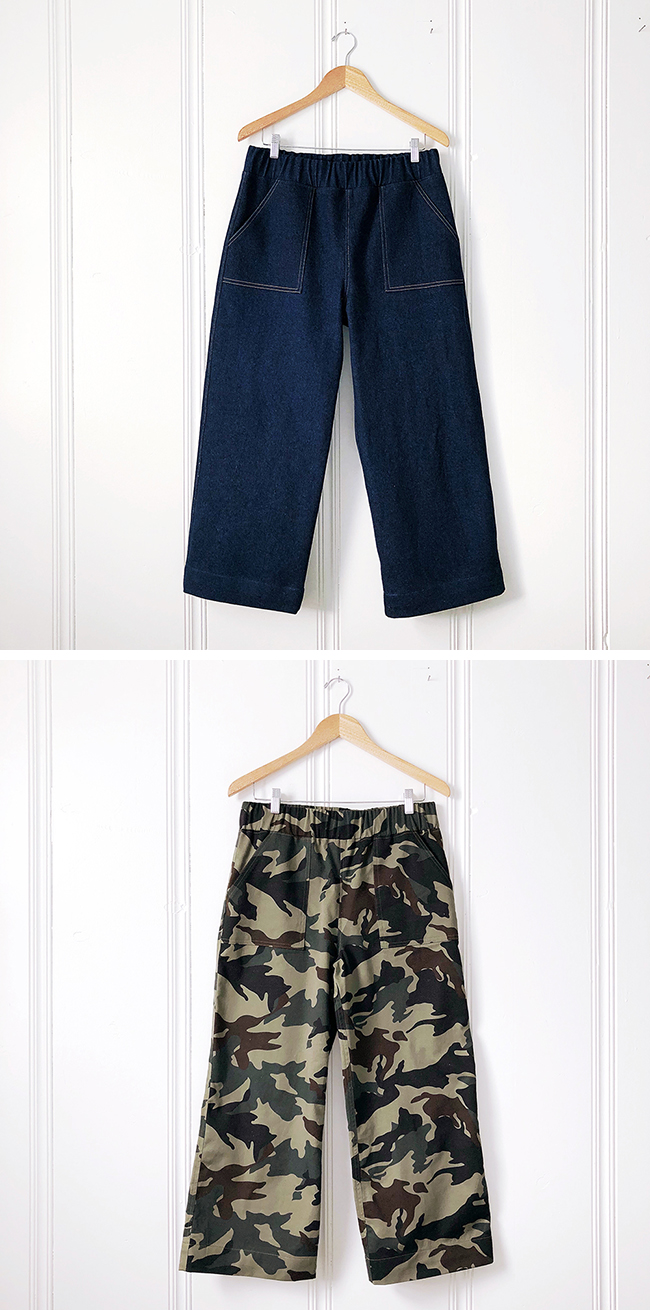
FO 14: DENIM
These came right after the olive ones and are identical. After marking a change to the pattern to lower the waistline in the back, I forgot to actually do that when I cut them out. Whoops! I also bought stretch denim by accident (at Fancy Tiger while I was there) but just went with it. These are currently my favorite pants, but they are rather heavy in this heavy-weight stretch denim. Next pair will be lighter and non-stretch.

FO 15: NATURAL
When Kristine Vejar was in town to teach in September, she brought me the most thoughtful gift: a length of Huston Textile’s Union Cloth — climate-beneficial California wool and West Texas cotton, woven in California — that happened to be exactly enough for a pair of pants. It’s incredible fabric, unlike anything I’ve ever owned. And as you may have seen, I was sewing with it on the day of the Climate Beneficial Fashion Gala to console myself for not being able to be there — cruising along, feeling pretty pleased with myself … when I absentmindedly attached my waistband to the wrong side of the pants. And serged the seam allowance. If you’ve ever worked with fabric off a smaller loom like this — where there are fewer, larger strands per inch — you know how shreddy it is. And of course I had used a nice tight stitch. So ripping out the construction seam was a painstaking operation, done a little at a time, and then I had to actually cut off the serged edge to separate the waistband from the pants. So these wound up with a 1.5″ waistband instead of 2″, and they’re slightly lower waisted. But they’re kind of perfect, for all that. As special as they are, I’m going to try not to treat them as precious.  Although you probably won’t find me cross-legged on the studio floor in them …

FO 16: CAMO
These were the third to be cut, and their whole reason for existence is so I can wear my beloved old camo pants much more sparingly for however much longer they manage to last. These don’t begin to hold a candle to those spectacular old dears, but they’re pretty great. For this pair, I did lower the back waistline about an inch and I also trimmed away some of the “excess” fabric in the butt and legs (due to my flat ass). So the fit of them is a little more traditional, but I really prefer the baggier ones. This fabric is the dead opposite of the natural pair as far as origins — it’s made in China, purchased from JoAnn online. It’s also on the thin side for pants, despite the product reviews on the website. If anyone knows of a more earth-friendly, heavier duty camo source, please let me know!

To see copious pics of the denim and camo pairs on me, in combination with my other garments, see my 20×30 outfit recap. The natural ones up top are pictured with my Channel cardigan.

.

PREVIOUSLY in FOs: The purple lopi pullover

SaveSave

SaveSave

SaveSave

SaveSave

SaveSave

SaveSave

SaveSave

SaveSave

SaveSave

Q for You: What’s your picky fit detail?

Q for You: What's your picky fit detail?

I’m pretty sure we all have a pet peeve or two, garment-wise — the little fit detail that can make the difference between most-worn and never-worn. Last weekend, I was posting on Instagram all the gory details of how I’m nailing down the exact length of the sleeves on this vanilla cardigan. Sleeves and neck shaping are the two potential deal-breakers for me. I can’t stand a garment that shifts around on me during the day, requiring me to tug at the neckline all the time, and same goes for sleeves. I want them out of my way, which means they’re either pushed up or rolled up most of the time. If a cuff is too wide to stay put when they’re pushed up — creating that perpetual push-and-slide scenario — I might actually lose my mind. And if they puddle on my hands when they’re pulled down, I definitely will. As I said the other day, I find this matter of sleeve length just that much more important on an oversized sweater like this. I want this cardigan to be nice and slouchy; I don’t want to look (or feel) like I’m swimming in it.

For me, that difference can be like a half an inch, and even though I have a blocked swatch and correct gauge and good math and preferred dimensions and all of that, no two sweaters sit or hang on the body precisely the same way. So since this one is top-down, what I’ve done is knitted one sleeve to just before the bind-off point and blocked it. Once I put it on, it was easy to see that it’s 6 or 7 rows too long — it already covers the top of my hand even without the bind-off row, whereas I want it to hit right at my wrist bone. So I’m ripping back the sleeve to 7 rows before the cuff, redoing the ribbing, and then it should be perfect. And I won’t have to worry about being institutionalized over a sleeve! It’s an easy enough thing to nail, and worth taking a minute to get it right.

So that’s my Q for You today: What’s the make-or-break fit detail for you — whether it’s a hat, socks, sweaters, whatever — and what do you do (or do you?) to get it just so?

.

PREVIOUSLY in Q for You: What do you do with your unworn FOs?

SaveSave

The cost (and payoff) of handmade

The cost (and payoff) of handmade

Once again, in light of Slow Fashion October, I’ve been tracking costs on my handmade clothes this year because I wanted to see how it held up over last year’s tally. And again, it’s a weird thing to talk about publicly (at least if you’re a born-and-raised Midwesterner like me), but I think it’s really illuminating in terms of the impact of acquiring less and making what you can, even when some of the handmades are an investment—

SEWN
$18.00 : White linen shell
6.00 : Grey wool pullover
20.00 : Striped muscle tee
54.25 : Blue button-up shirt
12.00 : Olive pants
73.00 : Blue jeans
17.50 : Denim pants
21.25 : Camo pants
——
$222.00 — average cost of $27.75 per garment

KNITTED
$175.00 : Black yoke sweater
213.50 : Camel Channel cardigan
110.00 : Linen Sloper
112.00 : Fisherman sweater
38.50 : Purple lopi pullover
——
$649.00 — average cost of $129.80 per sweater

So even with the top-shelf denim (for my jeans) and a couple of comparatively pricey sweaters in there, I’ve spent a combined average of $87.10 per month on my handmade clothes. If those were the only clothes I had added to my closet this year, and I had spent less than $100 per month, I’d be utterly floored and perfectly satisfied.

However, that’s not all I’ve spent or acquired. Since $87/month represents a savings for me, I’ve been able to invest in some coveted pieces from companies I feel good about supporting, such as my natural Willie jeans, my Elizabeth Suzann silk top, and my State smocks.

Far and away the most astonishing thing to me is I’ve added only about 2-2.5 garments per month to my closet. In my past life, 2 garments would have been a slow day at the mall, not a month’s total, yet in no way do I feel deprived or like I’m making do. Just the opposite: My wardrobe has never been better looking or higher functioning. So my heartfelt thanks to everyone who has inspired and encouraged me in this endeavor.

.

PREVIOUSLY in Slow Fashion October: Slow Fashion Citizen Jen Hewett

SaveSave

SaveSave

SaveSave

SaveSave

Slow Fashion Citizen: Jen Hewett

EDITOR’S NOTE: After three years of collaborating with Jen for Fringe Supply Co. (and taking her online class), I’m thrilled to have her on the blog today!
—Karen

Slow Fashion Citizen: Jen Hewett

BY KATRINA RODABAUGH // It’s an honor to share the work of talented printmaker, fiber artist and surface designer Jen Hewett in this week’s interview. I adore Jen’s use of color and shape in her bold and wildly inspired prints but I was also smitten with her Print, Pattern, Sew project where she printed her own fabric to make into garments. This allowed her to fuse her abilities as a surface designer and a sewer — rendering her garments unique and also imprinting her aesthetic not just in the silhouettes or combination of color and fibers, but in the bold and beautiful graphics of the garments, too.

I’ve known Jen for several years through the San Francisco Bay Area arts community, and while I loved her work from the very beginning, I always appreciated her candor, commitment and critical eye, too. Also, several years ago she brought champagne to my birthday brunch with a silver spoon because it’s known to keep the bubbly from going flat, and I fell for her then and there. Who knew silver spoons keep champagne from going flat? Jen did.

It’s that grace, humor and thoughtful nature that she brings to her work and her community. Watching Jen continue to push herself in her prints and in her technical skill is something that makes my heart race — she’s always inventing new projects, experimenting with new color palettes, and pushing outside of her comfort zone to make work that is simultaneously refined and absolutely alive. Welcome, Jen!

. . .

Your printmaking work is sublime. I adore your graphic prints, choice of fabrics, and the particular way you combine shapes and color to create bold and beautiful prints. Can you talk about what inspired you to start printmaking?

I’ve always been creative, and had started a stationery company in my twenties. I ran that until 2004 when, carrying a lot of credit card debt from the business, I sold the stationery company and started working a corporate job. My job was very uncreative (although I worked with a lot of designers and writers), but it allowed me to pay off my debt, and it gave me the time to figure out what to do next.

I needed a creative outlet, so I took a screenprinting class on a whim in – I think – January 2007. I was quickly hooked, and spent a lot of my free time in the screenprinting studio. I was laid off from my corporate job in December 2008, at the peak of the Great Recession. No one was hiring. I went to the studio as often as I could, and began selling my prints. My art career grew from there.

Slow Fashion Citizen: Jen Hewett

I remember when you launched your Print, Pattern, Sew project and it was thrilling to see your printmaking work applied to your wardrobe. This was a beautiful moment in slow fashion when your craft was transferred to your wardrobe and resulted in unique and meaningful garments. What led you to start Print, Pattern, Sew?

In 2014 I had a weekly project called 52 Weeks of Printmaking. Every week I’d create a different print, and would share it on my blog and social media. Halfway through the year I decided I wanted to do something more complex in 2015.

I took Jess Swift’s class, Pattern Camp, which is an online class about creating digital repeat patterns. It wasn’t much of a leap to figure out how to do this manually. At that point, I had been sewing my own clothes for a couple of years, and thought it would be fun to merge my love of sewing (and clothing) with my love of printmaking.

Every month in 2015, I hand printed yardage, then sewed that fabric into a different garment using either a self-drafted pattern or one from an independent pattern designer. At the end of the year, I had twelve truly custom garments, as well as a book proposal based on the project.

So many folks are intimidated to begin making their own clothing. Fear of imperfection, clothes that won’t fit, poor craftsmanship or somehow getting it wrong. Of course, we all have to start somewhere but were there any specific classes, patterns or tutorials you adored when you first started making your own garments?

As a working artist, I’m used to starting things that are just beyond my abilities and then figuring out solutions along the way. I approach sewing in this manner, too. Of course, I started with simple garments – April Rhodes’ Staple Dress was the first garment I sewed, quickly followed by Sonya Philip’s Dress No.1 and Dress No.2. None of those garments were perfect. Nothing I sew now is perfect.

Really, the best advice I can give anyone is “practice.” You can spend a lot of money on a good machine and nice fabric, but none of those things will make up for lack of skill. The only way to build your skills is to work on increasingly more complex garments, learning from (and fixing) your mistakes along the way.

Printing your own clothing is really a beautiful act in reclaiming fashion and making the garment truly your own. Designers talk about emotional attachment or why we keep certain garments forever even if they might be more sentimental than practical — the wedding dress is the typical example. Your printed clothing has the added emotional attachment of being designed and printed by you. Do you feel a certain attachment to these garments that you haven’t experienced in a store bought garment? Would you think twice before sending one to the Goodwill?

I don’t really treat any of my clothes as precious. I believe that clothes are meant to be worn, and not to be stored away in a closet for a special occasion (except for true special-occasion clothing). Wearing a garment regularly means honoring the time and money that went into its creation. And I tend to wear my clothes until they fall apart, so that by the time I’m ready to discard an item, I feel that I’ve gotten full use from it.

I probably won’t ever discard garments made with my hand-printed fabric, though. I do have an archive of my printed fabric, and will likely just add the garments to that archive.

Slow Fashion Citizen: Jen Hewett

It seems we’re craving connection and that’s one driving force in Slow Fashion. We’re exhausted by mass production and want something special or something valuable that can’t be so easily replicated in fast fashion. We often equate value with money but it’s also that triad of money, time and craftsmanship. Do you think making your garments for Print, Pattern, Sew altered your concept of the value of your garments?

I have always valued quality over quantity when it comes to clothing. I grew up wearing a uniform to school. I had five white blouses, two skirts, a sweater and a blazer. I got two pairs of school shoes each year, and they were meant to last the year. These were unexciting but durable clothes, and I had to take good care of them. But because I didn’t have to have a different outfit every day, my parents allowed me to splurge a bit on non-school clothes, buying a few pieces of well-made clothing that would hold up under repeated wearing. I didn’t have a lot of “free dress” clothes, but what I did have was of a good quality.

Sewing has changed how I shop for clothes, though, breaking my occasional impulse shopping habit. I rarely go to the mall or shop in boutiques anymore, unless I have a very specific purchase in mind. But the real excitement for me in making clothing is less a desire to opt out of fast fashion (partly because I never really bought into it in the first place, except for a couple of years in college) and more in the ability to create something that fits me and my style.

Any tips you might have for someone just starting to sew their own garments? Maybe tools you particularly love or something else that you learned through your project that inspired you to continue?

Always make a muslin when you’re trying a new pattern. It may seem like extra work to do so, but it saves so much work down the line. From my muslins, I’ve figured out that I’ve cut the wrong size, or that I need to make bust or dart adjustments. It’s much better to discover this before you’ve cut into your good fabric and have started sewing.

Also, buy good fabric. Your garment is only as good as the time and materials you put into it. Why spend all that time making something with shoddy fabric?

And finally, invest in a serger and an invisible zipper foot. I spent so much time making French seams before I had a serger. That was time I could have spent on something else! And I used to avoid anything that required an invisible zipper because I found them so intimidating. Once I had an invisible zipper foot, a whole new world of sewing opened up to me.

Lastly, your first book is underway. Congratulations! When can we expect it to be published? And could you tell us maybe just one thing about the book that you’re particularly excited about?

My book, Print, Pattern, Sew, will be published by Roost Books in May 2018. I’ve just reviewed the final, pre-press layouts. I think it’s such a beautiful book. I worked with the best team, and I’m excited for us to finally have it in our hands. I’ve been teaching some of the practices that are included in the book both in person and through my online classes, and I’m also thrilled that I’ll be able to reach so many more people through this book!

Slow Fashion Citizen: Jen Hewett

Katrina Rodabaugh is an author, artist and slow-fashion advocate. Visit her website www.katrinarodabaugh.com or follow her on Instagram at @katrinarodabaugh

.

PREVIOUSLY in Slow Fashion Citizen: Kristine Vejar

Photos © Jen Hewett, used with permission

Q for You: What do you do with your unworn FOs?

First off, a little apology: I know I told you the next Fringe and Friends Knitalong announcement was coming this week. Unfortunately, there’s a been a little snafu and change of plans. So I’ll let you know when I’m re-ready to announce!

Q for You: What do you do with your unworn FOs?

One thing we talk about all the time, and that has come up a lot in the #slowfashionoctober discussion, is that we’ve all made things that, for whatever reason, didn’t work out and go unworn. It’s a hard thing to face: all that time and yarn, just sitting the closet. Coming to accept that this happens — learning how to learn from it — is a big part of becoming a maker, I think. As is coming up with a strategy for dealing with it. I have so much admiration for those of you who frog things and reclaim the yarn and give it new life. For me, if it’s a perfectly successful garment that just doesn’t fit or suit me, I’d rather it went to a new home where it will be appreciated. (I have frogged things that hadn’t reached completion, for sure.) The only thing I’ve ever made that I couldn’t imagine giving to anyone else was my very first sweater, so I took it to a thrift store where I hoped some knitter would find it and feel wonderfully righteous and scornful about it! (I sort of hoped it might turn up on IG someday or something.)

There have been several things I’ve given to family and close friends. The one garment I couldn’t accept defeat on, or let go of, for such a long time was my Amanda cardigan up there. No matter what I tried, it just didn’t sit right on me and wasn’t getting worn, but it has so much history! And I’m so proud of the knitting, which is why I didn’t want to frog it. When it finally occurred to me I could use it to raise money to help people, that’s what it took for me to finally let it go — and to feel great about it. And I’ve put some other handknits up for adoption as well.

In every instance above, I love how excited the new owners are to have these garments — the very opposite of knitting something for someone and having them yawn. That said, I would love to someday find out what it feels like to frog a whole sweater. I imagine it’s the same kind of fun as sitting down in the stylist’s chair and saying “Cut it all off!” (One of my favorite experiences.) But it’s all got me wondering about different attitudes and approaches to the problem, so that’s my Q for You today: What do you do with your unworn FOs? And what about your muslins? Which is a whole ’nother ball of wax …

ASSORTED DELIGHTFUL TIDBITS:

– The Slow Fashion October topic for this next week is: HOW. Let’s talk about your how-to skills and where they stand (from how to knit/sew, to thrifting strategies, to caring for your wardrobe, etc); how you acquired and improve on those skills; how you make time for making your wardrobe (however you go about it) …

– Tomorrow is I Love Yarn Day, so how might you pass those skills along?

– Ash Gremel has announced she’s hosting a clothes swap and has created a shared map so others can add theirs! Will you host one?

– And we’re here for you at Fringe Supply Co. with freshly restocked Bento Bag shelves (all colors and sizes) and so much more!

Have an amazing weekend, and thank you for reading—

.

PREVIOUSLY in Q for You: Want to have a worldwide clothing swap?

SaveSave

Slow Fashion Citizen: Kristine Vejar

Slow Fashion Citizen: Kristine Vejar

BY KATRINA RODABAUGH // A Verb for Keeping Warm is one of the loveliest fabric and yarn shops I’ve ever visited and yet it’s so much more than a supply store for San Francisco Bay Area fiber enthusiasts. This space also hosts community events, book launches, classes, fiber clubs, an outdoor dye studio, a full range of materials for knitting, sewing, weaving, and regular appearances by the knitting world’s luminaries. Yet it’s also just a friendly place to buy fabric. To browse craft books. To trail your fingers gently across naturally dyed yarns and find some respite from the bustling pace of urban life.

Kristine Vejar (@avfkw) is the owner of “Verb” and she’s also an avid researcher, dyer, maker, author and teacher. Her passion for creating connections in the natural dye world, inspiration for a homemade wardrobe, and dedication to supporting the handmade community all spill over into the aesthetics, energy and attitude of her beautiful shop. When you enter Verb it’s like you’ve entered Kristine’s auxiliary living room. It’s difficult to summarize Kristine’s contributions to the Slow Fashion community because they are so wide, wonderful and heartfelt. She’s a savvy businesswoman, an artist and author, and she’s just so good at making folks feel welcome in her space.

Her book The Modern Natural Dyer is iconic in the natural dye world. It’s exquisitely designed, highly informative, and chock-full of gorgeously styled photos. Yet I get the sense that all of this is just the beginning of Kristine’s offerings.

. . .

A Verb for Keeping Warm is so much more than a shop. Was it always your intention to create a community gathering space when you opened?

Yes! Absolutely! The times in my life when I have felt most connected to others, and most understood, was through the act of stitching and making textiles.

I grew up within my grandmother’s knitting and sewing circles in rural Illinois. My grandma’s best friend, Doris, owned a yarn and gift shop named The Black Sheep. It was in a little house on the town square, across from the amphitheater where the local orchestra played Sunday evenings in the summer. Women were always gathered knitting and stitching. I adored going there as a child and still, in my memory, it is the epitome of a knitting store.

Years later, I went to school in India to study art and architecture. I found myself gravitating to a specific collection of bright, colorful textiles created by nomadic herders named Rabari. I traveled to the desert and found myself feeling at home amongst large groups of women stitching. Upon returning to the US, I learned to spin yarn and joined a spinning group. Again, in the circle of spinners, I felt at home. Oakland and the Bay Area have a lot going on. It can be overwhelming and exciting. I found that having a group to spin and knit with have helped me turn this big town into a small town. I felt I had a sense of place.

When I opened my first natural dyeing studio in Berkeley, I had studio sales and began to meet lots of people. By the end of the year, I rented another space, turned it into a little store, and more people began to gather for events and classes. Finally, I was at the crux of needing to decide the next direction for Verb. Would we move into a warehouse and cultivate a wholesale business, or would we go the community route and open a shop and school?

Due to my memories of stitch circles, I decided to go the community route and opened in our current location on San Pablo Avenue in 2011. I wanted to teach people how to use fiber, yarn, fabric and natural dyes. I wanted people to meet one another who share this same interest. And I hoped others would experience a sense of belonging brought on by textiles and community.

I think of others who make products similar in ethics to Verb as my community. So I felt that by creating a shop, I could support this community and carry their products — like Brooklyn Tweed, Quince and Co, Stone Wool, Spincycle, Manos, and Twirl yarn, as well as Merchant & Mills fabric, Fringe Supply Co. goods, etc. This year, we have traveled a lot to study natural dyeing and have brought a lot of materials and dyes home to Verb. It has been great to be able to support these independent artisans and farmers.

Slow Fashion Citizen: Kristine Vejar

Verb focuses on sustainable, handmade, independently designed, small batch, or otherwise ethically produced fibers. Was sustainability always at the forefront in your work?

When I went to school in India, we traveled way out into the country. I stayed with a family and farmed. To be honest, it was hell. They had one cow, a plow and a mud hut. (There is absolutely nothing wrong with having only three things in life, if it is a choice and if there is a safety net – security that if your crop fails, you will not starve.) I spent my time there on my haunches in over 100-degree weather, weeding. I had already been pondering the differences in socio-economic conditions between people: why and how such disparity existed, and why it is acceptable. And in that experience on the farm, my world and perspective broke open. In the following days, everything I saw – t-shirts, pants, rice, flour, vegetables – I saw those farmers bent over, for endless hours and days. I thought if I am paying only 5 cents for a bag of rice (or even in the case of the $10 t-shirt in the US), given how many hands all of these products must have travelled through, what must the farmer earn?

Meanwhile, still in India, I wandered into a shop one day. There was a man behind the counter wearing clothing which in my mind looked traditional – or what I had seen in photos – a kind of cloth pill-box hat, and a shirt which had a short collar and 4 buttons along the chest. Behind him in glass cases were stacks of cloth and clothing. I asked to see these pieces. There was a rustic quality to them – although sometimes the fabric was very fine – there was an irregularity to the threads. I looked above him and there was a photo of Gandhi. I felt confused. He gave me a book to read. I had known that Gandhi led India’s fight for independence from Britain in 1947, but what I learned is that Gandhi encouraged people to spin their own cotton and weave it into cloth, in their homes, as a way to boycott their British colonizers. The action of making cloth undermined Britain’s financial hold on India. The cloth in that shop was handspun and handwoven. It is called khadi cloth. And to this day, the government subsidizes these shops. I found this incredibly inspiring on so many levels. Cloth having the power to either indenture someone or free them. Individuals taking the power back by creating their own cloth. And the fact that each person, in their own small way, can make a difference. Cloth was and can be a medium for social justice.

About a year later, when I was again in India, I was working with dyers. There were chemical dyes in puddles. I began looking into what these dyes were made of. And again, I questioned how the choices I was making through my consumption were altering the lives of others in negative ways. And how does the health of the Earth impact the health of humans? How can we co-exist with the Earth, work with our hands, and be healthy and financially stable? Why do we value and are willing to pay programmers or CEOs millions of dollars but not the people who grow our food and fiber? How can I redistribute this money to those whose work I believe in – those who treat people, the Earth, and their animals kindly. People who are purely profit-driven are behemoths. So how do I focus my attention and energy on all the “little people” whose work resonates with me.

I began to think about equality. No one should work so hard and have to suffer. And I certainly did not want to contribute to this suffering. In that moment, I wanted to make things better. I wanted to help increase the value of these everyday objects that are so easily taken for granted. Life is complex and complicated. I was stunned by what to do. I felt judgmental to insert what I believed should or could be done in a country that was not my own. So I returned home to the United States, where I thought that possibly I could engage in a conversation and/or create a product which could increase value for the work of those around the world. That said, I was really young and lost. I got a 9-5 job. It was a good job but not my passion. This came as another life lesson: There have to be others like me for which corporate culture makes them unhappy. I began thinking about the possibility of being able to create a company that could employ others, like me, interested in textiles and people.

And then the conversation about global warming began to be more widely discussed. I went to school for Art and Art History so I had a lot to learn (still do). I began to learn terms and theories – like thinking about my carbon footprint. Of course, from living in the Bay Area I was aware of Alice Waters’ work and growing food locally in order to reduce one’s carbon footprint and to support local farmers. So as I began my yarn line, I desperately wanted to have yarn made from local farmers’ wool. But it was a puzzle. Every time I could find local wool, it was really scratchy. I liked it but I knew it would not sell well. Natural dyeing is labor intensive and the dyes can be expensive. Every time I found soft wool, it was very expensive and available in small supply. I pushed forward using imported yarn.

Also, something to note is that investing in local fiber typically means investing a lot more money up front. In most cases, there would be a distributor who would make that initial investment and order thousands of pounds of yarn at once, and we would receive the opportunity to order small quantities of yarn on demand. As we have moved towards more local fibers, we oftentimes pay thousands of dollars for wool, which we will not see in yarn form for 6-9 months. Once we receive the yarn, we still need to dye it, so it could be a full year before that yarn hits the shelves. So before we could fulfill my mind’s eye, we had to have enough financial (and emotional!) stability to feel confident enough to take the plunge.

Slow Fashion Citizen: Kristine Vejar

In 2012, I met Sally Fox, the notoriously independent, organic, colored-cotton breeder, and we hit it off. She lives about 90 miles from me. With her guidance, I made my first local yarn from the wool of her sheep and named it after her: Pioneer. We are now on our 4th batch of Pioneer and have made at least a half dozen other yarns composed of California and/or US wool.

There are more people now who care if my yarn is made of US wool, but for many years, and somewhat still to this day, there are other things of greater importance to customers – like color or price point. So using US wool is something that I care more about, and intend to supply, than the current demand. This is a risky place to be in — most business advisors recommend seeing where demand is and filling it. You know, give people what they want. I guess I am stubborn. For instance, we are in the process of shifting our yarn called Annapurna, which is made of imported superwash merino, cashmere, and nylon (an extremely popular blend industry-wide) to California Rambouillet wool. While it is soft, it is most definitely not going to be as soft as Annapurna and the hand is going to change slightly. We might really upset our long-term customers. So the question becomes: When might people alter the expectations (softness/color/hand), to support wool with a lower carbon footprint that will help the environment and which will support a local farmer? Or who knows – maybe the stars will align, everyone will love the new yarn and I will have spent many nights worrying for nothing.

I’ve come to learn that my days of working in 100-degree-plus weather on a farm are far from over as I’ve helped Sally over the years with her farm: planting cotton, dye plants, skirting fleece and lots of weeding. And still, as I’ve spent hours, and look out and see how much is left to do, or how there’s been too little or too much rain, needing to surrender to what is, I think of those farmers in India – and of the thousands of other farmers around the world growing fiber and food. And once again become committed to leveling the playing field, education and uplifting the value of farming.

There’s such an incredible community of textile artists, knitters, crafters, makers and otherwise insanely talented people in the Bay Area. Are there particular ways that you proactively engage community through the shop or through your work with teaching and dyeing?

We hold a monthly meeting called Seam Allowance that is essentially a support group for people who have pledged to make at least 25% of the clothing they wear on a daily basis. People share what they have been making, perhaps where they are stuck, and what they hope to make in the future. It’s been amazing to watch people’s progress. We have had people who just learned to knit make sweaters, and eventually learn to sew, and make dresses and shirts. And there is a sector of this group that has become really involved in learning about materials and is focusing on farm-raised, local materials.

We also host many teachers from around the world. It is wonderful to have the community come together to take class from these teachers. And then, like you said, we have very talented local artists and makers in this area and they teach at Verb as well. I love being able to support their work and to offer their products to other makers. We also offer a series of free knitting and sewing demos.

This year is different than prior years. Since June 2016, we have traveled to Iceland, Oaxaca, Indonesia and Japan to research natural dyeing. Usually, I am home nearly the whole year and teach natural dyeing about once a month and classes focused upon the work of Natalie Chanin and Alabama Chanin. Then, about three times a year, I host a community indigo dip, where people are invited into the studio to dip a piece of fabric and try their hand at indigo dyeing. Seeing first-hand dyeing of fabric in India was so life-changing for me that I try to expose people to the process of dyeing, spinning, weaving, knitting and sewing so they may be drawn into the process and engage! In 2018, I am planning to travel less, so we will be able to resume more of these community-specific events.

Slow Fashion Citizen: Kristine Vejar

There’s been so much interest in natural dyes lately and it is so exciting to see a wider audience taking interest in plants dyes. Can you talk about the opportunity natural dyeing creates for you to connect with your garments or fibers?

It is so exciting! I don’t think a day goes by when I’m not in awe that color can come from plants and attach to cloth. The more I learn about natural dyeing, the more I realize I have only scratched the surface. For example, although I work with plants on a daily basis, I know .5% (maybe less, there is that much to know) about plants. There is SO much to learn regarding the different plant families and the properties of those families, and how their relationship to soil affects pigment.

Even scientists, such as botanists, are discovering new plants and learning more about plants on a daily basis – especially as it becomes easier to test genetics. In the past five years, a type of indigo grown in Japan shifted in name from Polygonum tinctoria to Persicaria tinctoria. Sometimes I find this overwhelming. I crave an answer. The answer. I want to understand. I don’t want the answer to change. For me, natural dyeing symbolizes the ability to surrender to the unknown, but finding beauty along the way, staying curious, being a student, and feeling uncomfortable because I am stretching my knowledge and understanding of nature.

I am most calm when I am in the woods. Natural dyeing is a way to bring the woods with me in the form of my clothing. Natural dyeing is a challenge. How can a rich, beautiful palette, possibly consisting of 100 colorways, be made with 7-10 plants? How have people around the world used materials found within 100 miles of their homes to create clothing, embedded with color and motifs, which upheld their culture and community through the cultivation of their distinct local fashion, where the clothing is worn with pride of place, as a signifier of connection to the land upon which they live and work for survival?

The Slow Fashion movement is so exciting right now for the multiple ways it’s engaging makers — dyeing, mending, sewing, knitting, weaving — but I always try to consider the way folks might engage if they aren’t at a technical place to make their own garments. What do you suggest for folks who are truly beginning or not yet making clothing?

There are so many points of possible engagement. Anything from purchasing clothing secondhand to purchasing clothing from a local designer, possibly one who is manufacturing their clothing locally, and possibly also looking closely at the materials chosen to make the clothing. Learning to thread a needle and take a few stitches. Dropping into a yarn shop and acquiring yarn and needles to make a simple garter stitch scarf. Try dyeing a piece of clothing.

Have a few extra hours? Perhaps a local farmer, small yarn producer, or designer needs an extra set of hands. Maybe you are a writer, and can lend your voice. (If I have to read one more New Yorker article about the dawn of time, and not have textiles mentioned as an incredibly influencing factor over just about everything, I am going to scream.) Or an artist, who could create a piece of art reflecting the images and portraits of things you find inspiring and motivational. A song would be great!

People might laugh at my answer, but I truly think for this movement to take root, we have to explore the natural affinities clothing shares with other pillars of our culture – like food, shelter, art, literature, music and dance. Plus, that crossover can be so interesting, and draw in more people who have not previously thought of clothing as more than something to just cover one’s self. And sometimes, from the inside, it is hard to see. So having someone new come to the table and add to the experience is a wonderful thing.

Slow Fashion Citizen: Kristine Vejar

You have a beautifully handmade wardrobe ranging from knitted garments to sewn garments, dyed garments and so much more. What have you learned to be the best combination for patterns, fibers and colors? We’re all looking for that magical combination in a homemade garment that we can wear over and over again. Do you have a formula like, say, neutral colors in natural fibers that are loose fitting? Or is it more serendipitous?

Aw, thanks Katrina! You know, funny enough, I have a long history of making things that wouldn’t be called basics. I do have a history of following fashion, i.e. making things that go out of style. The first time I sewed my entire wardrobe was when I was going to work in Washington D.C. at the Textile Museum in 2001. It was January. I had been working at Poppy Fabrics (R.I.P.) and I made my pants, blouses, dresses and coat. I loved everything I sewed but it was made solely for that experience. I was there to work as a consultant for about two months. None of that clothing transitioned back into my life in Oakland.

The same thing happened when I returned to D.C. that summer. And again, when I went back to India to live. And now it continues: I find myself most apt to sew when I am about to go somewhere. I make these little collections. The geographic location and climate cultivates the restraint around what design I choose and the materials I use. Otherwise, I find the process can feel too open-ended. Some of these pieces do make it into my daily wardrobe. Currently, this tends to be a collection of linen dresses which I mainly wear to keep cool.

I am what some might call boring. I tend to like all neutrals and indigo blue, and all natural fibers, especially linen, cotton and wool. The focus of my clothing is more where the fiber is grown and what it is dyed with than a high level of technical sewing skill. My knitting tends to be more technically adept. Although because I find myself dialed in so much to my dyeing, which can be quite fussy, I will fully admit to wimping out and forgoing a sweater pattern because it is written to be knit in pieces (rather than seamless). So in other words, I am most satisfied when I enjoy the process of making, the materials I am using, and then feel comfortable wearing once complete.

Lastly, tell us three tools you personally cannot live without.

My Addi Turbos! Specifically the super sharp Rockets and the interchangeable lace needles with long handles. I love that these are made in Germany and are traceable. They are smooth and help me knit very fast!

My camera, as it helps me to record a visual journey of my time traveling, researching and creating.

My dye journal so I can understand how I have achieved specific colors and to learn more about plants.

Slow Fashion Citizen: Kristine Vejar

Katrina Rodabaugh is an author, artist and slow-fashion advocate. Visit her website www.katrinarodabaugh.com or follow her on Instagram at @katrinarodabaugh

.

PREVIOUSLY in Slow Fashion Citizen: Karen Templer

Photos © Kristine Vejar, used with permission

Wardrobe Planning: October outfits!

Wardrobe Planning: October outfits!

Wardrobe Planning: October outfits!

So! Here it is: My big 20×30 outfit plan for October (aka Slow Fashion October). Except I picked out my twenty pieces (above, not counting the shoes), started playing closet rummy and quickly made thirty-five outfits without exhausting all the possibilities. Which is a good thing, because this is October and any plan is going to have to have some wiggle room in it. We’re still in the lower-mid 80s right now (and loving it, honestly — the humidity finally broke) but with any luck we’ll be down into the 70s or upper 60s by the end of the month, but there’s really no predicting it. I’m being necessarily flex about the shoes, too: the black huaraches will give way to black ankle boots; the tan sandals will become tan flats. And somewhere in there I’ll need to make a separate packing list for Rhinebeck, where it will be colder than this.

An increasingly crystalline truth is that I can get by in any situation with this combination of shoes: one black, one tan, and a wildcard or two.

There are a few issues here, mind you. Ten of these outfits are based on a natural version of my “toddler pants” (I’ve told you this is what I call my olive pants and their descendents, yes?) which aren’t done. I, uh, had a little mishap. So that’s why they look funny in the photos: They’re wrong and not done. Also, some of those outfits are sleeveless. Will the pants be fixed before the temperature drops? We shall see. Likewise, the dark jeans pictured are my Willies because my me-made jeans don’t have a hem yet, but in reality I could be wearing either pair. And the striped sweater needs one of its raglan seams redone before it gets cool enough to wear it. Hopefully it will get cool enough to wear the sweaters I’ve included — at least once! But I’ll be winging it if not.

So I’m not being a slave to this, BUT (weather permitting) I can get dressed all month from the following without giving it another moment’s thought … unless of course I want to.

I’ll be attempting to document my outfits every day for #slowfashionoctober either in my main @karentempler feed or my Story (those are my Monday and Tuesday outfits up top), and will post a wrap-up at the end of the month — but I can tell you right now this is my favorite array of outfits I’ve put together yet.

Wardrobe Planning: October outfits!

For details on all of the garments pictured, see my Fall Closet Inventory + Refashioned army jacket + toddler pants post coming as soon as the natural ones are fixed, but they’re all basically the same as the olive pair (with assorted variations).

.

PREVIOUSLY in Wardrobe Planning: Pre-fall Outfits!