Dark night of the crafter’s soul

Dark night of the crafter's soul

Saturday was one of those days. You know, when nothing is working right: technology, interpersonal relationships, spatial reasoning. The kind of day where the last thing you should do is try a new-to-you sewing maneuver, right? And yet, I was feeling way behind on my Archer for Summer of Basics, which was still at the state you had seen it last Monday. My goal for the weekend was to attach the sleeves, sew and finish the side seams, topstitch everything, and hopefully get the collar and/or the cuffs attached. The first part of that went fine, amidst assorted other turmoil — sleeves, sides, topstitched. Then I decided it would be better to tackle the cuffs than the collar, given my suboptimal mental state. Why did I think that? I have no idea.

It did not go well.

Remember that quote I included in Elsewhere on Friday, about being willing to be bad at something in order to get good at it? Normally, lately, I’m totally feeling that way about sewing. I’ve been sewing at beginner level all my life (having peaked in the 8th grade and then regressed from there), did more sewing last year that the previous couple of decades combined, have gotten very good at bias facings and precise edge-stitching and whatnot, and I’m now really committed to enduring the discomfort of expanding my skills. But on Saturday, following several days of doing a series of other things I’m either not yet or no longer good at, it was brutal to be so stymied by my first cuff. (Or at least my first cuff since that 8th-grade popover anorak. I wonder if my mom still has that pattern somewhere — that just occurred to me for the first time.)

There I was, already steeping in frustration and stress over so many other things, reading the pattern instructions and the tutorial, scouring the internet for other blog posts and photos that might provide me with the crucial details I couldn’t get my brain around — failing to find those clues anywhere — but still feeling like I had to press on. So I tried to fumble my way through it … and … nope. And I just about lost it.

The thing is: It was not a big deal. It was just a few minutes’ worth of sewing that wasn’t right. The stitches could be ripped out. No harm was done. And yet I tortured myself (and Jen!) over the course of a couple of hours, between the googling and the trial-and-erroring and the stomping around on my beloved walking path (ruining a perfectly nice outing with my husband), and the texting with Jen, trying desperately to understand what she was telling me even while telling her my brain was in no mood to do so.

I always say to myself and others: walk away. If something’s not working, don’t make yourself crazy. Don’t send hate mail to the pattern designer — it’s probably not their fault. Don’t light the project on fire. Just put it down, walk away, sleep on it. It will almost certainly look different in the morning. No matter how urgently I wanted to get it figured out and have a win for the day, I eventually had no choice but to take my own advice.

There was a great photo in the #fringefieldbag feed recently, by @disorbo, whose caption read: “A little post mountain bike knit. After a ride, I like to remind myself that there are things I know how to do relatively well.” I thought of that as I plunked down on the couch Saturday night for what would normally be knitting time, but I knew it would be unwise. There was no way I was risking messing up my fisherman, and in the dark place I was in, I felt fully capable of screwing up even the grey stockinette thing. So I just sat there, like non-knitters do. It was terrible!

It did keep me awake, the cuff failure. I woke up turning the task over and over in my brain, sorting through the fog. And I got up, and I tried it again, and it worked.

.

PREVIOUSLY in Archer: Queue Check July 2017

What I Know About: Dress forms (with Liesl Gibson)

What I Know About: Dress forms (with Liesl Gibson)

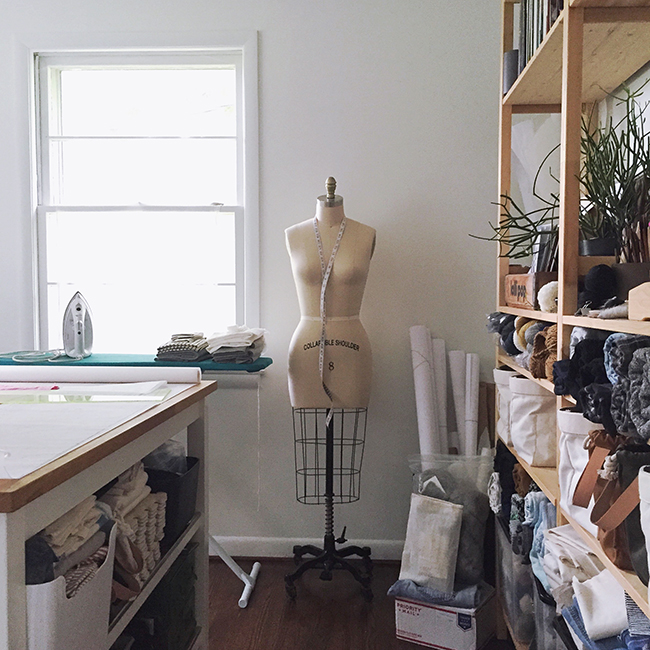
Easily the one thing I get asked about more often than anything else is … my dress form. Every time I post a picture of it (ref. above), there’s a handful of people quite reasonably asking where I got it, do I like it, how did I pick it? I know exactly nothing about dress forms — mine came from the first page of a hasty search on Amazon for “collapsible shoulder dress form,” and I use it to hang things on in our booth at shows and for taking photos of WIPs in my little workroom at home. It tells me nothing, really, about how anything will fit me since we’re completely different, she and I. She has narrow shoulders, meaningful breasts and a nice short torso; I’m the exact opposite of all that. She’s nothing but a prop. So I’ve asked pattern designer Liesl Gibson (of Oliver + S and Liesl + Co) to give us her expert thoughts on the subject! For more of Liesl’s bottomless wisdom, check out her blog and her Instagram, and if you’ve never watched her bias tape tutorial on Creativebug, I’m telling you: It changed my sewing life. (No pins!)

[N.B: Don’t miss the SALE news at the end of this post!]

. . .

KT: So, Liesl, this is a one-big-question inteview: Does the average home sewer or knitter need a dress form — and if so, what kind?

LG: Whether you need or can use a dress form depends a lot on what you want to do with it.

Many dress forms or mannequins are made solely for display in stores for merchandising the clothing. These can be great for taking photos of your sewing projects, but they’re not very useful for sewing or for draping because they aren’t very accurate in terms of body shape or sizing. On the other hand, if you’re a blogger and hate to pose for photos, go for it! I totally support this idea, especially given my personal dislike of posing for blog photos.

Here’s the truth about dress forms: Many people assume that a dress form will be really useful for making clothes that fit properly. But unless you have draping skills and plan to drape your clothes from scratch, it’s very likely that you won’t make much use of one. I was pretty certain I needed one when I graduated from design school, and then I got one and it served mostly to frighten the internet installation guy until I finally sold it.

Personally, I find that I prefer to fit clothes directly on my body. It’s difficult to find a dress form that mirrors your body, and truthfully I think it’s really important to feel how the clothing feels and looks on your body: How much easy do you need; where does the neckline look best; can you bend over, turn, and breathe? And if you don’t know how to drape, there’s a good chance you won’t know what to do with a garment once you get it on a dress form anyway. If you fit a pattern to your own body you’ll be able to see and feel what needs to change.

Yes, there are all sorts of custom options out there: the duct tape dress form, padding a basic dress form to mimic your body, 3D modelling, etc. They each have advantages and disadvantages. One distinct disadvantage of a duct tape dress form is that, although it’s quite inexpensive to make, you can’t pin into it without gunking up your pins. And frankly, when you’re wrapping yourself in duct tape (or someone is wrapping you), it’s going to distort your body, so the finished dress form won’t be very accurate. The custom models can also be really expensive. Padding a dress form to mirror your own body can be done, but it’s complicated and difficult to mimic your shape and stance. Are your shoulders forward, or is one higher than the other? How straight is your back? If you don’t get the essential posture of your body just right, the dress form probably isn’t going to give you the results you want. 3D options can be quite pricey for something you might not use as often as you think you will.

Having said all that, I own two dress forms. Here’s how I use them.

For our Oliver + S kids patterns I use a traditional Royal form, which is basically a paper mache torso, legs, and arm covered with linen. This dress form works well for checking the fit and proportions on our sample size, but I mostly develop patterns with a flat pattern technique, so the dress form serves mostly as a check to confirm that the patterns fit and look well before they’re graded. Once all the sizes have been developed we do a lot of further testing on real bodies to check the sizing and fit for all the various sizes.

For our women’s Liesl + Co patterns I use a custom AlvaForm, and I love it because it’s anatomically very accurate. By that I mean that the shape is much more accurate than the traditional dress forms like Wolf and Royal, so the fit through the bust and armhole can be better than it would be with a traditional form. If you’ve ever sewn a pattern that gapes at the armhole even if it fits well through the bust, chances are it was developed or fitted on a traditional paper mache form that didn’t allow correction of the concave area between the bust and shoulder. Alva forms solve this problem but are very expensive (and the shipping from Asia costs almost as much as the form itself!), so this is really not an option for most home sewists. But again, on a professional pattern-making level this form allows me to develop sewing patterns that adhere to a standard fit before we grade to develop the different sizes and test those sizes.

However, I never rely solely on a dress form for pattern development. It’s important to see how a pattern fits and feels on real bodies, so we do lots of fittings and wear testing before a pattern is ready for grading. I sew our women’s patterns for myself and wear them for a few weeks, at least, before they’re graded. I make basic pattern adjustments for my body when I sew the samples — I’m longer waisted and smaller busted than our standard sample size — and this way I can tell if there might be as issue somewhere in the basic pattern. Maybe I notice that the armhole is too high or that the neck is uncomfortable, or perhaps it needs more room across the upper back so you can move. This is the role that a traditional fit model plays, but of course being the small company that we are I don’t have the budget for a professional fit model. So I alter the patterns for my body and fit test them myself. I also rely on our pattern testers to do the same so we can check the sizes on a wide variety of body shapes and sizes, and I sew the samples for our photo shoots so I can check the fit against our models as well. (I have a very reliable group of testers — some experienced and some quite new to sewing — who help me with a lot of this process.)

But when it comes to sewing for myself for fun, I sew for my body and don’t use a dress form at all. And that’s despite the fact that I’m quite close in size to my Alva dress form! I honestly don’t use it for myself. It’s much more useful to fit the pattern to my body in the form of a muslin. This is what I teach in my fit classes, too. It helps to have a sewing buddy who you can work with, but none of my friends sew so I do it myself. I make a muslin, look in the mirror, ask my husband or daughter to take some photos from the angles I can’t see very well, and then I take off the muslin and make adjustments before starting the procedure again. It’s trial and error until I like the result. My best tools for fitting? A mirror, a camera and a copy of “Fit for Real People,” which I highly recommend to all my students and all our customers because it explains how to get a good fit in ways that are relatively intuitive, with lots of photos, diagrams and examples to help you along the way.

So do you need a dress form? It’s sort of up to you, but I generally counsel against it. It looks cool in a sewing room and in blog photos, but unless you’re developing sewing patterns yourself my personal opinion is that you won’t get very much use out of it. Use your own body and a few tools, and you’ll get much better results.

. . .

Thanks so much, Liesl! Happy weekend, everyone—

IN SHOP NEWS: We’re clearing out the magazine shelves and a few other straggling gems — check out the Sale section for some rare markdowns while they last! But I should also warn you we’re expecting the long-awaited Lykke (full/standard) interchangeable sets to finally arrive this afternoon (although I’ve probably jinxed it by posting that). We’ll put them back in the shop the moment they arrive, so check in late today! [UPDATE: The Lykke needle sets are here!]

.

PREVIOUSLY in What I Know About: Holding yarns together

SaveSave

SaveSave

SaveSave

Q for You: What are you afraid of? (with FAFKAL news)

Q for You: What are you afraid of?

My favorite thing about #summerofbasics so far (intro here) is getting a peek into so many people’s thought processes — picking out not only what feels “basic” but also what feels like a fun challenge to take on in good company. This is the time of year when I usually start to at least hint at what the big Fringe and Friends Knitalong* for the year will be, and I realized recently — and mentioned in the East London Knit conversation — that the past several knitalongs have been about getting us all out of our comfort zones. This goes along with my post-Squam opining, but my big life lesson in the last several years has been how thrilling it is to keep pushing myself out of my own comfort zone (social and otherwise) and proving I’m fine. What happens when you do that is the boundaries get redrawn, right? The zone keeps getting bigger. (I imagine most people learn this earlier in life!) I have a pretty damn roomy comfort zone when it comes to knitting, even though I’ve only been doing it for 5.5 years, whereas my sewing comfort zone is pretty tiny, despite having learned the basics as a kid. Which was the impetus for Summer of Basics — I wanted to sew a button-down shirt and decided to drag you all into it with me!

So the next FAFKAL, as they’ve come to be nicknamed, will be another case of getting us all to try something that takes a bit of bravery. I’m not ready to share any specifics just yet, other than that it will start in January this time, rather than September. (The last two have been a different kind of challenging, as they overlapped with Slow Fashion October, and this year sandwiching it between SoB and SFO would put me over the edge.) But in the meantime, with SoB underway and FAFKAL on the horizon, I thought I’d ask: What scares you? From trying a new trick to making a whole garment to learning a whole new discipline (sewing? knitting? spinning? weaving?) or whatever it might be. And what is it about it that seems so scary, exactly?

Mine is definitely steeking (the act of cutting an opening in a piece of knitted fabric), and it’s because the one thing I’m always telling people about knitting— “It’s just yarn! You can always unravel it and it will still be yarn!” — ceases to be true. So that’s the thing I want to take on. And yes, that is a bit of foreshadowing … although the scrap of my St. Brendan that I used for this photo has nothing to do with it! Although it is relevant in the sense that cutting off the bottom of that sweater was a pretty thrilling gulp! of a moment.

*Previous annual FAFKALs being: Amanda, Cowichan, Improv top-down

.

PREVIOUSLY in Q for You: How do you decide what to make?

SaveSave

Squam 2017: Reflections and outfits

Squam 2017: Reflections and outfits

I have a lot of Deep Thoughts coming away from this year’s Squam Art Workshops, but that’s sort of what Squam does to you. Some of those might find their way into this post in one form or another — I’ll see what happens as I write — but if you really just want to know what I wore, feel free to scroll on down, that’s cool! “Whatever makes you happy” is sort of the number one rule of Squam, so go with it.

(Bob came in and started talking to me just then. I said, in apologies for shushing him, “I’m trying to write about what I’ve learned about myself in the last five years.” He said, “Wow. It’s a good thing you got a nap.”)

The simple summary of the trip is: I had the best, most peaceful time imaginable. I flew to Boston the night before and met my longtime online friend Felicia Semple for the first time at the picturesque Squam Lake Inn in Holderness, NH, near the old camp where Squam takes place. We had dinner and talked each other’s ears off, and the next day we drove an hour and a half to visit the Harrisville Designs mill and take the tour — my first time watching yarn being made. (I couldn’t get a cell signal there, so I’ll be belatedly putting all the images and videos into my Instagram Story today.) New Hampshire is so pretty it feels like you’re in a movie set: Every little general store and fire station is picture-perfectly adorable, and Harrisville is definitely no exception. But even without the scenery and the mill tour, I cherish that chunk of time I got to spend with Felicia, yammering like mad and making observations about the ways we talk about ourselves or our endeavors. As they say, it felt like I’d known her forever, but she’s that sort.

Wednesday evening we checked in at camp and got our cabin assignments. I had the good fortune to be bunk mates with my hilarious sprite of a friend Mary Jane Mucklestone (who I first met taking this class from her four years ago) and two people I’d not met before: the warm-hearted dynamo Anne Weill (who I’ve admired since her graciousness in the face of this snooty post I wrote in 2015) and Camille DeAngelis, who was teaching the writing workshop and is a lovely, gentle soul. We were assigned a fantastic cabin on the tip of the spit of land with the widest view of the lake I’ve seen so far — we couldn’t see another cabin from our dock, just water and trees and the greenest hills — and my teaching cabin was right next door. So yeah, off to a great start.

Squam 2017: Reflections and outfits

The dining hall that night was full of old friends, heroes and new faces, and my hermit heart was racing a bit, in a good way. Everyone was asking me how I felt about being there to teach for the first time, and honestly I was feeling pretty chill about it. I had what I thought was a solid plan and good notes, plus I was already under the lake’s spell and still high from the whole Harrisville adventure. I was a little shy at dinner with my class that night, but by breakfast felt entirely relaxed and ready. Then I ran into our fearless leader Elizabeth on the way to the wooded path toward class and she gave me such an intense pep talk that it got my heart pounding! But that gave me a funny anecdote to open with, so thank you, Elizabeth, in a million ways.

I could go on for days, but what I want to say is it went fine. Better than fine. My students were lovely and relaxed and determined, and nearly all of them even finished their hats! (Note to beloved students: the Debutant pattern is listed on Ravelry, please link your projects!) On the whole, I got to spend several days surrounded by so many people I already loved, so many more I loved getting to know, and many moments just sitting quietly on the dock, gathering energy to rejoin the happy-noisy crowd or teach the next session.

What this all has to do with what I’ve learned about myself in the last five years is this: I’ve spent my whole life telling myself I’m inept at making conversation with people I don’t know. That I’m better in writing than in person. That I prefer solitude to crowds. All of that is true of me, but it’s not the whole story. Since starting Fringe, I’ve forced myself to challenge those notions. I showed up at the trade show the first time without knowing a soul, and now each year it’s a sort of homecoming. Likewise, I’ve traveled to events and workshops and retreats (Squam included) with a few friends and come away with new ones every time. I’m part of a community I value so much, and am so honored to be involved in, and I’m blessed with these friendships and opportunities because I’ve dared to show up and to not sit in the corner. (At least, not the whole time.) I’ve learned that yes, it will take a lot out of me, but it’s beyond worth it and I’ll sleep that part off when I get home. Somehow all of this was amplified in those woods last week. And discovering that I’m perhaps not a half-bad teacher was a whole new level of the process.

There’s more in my head, but that’s the part I feel is important to share here: Please don’t believe all the things you tell yourself about yourself. You’ll be amazed at what you’re capable of.

So this is a love letter and thank-you note to everyone I’ve met, been befriended and/or challenged by these last five years. I’m awash in gratitude. And yes I got that Dottie Angel “I am a W.I.P.” shirt (and tote bag!) at the fair Saturday night and feel it more strongly and proudly than ever.

. . .

So what did I wear? Here’s what was either on me or in my little carry-on suitcase, along with a box of teaching materials, an umbrella, two headlamps, my travel dryer and toiletries:

Squam 2017: Reflections and outfits

white linen shell
black hemp muscle tee
– grey Everlane linen knit muscle tee
– black silk Elizabeth Suzann artist smock, which I LOVED wearing with jeans and sneaks
– secondhand chambray shirt
– old flannel
– purple J.Crew boiled wool pullover from a few years ago, which I finally got around to taking the waist elastic out of and newly adore, wish I’d gotten to wear it more
black linen-wool cardigan
camel cardigan
– J.Crew made-in-LA jeans
– black linen Elizabeth Suzann pants (with added pockets)
– old cutoffs
– my heaviest/warmest LL Bean tights for cold nights
– dirty old Chucks for tromping along wooded paths
grey Orlane shawl

And here are all the ways it went together, from travel day through return-travel day:

Squam 2017: Reflections and outfits

In addition to Squam life calling for a lot of changing of clothes (for example, Saturday was teaching in the morning, knitting on the dock in the afternoon, boiling hot art fair setup, the fair itself, and a chilly night back at the cabin), the NH woods in early June are an unpredictable place, weather-wise (e.g., Friday morning we were on the dock before breakfast, basking in the early warmth, but were huddled around a fire in the living room by mid-morning). So it requires versatility and layers.

Not pictured are the rain boots I wore only the first day (on the plane and the drive up) thanks to the predicted rain being replaced by mostly unseasonably warm weather, and the sandals that never came out of the suitcase. My grey shawl also stayed in my bag the whole time, since I flung my black cardigan around my neck when needed. Pretty much everything else got worn more than once, but I could have gotten away with just the sneakers, one cardigan, the pullover, and I believe in having both the flannel and the chambray. Notes for next year, as I’m hoping there will be one!

Squam 2017: Reflections and outfits

PREVIOUSLY in Wardrobe Planning: The summer 2017 plan

SaveSave

SaveSave

SaveSave

SaveSave

SaveSave

SaveSave

SaveSave

SaveSave

SaveSave

SaveSave

Our Tools, Ourselves: Anna Dianich

Our Tools, Ourselves: Anna Dianich

I’m sure many of you know Tolt Yarn and Wool owner Anna Dianich is one of my dearest friends — we started our businesses around the same time and have sort of “grown up” together. But what I only just realized myself last week is that I’ve never seen where she knits at home or what her stuff looks like! Any time I’ve ever spent in Carnation WA has been at Tolt, and I was suddenly intently curious to see her knitting life beyond the store. So of course I asked if I could subject her to the Our Tools, Ourselves treatment. Thanks so much for doing this, Anna! For anyone left wanting more, make sure to follow @toltyarnandwool on Instagram.

. . .

Do you knit, crochet, weave, spin, dye, sew … ?

I knit. I can spin, and when I do sit down at the wheel (which is not often!) I remember how much I enjoy it. I’m not a technical spinner — I just do it for fun and the feel of the wool, the meditative motion of the pedals and wheel, and the draw, not to get the perfect twist per inch or the exact weight of yarn for a project. I think that’s how I do most of my crafts, really. I’m not super technical with knitting either. I do it because I love working with my hands and creating something useful. I don’t like fussy patterns or complicated construction. My husband, oldest daughter and I just started taking pottery classes and it’s a familiar feeling. I love the rhythm of the wheel, the feeling of the clay and making something useful. And, like knitting and spinning, it takes a bit to get that muscle memory, and I hope that it will click soon because I love it!

Our Tools, Ourselves: Anna Dianich

Tell us about your tool preferences and peccadilloes.

When I first started knitting I only used bamboo needles — circular and double points. They were less expensive and easy to find, and less slippery for a newbie. I now use mostly my Addi Click interchangeable sets, and magic loop instead of double points. I love Addi’s — they are smooth, and the yarn seems to move swiftly on and off the needles. My only complaint is that, although I love how the needles click on and off the cords, sometimes that connection can get fussy on small needle tips, making the stitches hard to slide across that connection. I just got a Lykke set for this reason (and they’re beautiful to look at!) and I am really enjoying them.

How do you store or organize your tools? Or do you?

Organization is not my thing. I would like to blame it on my busy life as a working mom with four kids and such, but I think it’s just me. I’m just not organized. I don’t have a craft room or home office, so most of my supplies are stored in and on a cabinet that’s in our living room. There is a large room above our barn that could be used as a studio, but it’s so far from the activity at home that I don’t use it.

My interchangeables are relatively easy to store; if they’re not on a project then they are kept in the case. I keep the cases nearby, or in my project bag just in case I need to switch needle sizes. I do carry a small leather pouch (that I got from Fringe years ago) that I keep my notions in. I am constantly having to find my measuring tapes — I swear I own at least twenty, but can never find them! I guess that’s why the leather ruler bracelets are so handy!

Our Tools, Ourselves: Anna Dianich

How do you store or organize your works-in-progress?

Again, I’m not that organized. Such a bummer! I try not to have too many projects going on at once (maybe two or three at the most) and they store nicely in a project bag that can be found on my couch, chair, bed, in my car or in my backpack. If I’m going on a road trip I can usually fit two to three project bags, plus my needles, in my Porter Bin. That keeps everything together and gives off the impression that I am organized, haha!

Are there any particularly prized possessions amongst your tools?

Hmm, not really. I think we, our bodies and ourselves, are our most prized tool that needs to be cared for and looked after. I think this became real for me after breaking my leg. Eating well, staying active and also knowing when to rest so that we can stay healthy to do all the activities that we love.

Do you lend your tools?

I never really have, but I would.

What is your favorite place to knit/sew/spin/dye/whatever?

Most of my knitting happens after the kids go to bed. I plop myself down on the couch or in bed, and knit while my husband and I watch TV or talk. I also get a lot of knitting done in the car while waiting for kids to get done with school or dance practice or driver’s ed. However, my favorite place to knit would be by a campfire, or by a lake or river in the summer, and cozied up next to a fireplace in the winter.

Our Tools, Ourselves: Anna Dianich

What effect do the seasons have on you?

I pretty much knit year round. I also knit mostly wool, even in the summer. I’m not usually into “summer yarn” — although I did just finish a Vasa top using YOTH’s new Best Friend yarn, which is 75% cotton and 25% wool, and I really enjoyed working with it, and like the fabric.

Do you have a dark secret, guilty pleasure or odd quirk, where your fiber pursuits are concerned?

I’m kind of obsessed with books, all types of books. Knitting, cooking, decorating, travel, pottery, wood carving … I have shelves and shelves full of books.

Another little secret is that I still get very nervous when working the floor at Tolt. I spend most of the time in my office upstairs, but every once in awhile I work the floor, and I’m so scared someone is going to ask me something I don’t know the answer to, or I’m going to mess up on the cash register.

Our Tools, Ourselves: Anna Dianich

What are you working on right now?

Right now I’m working on the Morrison socks by Jenny Blumenstein. Jenny designed these socks for our LYS Tour and they are super fun to knit. I also have a ton of things I’m excited about casting on so I’m trying to make a list, but, you know, I’m not that organized.

I am also trying to find more time to do pottery. I would really like to have a little studio some day with my own wheel. Like any craft or activity, you get better the more time you spend doing it. I’m working on the basics still: centering, opening and raising.

Our Tools, Ourselves: Anna Dianich

PREVIOUSLY in Our Tools, Ourselves: Brandi Harper

Photos © Anna Dianich

Q for You: How do you decide what to make?

Q for You: How do you decide what to make?

I’ve been thinking about the urge to knit or sew things for myself and how it compares to the old urge to shop (which are at once the same and very very different). Obviously over the past few years — and increasingly the past few seasons — I’ve put a lot more effort into wardrobe planning than I ever had before. But even with all of that, I find myself pondering what are my actual criteria for when I add something new.

It’s definitely still a gut thing, framework aside. Any new garment has to fit into my wardrobe, sure — has to follow the old “makes at least three outfits right off the top of my head” rule — but it also has to meet or exceed my notion of how I want to dress, how I want to feel. It must have appeal for more than a season. I have to be realistically able to make it: a fingering-weight stockinette sweater will never get finished. It should fill a gap rather than being redundant with things I already own. But most of all there is good old raw, instinctive WANT. I need to feel excited to wear it — not just “yeah, that’s useful” — or else, again, it’s in jeopardy of never being finished and/or dulling my love of making. Bonus points if it can be made from stash or with a known yarn/fabric I’ve been trying to find a project for. (My stash is not very big and I rarely acquire anything anymore without a specific project already planned for it, so there aren’t that many “shopping my stash” opportunities. But to the extent I have a sweater quantity of something that’s not already earmarked, that is a definitely a decision driver.)

So I guess for me it’s about finding the sweet spot between fashion lust and practicality — it has to win over both of those judges in my head — but my favorite thing about humanity is how different we all are, and I love hearing about all those countless differences.  So that’s my Q for You today: How do you decide what to make? Do you follow a list or a whim? Are you driven by your stash, your Pinterest, the Hot Right Now page at Ravelry, your budget, your color sense, your desire to use certain skills … How does it tend to work out for you? And is it the same decision-making process for making as for buying?

(Porter Bins and Field Bags from Fringe Supply Co.)

.

PREVIOUSLY in Q for You: Are you a repeater?

Outfits! : The Summer 2017 plan

Outfits! : The Summer 2017 plan

I continue to feel incredibly self-conscious about all this wardrobe planning — especially since I’m doing it publicly — but dang it’s fun and useful! So I’m just gonna get over that. Like I said last week, simply isolating the key players and laying them out in a grid of photos is wildly beneficial for seeing what I have to work with and spotting combinations I wouldn’t have otherwise thought of. There’s an extent to which you could look at that grid and just pick a top, a bottom and a pair of shoes, and I could probably sit and do that all day and come up with who knows how many outfits if I wanted to literally represent each and every one of them — I won’t go quite that far. One thing I’m finding with the summer group, though, is there are quite a few tops in the lineup that really only work with maybe 1-3 of the bottoms — limited usage, but hey, perfectly good outfits.

Outfits! : The Summer 2017 plan

If this were me working on a packing list, there are pieces that would get cut for not being re-combinable enough. But this whole exercise is about finding ways to wear the things I already made/bought and have allotted space for in the closet. (And making sure I’m making wise decisions about where to spend my future making energy.) Plus many of them may also have a larger role in other seasons, so it’s fine for them to factor in more lightly for summer, for variety. (One thing to note, though: If it involves sandals, it’s not a work outfit, so I’m mentally looking at each of those and asking if there’s an excessive-A/C alternative. If it’s sleeveless, it has to accommodate a cardigan or jacket or it’s also not safe for work.)

Or take the case of this linen Fen top:

Outfits! : The Summer 2017 plan

That’s really three versions of the same outfit, and while I like it/them and will wear it/them, it’s a tiny bit dour, even for me. (The first, the best one, can be seen in full outfit sketch form below.) There are other bottoms it technically goes with, but which I’m not including because I know I won’t wear them. For example, it works with the khaki pants but that’s even drearier. It’s perfectly fine with jeans, but just not me somehow. It’s a hair too short for wearing with the camo pants, since I’m not of midriff-bearing age. (Although I apparently am still of camo-wearing age! lol) It’s adorable with the full grey skirt — that’s probably its best outfit, objectively speaking — but on me that’s way too girly. So I’m limiting how much it gets used.

Then there are the really hard workers, starting with that soon-to-be go-to, my ash linen Sloper in progress, at the top of this post. As you can see, it will go over both of my skirts, all five pants and 3 out of 5 dresses — that’s an outfit a week for 10 weeks right there, at minimum. Knitting time and money well spent!

Likewise the sleeveless black tops I made last year (one hemp jersey, one silk gauze), and the two white tops I have at the top of the sewing list right now (white linen tee — also to be done in black linen — and white cotton sleeveless top—

Outfits! : The Summer 2017 plan

Outfits! : The Summer 2017 plan

Outfits! : The Summer 2017 plan

The modified slip dress will also be a fabulous use of a little bit of time, since shortened and be-pocketed, it will be able to be worn many different ways, and will easily accommodate an outer layer for work. This little refashion is top-most priority.

Outfits! : The Summer 2017 plan

And what about the pieces I’m trying to be more deliberate about wearing more often? You can see the black, 20-y-o Katayone Adeli skirt factoring in throughout this post, which is marvelous — and makes the full black linen skirt on my to-sew list a less pressing matter. Other pieces I wear only occasionally but love and want to bust out more are the little ivory Meg-made sweater and the black chambray top I sewed up from some scraps back in 2014, just before we moved.

Outfits! : The Summer 2017 plan

Possibly the smartest addition to my closet in recent months (of which there have been precious few) was one I thought might be the opposite. When I bought the Nade Studio tunic on impulse at Porter Flea in December, I thought it might be a mistake: I love supporting Maggie’s business and love the piece, but worried that it simply wouldn’t get a lot of use — that it wasn’t very versatile. Once I started playing summer closet rummy, though, I realized it’s actually the star of the show. It looks amazing worn open over a dress or buttoned over a skirt — the skirt just peeking out from that arc in the front hem. These are actually the outfits I’m most excited to get to wear.

Outfits! : The Summer 2017 plan

To my great astonishment, going through the process of these Summer 2017 Wardrobe posts has transformed my lifelong dread of summer dressing into something resembling optimism or maybe even excitement. Never thought that was possible. Which isn’t to say I’ll ever feel as at-home in a dress and sandals as I do in a sweater and jeans, but it’s a major and welcome improvement.

There are over 70 outfits pictured here, without exhausting the possibilities of these 30-ish items. Not every piece from the inventory wound up being included here, and admittedly several of those that are here don’t yet exist or are awaiting mending/alterations — but nor have I accounted for a couple of other garments on the make list, each of which represents another good clump of options. All told, it seems like I’m in amazingly good shape, as long as enough of these prove workplace-worthy. And I’m already worked up about exploring how everything here (and some of the never-worn Paris combos) will come into play for fall!

Outfits! : The Summer 2017 plan

For the details on any or all of the garments seen here, see last week’s Closet Inventory (which I’ve updated with pics of the new and previously-missing items).

Oh, and lest I forget, these are my topper options — one WIP and one on the make list:

Outfits! : The Summer 2017 plan

(Fashionary sketch templates via Fringe Supply Co.)

PREVIOUSLY in Summer ’17 Wardrobe: The make list