Yarns in waiting

Yarns in waiting

Once upon a time (have I told you this story before?) I ran a community site about books and I was on the mailing list of every publishing company on the planet, whether I wanted to be or not. Every day books landed on my doorstep unsolicited — most of them wildly inappropriate for my site (kids books, self-help, pulp fiction …). People always think it sounds like a ridiculous thing to complain about — who doesn’t love free books! — but try getting hundreds of books out of your house on a weekly basis and tell me what a blessing it is. So I’m now incredibly cautious about people who seek to send me yarn. I really don’t want a lot of yarn in the house, generally speaking — especially single skeins — so am frequently in the awkward position of turning down offers of yarn, no matter how luscious it may be. Every once in a blue moon, though, I cave. And then there’s the fact that I have a lot of good acquaintances and close friends in the yarn business, and sometimes they send me yarn without my knowing anything about it. So things find their way in.

Lately my mail has been pret-ty amazing, and I thought I’d tell you about some of these beauties:

1) I don’t have any friends at luxury yarn company Jones & Vandermeer, but after I posted about trying to find the perfect camel-colored yarn for my upcoming Channel cardigan, I got a nice note from them asking if I wouldn’t like to swatch with their 100% camel-fiber yarn, Clever Camel. And obviously the answer was yes, I really would. Swatching will commence this weekend.

2) My friend Kristin Ford of Woolfolk sent me a hilarious email recently about some random colors of Far she had from the mill, wondering if she could share some of it with me. I asked her for a pic, and a few days later I got a box. My favorites are the few skeins of this blue-and-white marl. No idea what I might do with it (or if it will be going into production), but it will be heavily petted in the near term.

3) I mentioned before that my friends at Purl Soho sent me a box of their Linen Quill before I had a chance to complete my order. Knowing me as they do, they sent skeins of the black and the grey-natural marl, both so incredibly stunning. I’ve already wound two skeins of the black and started playing with it last night.

4) A dear friend in the biz sent me these two incredible skeins of aran-weight tweed yarn that I’m pretty sure I’m not allowed to talk about just yet. But ooh la la … coming this fall, I think.

So for me, this weekend is for swatching and seaming, seaming and swatching. And maybe drowning my tax sorrows in a nice glass of rosé. What are you up to?

IN SHOP NEWS: The spring/summer issue of Amirisu arrived this week, packed full of great little sweater patterns and three shawls. And you’ll also once again find all three shapes of brass hangers and both sizes of brass-and-steel scissors on the virtual shelves waiting for you. Among the Field Bags and all the other lovely things at Fringe Supply Co.!


Idea Log: Three sweaters haunting my thoughts

Idea Log: Three sweaters haunting my thoughts

This is a much less complex Idea Log than past installments, albeit in triplicate. Here we have three very simple sweater ideas, spurred by specific yarns, that I can’t stop thinking about knitting. So I’m recording them for the moment rather than making any queue commitments:

1. I think I’ve abandoned the whole Penguono project. (For me to ever complete a knitting project, I have to be entirely covetous of the FO, and I’m just not in this case.) But these insane skeins of black-and-white handspun yarn I got from Rebekka in the course of things keep begging to become a sleeveless tunic. I’m imagining a slightly oversized, crewneck version of my turtleneck.* It would be so quick and simple and delicious, but also a bit of an investment by the time I acquired enough skeins.

Idea Log: Three sweaters haunting my thoughts

2. A little birdie pointed me to this new Purl Soho yarn, Linen Quill — I don’t think it’s even been officially announced yet — and omigod I cannot stop imagining the perfect sweater for each gorgeous color. (Held double, of course.) But the ones that are haunting me most are an easy wide-cropped cardigan (you see I’m debating the sleeve shape) in the Kettle Black — despite my having knitted 3 black sweaters in the last few months! —and …

Idea Log: Three sweaters haunting my thoughts

3. … a simple little tank in the Rose Granite. I’ve been wanting a pretty pale pink top since seeing a certain J.Crew photo in late 2014 (blush top, lilac cardigan, army pants, so good), and have been imagining it as a slinky woven item, but now I think it would be amazing in this yarn. Only question is how it would look with my skin.

*I know, y’all. I would really love to write that pattern, but there’s never time. Hopefully one of these days!

The ultimate handknit sweater, $28

The ultimate handknit sweater, $28

Oh, you guys, I can’t even think straight! I blocked my black lopi raglan sweater to make sure it really needed a revision to the lower body, and it turns out it’s PERFECT. And I don’t just mean it doesn’t need any more work, I mean it is the perfect sweater.

Imagine if I said you could knit a sweater in two weeks or less that is thin and light as air, but very warm. That is durable — as in, it will last for decades. [ETA: Judes makes an excellent point below.] Knitted from totally ethical, traceable farm yarn. And which would cost you well under $100. (Mine cost about $28.) You’d ask if it was spun whole by bluebirds from fairy dust and unicorn hair, right? But that’s exactly what this sweater is. (I promise I’ll take FO pics and show it to you ASAP.) Lettlopi aran-weight Icelandic wool knitted on US10 — or even 10.5 — needles is pure unadulterated genius, brought to my attention by Mary Jane Mucklestone and her Stopover sweater. Little did I know, the day I put on Kathy’s for that photoshoot, that it would change my entire knitting worldview.

I’m so driven to distraction with yarn love that instead of writing the post I meant to write for this morning, I’m back on Tolt’s Lettlopi page fantasizing and picking out colors for five more sweaters. Because all I want to knit now is every archetypal sweater in Lettlopi stockinette at 3.5 stitches per inch—

– Basic crewneck cardigan : Color 56 (silvery grey)
– Hip-length boyfriend cardigan with inset pockets : Color 1402 (sky blue)
– Short, long-sleeve v-neck pullover: Color 1400 (camel)
– Crewneck pullover, long full sleeves : Color 1413 (lilac)
– Short, elbow-sleeve crewneck pullover (same as the black one) : Color 9421  (army)

Along with the black (Color 0005), that’s my whole life palette right there, by the way — it doesn’t seem to ever change.

Look, I have to say this: This yarn is not for everyone. If you like gooey soft marshmallow yarns, you probably won’t like lopi. It is soft, but not that kind of soft. It’s airy and hairy and does magical things when you soak it — at least (or especially?) at this gauge. It’s fascinating.

.

Lettlopi photos © Tolt Yarn and Wool

Black is the new black

Black is the new black

I don’t know if it’s just me or if it’s in the air, but I am super into black right now. Every top and dress I imagine making, I picture it in black linen or black boiled wool. And every sweater dancing around in my head is knitted in black wool, as well. The thing is, black yarn ain’t that easy to come by. When I started in on my Black Anna (which is set aside for the moment), I got into a conversation with my friend Kate of Kelbourne Woolens (distributors of the Fibre Co yarns) about why there’s not a black in every line — too hard to make, or too hard to sell? The short answer is that nobody buys them, presumably because knitting with dark yarns is generally considered hard on the eyeballs. And maybe it is! But do we not all want the perfect black sweater — er, sweaters — in our closets? Maybe I’m in the minority, but right now I feel totally willing to sneak in rows during daylight hours or even turn up the famously dim lights in my house if the end result is delectable handknit sweaters in blacks and near-blacks.

So where does one find the yarn? Here’s a smattering of high-quality blacks:

– The Fibre Co. makes several: slubby worsted-weight Terra in a deep black called Coalwood, which is the black I’m using for my Anna; lace-weight Meadow in tweedy Black Adder; Canopy Fingering in Obsidian; speckly DK Acadia in Cormorant; and worsted, heathered Knightsbridge in Flintshire

– YOTH makes all of their yarns in an off-black color called Cracked Pepper, which varies slightly from base to base

– Quince and Co has two blacks, both of which I believe are available in all of their 100% wool yarns: Crow is the blackest of blacks and Sabine is a heathery off-black (I used it for my sleeveless turtleneck — yes, I swear, the pattern is coming! — and leftovers hat)

– Brooklyn Tweed makes both Shelter and Loft in Cast Iron, also a tweedy off-black

– Shibui makes all but one of their yarns — including Linen! — in what they call Abyss, the blackness of which varies with the fiber content and style from yarn to yarn

– Woolfolk makes Far and Tynd in a true black (“Color 15”) and Sno in three different black marls

These are certainly not the only blacks out there (feel free to name your favorites in the comments!), but I also feel like black is endangered in the yarn world, so if you love it and want it to keep existing, put your money on it.

p.s. The new issue of Taproot has landed over at Fringe Supply Co., with a new sweater pattern by Carrie Bostick Hoge!

.

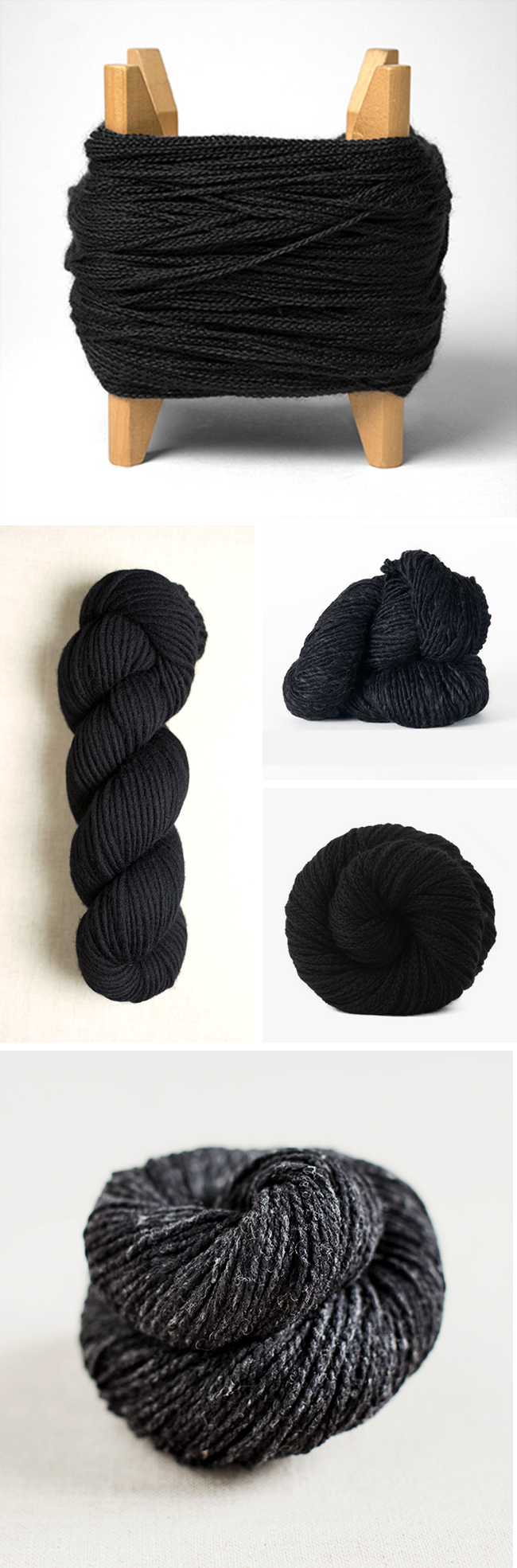
Pictured, top to bottom: Shibui Maai in Abyss, Quince Puffin in Crow, Fibre Co Terra in Coalwood, Woolfolk Far in Color 15, Brooklyn Tweed Shelter in Cast Iron

.

PREVIOUSLY: Camel-colored yarns

yarn + water = magic

yarn + water = magic

Here’s what I want to talk about today: Water changes yarn, and it changes knitted fabric. Sometimes it changes it for the better, sometimes not so much. Knitting swatches — and blocking those swatches — is always described as a critical step in achieving the right fit. And it is. (It’s the only way you can know how big your stitches and rows are, and thus how big your finished object will be.) But it’s also so much more than that, and the “more” is far less often discussed.

I’m not an expert on breeds, fiber characteristics, how yarn is spun … none of it. Not by a long shot. But I know a few things, and a lot of what I’ve learned, I’ve learned from knitting and soaking yarn. (Or watching Clara Parkes do it.) If you give it a chance — if you look and touch and listen — yarn will teach you things. So at the risk of sounding didactic, I want to talk a tiny bit about why you should soak your knitting, if you don’t already — especially your swatches.

1.) See that photo up top? It’s an amazing small-batch yarn from Hinterland called Range — a woolen-spun wool/alpaca blend that is so light and airy and cushy I actually have a hard time believing there’s alpaca in it. I met the lovely Hanahlie Beise of Hinterland in Carnation last weekend and she had with her these two skeins of the same yarn. The one on the right is how it’s sold in the skein, and the one on the left has been soaked. See how much plumper it is? I wish you could squish it. It “bloomed” — or fluffed up! — when washed. Yarns like that are my very favorite yarns, but you can’t know how a yarn will behave until you soak it. If you swatch and don’t block, you don’t really know what sort of fabric you’re creating, don’t know what the yarn is capable of — and what it is capable of might affect how it should be knitted. This yarn would benefit from being knitted a little on the loose side so there’s room for those stitches to grow. Right? (Hanahlie gave me a skein of this amazing stuff before we parted ways, and I look forward to figuring out the exact right thing to do with it.)

2) See the photo in the middle? That’s (the now discontinued) Shibui Merino Alpaca. It’s a sweater I started long ago and will apparently never be finishing, but this photo is a good example of the most commonly known result of blocking knitted fabric, which is that it relaxes into itself. Lace opens up; stitch patterns lay flatter. These two sleeves are identical, but the one on the bottom has been blocked. The individual stitches have all settled into their new shapes, and the fabric has become more cohesive, with a very slight halo. In this case, it’s also become more drapey. (Too drapey for my taste. A lot of people like drapey; I happen to not.) If the pattern called for the wool/alpaca Hinterland above and you were substituting this yarn, or vice versa, you’d wind up with a garment that hung and wore and behaved very differently from the designer’s version because the yarns are so different, despite their seemingly-not-that-different fiber content.

3) And then that photo on the bottom? You’ll have to take my word for what’s going on here, but that’s the blocked swatch and one of the unblocked sleeves for the sweater I’m knitting from my Sawkill Farm yarn. Again, this a yarn that blooms a bit when washed — compare the fringe on the left edge of the swatch with the working yarn just above it — and can tolerate a slightly loose gauge. But beyond that, what you’d find if you could see and touch these two things in person is that the swatch feels very different from the skein or the unblocked sleeve. Again, I’m no expert, but apparently some yarns are washed one last time after they’re spun (before they’re skeined) while others are not. This one feels lovely in the skein but seemingly hasn’t had that post-spin wash, so there’s a little trace of machine oils on the yarn — again, not uncommon. (This was pointed out to me by more astute friends. I wouldn’t have been able to explain the difference.) The washed swatch is a clearer grey and it feels as light as air. If you’ve ever felt lopi — the yarn of Iceland — you’d be able to guess that there’s some Icelandic fleece in the mix here. It has that weightlessness and fuzziness, which wasn’t apparent until it was soaked.

When you soak a piece of knitted fabric, you might find these things — yarn blooming beautifully, getting softer, taking on an appropriate drape (or not). Or you might find that your nice plump cables fall flat, or that your heel stitch exhales to the point that your formerly perfect-fitting hat falls down over your face. (These are real examples from my own life.) Different breeds and blends do different things. Worsted-spun is different from woolen-spun. An undyed yarn can knit up and behave differently than the same yarn plus dye. All of these nuances and complexities are what make yarn and knitting so fascinating. And the best way to begin to understand and appreciate it on that level is to simply run some tepid water* and give that swatch a dunk.

*For those about to ask what I recommend as far as wool wash, my longtime favorite soap to use when blocking knits is the bar soap that I’ve recently been able to start selling. Anything with lanolin — which is stripped from wool in varying degrees during processing — will increase the softness of wool when used.

SEE ALSO: How to knit and measure a swatch and How do you block your knits?

Slow Fashion October, Week 5: KNOWN — and a roundup of yarn resources

Slow Fashion October, Week 5: KNOWN — and a roundup of yarn resources

It’s Week 5 of Slow Fashion October already, our final week (such as it is), and our theme is KNOWN. Let’s talk about favorite sustainable resources / the changing concept of “local” / traceable fabric and yarn origins / traceable garment origins / reference books, films, videos. How much do we know, where did we find or learn it, and how can we share both the resources and the knowledge?

At the core of “slow” anything — slow food or slow fashion — is knowing (i.e, asking) where things come from. Buying meat from a nearby farmer that was butchered just down the road is a whole different exercise from buying meat in a chain grocery store and having no idea who raised it, under what conditions; what factory it was processed in, and when; how it was handled between that factory and you. No way of knowing what exactly it is you’re buying or who and what you’re supporting with your money, other than the grocery chain’s CEO. Same thing goes for clothes. Once you start asking where your shirt or your fabric or your yarn comes from, you become more aware of the entire chain of farmers and mills and factories and global shipping companies and distributors and retailers that all have a role in getting fleece or plant fiber from the farm to your closet or your stash. And you start to make more thoughtful decisions about what you put your money into. Or you try to, anyway.

The fact is, knowing is hard — both the finding things out and the knowing what to do about what you know or don’t know. I’m exhausted and limp-brained right now trying to formulate thoughts about it. Buying clothing from a small-batch designer with in-house production instead of a mall store cuts out a lot questions and middlemen to wonder about, but they’re still sewing with fabric they probably can’t tell you much about. Fabric is the hardest, which you know if you sew. Maybe you know something about the fabric company, maybe they’ll tell you what country the fabric was made in, and you can take their word (or not) for whether that distant factory operates in ethical ways, paying their workers a living wage and providing a safe working environment. But even then, where did the fiber come from? How was it dyed? Once you start pulling that thread (no pun intended) you realize how long and tangled it is.

Yarn is the easiest. Not all yarns are transparent — not by a long shot — but a lot of them are, and listing some of those is a thing I can do! I’m focusing on the US because that’s where I am, but what I would love to see this week is a whole lot of listing and sharing. So here’s my sliding-scale overview of some conscientious yarn options, which I truly hope you’ll build on:

– Farm yarns: As I mentioned last week, farm yarns — yarns sold by the farmers who raised the animals — can be found at farmers’ markets and fiber festivals everywhere. When you buy directly from a farmer (especially a local one whose farm you might even visit), you not only support the farmer directly, but you can get to know basically everything about that yarn, from the specific breed of animal/fiber to how and where the yarn was milled. Farm yarns vary greatly in terms of how big the batches are and what the price is, depending on how big their flock is, how far the fleece has to travel (round-trip) to be processed, and whether they’re only selling it themselves or whether there’s distribution involved. You’ve got tiny little enterprises like Sawkill Farm or Green Bow Farm (or those without even a website) at one end of the spectrum and Imperial Ranch Yarns at the other end, where they’re producing significant amounts of yarn and distributing it through yarn stores everywhere, but it’s still ultimately farm yarn, bearing the label of the ranch it comes from.

– Boutique yarns (for lack of a better term): I’m thinking mainly about a breed of yarn store owners who’ve developed their own small-batch yarn, working with farmers and/or a mill. Examples: 1) Heirloom from Fancy Tiger Crafts, who developed their all-Romney yarn in conjunction with Elemental Affects. Jaime and Amber can tell you anything you want to know about the two farms where the sheep are raised and the mill where it’s spun.  2) Snoqualmie Valley Yarn, which Anna at Tolt Yarn and Wool had spun from the previously unused fleece of a neighbor farmer’s BFL–Clun Forest sheep. 3) Several yarns, at this point, from Kristine Vejar at A Verb for Keeping Warm, who likewise is gathering fleece from a variety of compelling sources and having these site- and breed-specific yarns milled, which she then naturally dyes. These include Pioneer, Big Sky, Clover and Flock. 4) She’s not a yarn store owner, but I would also put wool guru Clara Parkes’ Clara Yarn in this category, among many others.

– Mill yarns: Just like a lot of farms produce and sell their own yarn, so do some mills. Harrisville and Green Mountain Spinnery are two prominent examples of mills that spin yarn for other well-known brands as well as for their own line. Mill yarns can be a little more affordable than smaller-batch farm and boutique yarns because there’s one less link in the supply chain. Mini-mills do tiny batches of yarn from a wide variety of fleeces and farms because they don’t require the same volume of fleece in order to spin a batch. For instance, you never know what Abundant Earth Fiber might have on offer at any given time.

– Brooklyn Tweed: An example of a small yarn company with a little bit higher volume leading to a more affordable yarn but still with lots of transparency. BT discloses the entire supply chain of the yarn — from the scouring plant in Texas to the dye house in Pennsylvania to the mill in New Hampshire. We also know that the fleece is a mix of Columbia and Targhee from sheep raised in Wyoming — the only thing we don’t know is exactly what farms the fleece comes from.

– Quince and Co: A little further down the transparency spectrum, Quince yarns are a great and very well-priced option for anyone wanting to know that what they’re buying was subject to US laws and restrictions, and not shipped in from around the globe. Bigger yarn companies buy fleece from brokers. The wool comes from all over the world and is sorted by color and diameter and other qualities, as opposed to by breed or point of origin. So when you see “100% wool” on a yarn label, that’s really all you know — it could come from anywhere or be from any number of kinds of sheep. Quince, on the other hand, uses only US-raised fleece for their wool yarns, so while we don’t know the specific breed, much less the specific farm(s) raising it, we do know it’s all sourced and processed in the US.

Obviously, these yarns are a drop in the bucket. I’m leaving out dozens of great, affordable, transparent options. I would love it if you would enumerate them in the comments! Especially those specific to other parts of the world.

And will someone PLEASE do a similar roundup of conscientious, traceable fabric options? I’m begging you.

EDITED TO ADD: I realized this morning I left out the entire category of hand-dyers. It wasn’t an intentional omission but I admit it may have subconsciously been due to the fact that the hand-dyeing subset of the yarn business is complicated. Not a lot of dyers are developing their own yarns or even particularly mindful of origin. When asked, many or most couldn’t tell you where the fleece came from — they’re buying finished, undyed yarn from mills or brokers based on a huge variety of factors and preferences, and origin may or may not be one of them. On top of that, many hand-dyers use primarily superwash wools, which are very heavily processed. Hand-dyers are lovely people who adore yarn — some of my best friends are dyers! — and when you buy from them, you’re supporting small/local businesses, and that’s all good. Several dyers focus on natural (non-superwash) fibers, and there are some that offer known-origins yarns but the ones that spring to mind did so in the past and have moved away from that level of specificity. So if you want to buy from a hand-dyer and you have questions about their yarns or their process, check their websites for details and/or ask them.

EDITED AGAIN TO ADD: I’ve highlighted four dyers on Instagram this afternoon.

.

PREVIOUSLY in Slow Fashion October: Elsewhere, Slotober edition 3

Photos © Anna Dianich / @toltyarnandwool

The Rhinebeck report

The Rhinebeck report

I don’t suppose I can go to Rhinebeck (aka the legendary New York State Sheep and Wool Festival) and not blog about it. I have a tragic dearth of photos, though, because my hands were frozen solid for most of the weekend and I didn’t reach for my phone much. Monday morning I did — I took a whole bunch of future-award-winning photos of my sweet friends and the beautiful farm we visited, but then discovered (too late) that my phone wasn’t saving any of them. At least I have my memories.

The highlights: SO MANY of my favorite people, seven of whom I got to share a house with (I even got to meet Nicole Dupuis quite unexpectedly); best falafel of my life; an incredible number of Fringe tote bag sightings; the visit to the aforementioned farm, owned by a guy who turns out to have grown up in the same Kansas suburb as me; amazing yarn from that farm. All in all, a great trip.

To be honest with you, I spent all day Saturday wondering why I had worked so hard and traveled so far so I could spend an entire day standing in painfully long lines. It was like sitting in traffic for six hours. Seeing so many beloved faces while standing in those lines was the only thing that made it bearable.

When I woke up Sunday morning, I seriously considered telling my housemates they should go without me. I could really use a day of rest, and having a creaky old Hudson Valley farmhouse to myself for a few hours sounded way more appealing than a repeat of Saturday. But I’m SO GLAD I went. Sunday the crowds were manageable, and while it was even colder (it snowed on us!) and I looked like a very sad sack indeed — with my army shirt-jacket over my beautiful bulky sweater, droopy hat over my unwashed bun of hair, shivering so violently I lost a few pounds — I had a lovely time. I got to see the animals, eat the falafel I couldn’t get anywhere near the day before, visit many more of the vendors’ booths. Still, it looked like I was going to leave empty-handed.

Late in the day, Anna mentioned that we should all go to the booth where she had bought some nice tallow soap on Saturday, in a building I hadn’t been in. The booth was well done and the soaps on the front table were prettily packaged. As I stood there sniffing the bergamot soap and wondering whether to buy one bar or three (you know bergamot is my favorite) I noticed the deep freezer in the corner, a hand-lettered sign over it listing out the kinds of meats inside. Kate and I were debating what variety of sausage to take home for the evening when I noticed the bushel basket of yarn to the left of the freezer. Hold up now. I had picked up and put down numerous skeins of yarn over the weekend. All small-batch and perfectly lovely, but nothing that sparked joy, as they say — I didn’t want to buy something for the sake of buying something. But this was the perfect natural grey, and as we talked to Kallie about her wares and their farm, I wanted to buy from her. Of course I’d take a skein along with my soap and sausage, and so would the rest of my housemates, and we instantly started planning to all knit the same hat from it, to commemorate the weekend. But as I stood there, petted the skein, read the unusual mix of fleeces involved — Romney, Icelandic, Finn and Texel — I thought, now why would I not buy a sweater’s worth of this? Have I not been saying the wear-everywhere grey sweatshirt sweater is the giant gap in my closet? And have I not been trying to decide on the perfect grey yarn for that sweater? And was this not a beautiful, unusual, memento yarn I had in my hand, direct from a farm I’d love to support? Yes. Yes to all of the above. So I bought a sweater’s worth and will cherish the sweater it becomes.

The next morning, we went to visit Kallie and Michael’s beautiful farm, Sawkill Farm in Red Hook, and that was my favorite part of the whole trip. That’s where I took all the beautiful photos that didn’t save (I’ll never get over the loss of the one with the piglet running through the sunbeam!), but you can see the pics my friends took on their Instagram feeds: @toltyarnandwool, @fancyamber, @fancyjaime and @kelbournewoolens.

Kallie mentioned that her email and Instagram lit up after we posted about buying her yarn, and that makes me really happy. And I’m also happy for everyone else who saw it and bought some, it having been her first, small batch. But here’s the thing I want to say if you’re feeling like you missed out on Rhinebeck or this yarn: Wherever you live, there is very likely a fiber festival of some kind. Not to mention farmers’ markets. Go to them! There will be farmers there from your part of the world, and some of them will have their own yarn for sale. It’s awesome to travel to other places and find special treats to take home, but the real beauty of farm yarns is meeting farmers and buying directly from them, wherever you may be. You just never know what you might find.

Oh hey, speaking of which — this weekend is our local festival, Fiber in the ’Boro, and we will be there again with our Fringe Supply Co. booth. So if you’re anywhere near Middle Tennessee, get there!

Pictured are my housemates eating the famous apple cider donuts; gorgeous skeins of Sea Colors yarns hanging against a wall; a cashmere goat; and my haul of Sawkill Farm yarn in my favorite tote bag